Watching a horror movie is a bit like inducing a nightmare: Your heart rate rises, your breath comes faster, your adrenaline spikes — all in response to fictional events. According to one theory, dreaming helps us master our fears by allowing us to confront them in a safe environment. Scary movies, for many fans, fulfill a similar function — and trends in the genre mirror the anxieties of the age.
In the 1950s, movies like Godzilla dramatized the fear of nuclear war and instant annihilation. The 1980s were the golden age of serial killers in the US and brought slashers like A Nightmare on Elm Street and Friday the 13th . Over the past few years, a growing number of dark movies has coalesced around a new fear: the postpartum period.
The emerging genre, which riffs on the bewilderment of early motherhood, has already developed its own tropes: The new mother will hallucinate the sound of her baby crying. She will try to reconnect with her friends and family, only to realize how much she has changed. She will neglect the family pet (or worse). The camera will linger over her bloody nipples. In a classic horror film, a woman in white will end up covered in blood; in postpartum horror, a woman left to solo-parent while her husband travels for work will break down.
Roman Polanski’s Rosemary’s Baby (1968) may be the obvious predecessor: Aspiring actor Guy (John Cassavetes) trades his wife’s womb to a coven of witches to further his own career. Shortly after conceiving, Rosemary (Mia Farrow) senses that something is wrong — she is losing weight and suffering from mysterious pains — but Guy, a cabal of sinister neighbors and the doctor all insist that her pregnancy is going fine. Eventually, she gives birth to a baby with demonic eyes and the plot is revealed, yet by the end she gazes tenderly at her son and gently rocks his black-veiled bassinet.
The new wave of postpartum cinema, mostly written and directed by women, is angrier and less rosy-eyed about the redemptive power of the mother-baby bond. Films like Baby Ruby (2022), Nightbitch (2024), Die My Love (2025), If I Had Legs I’d Kick You (2025) and Nightborn (screening at the 2026 BFI London Film Festival this month) depict new mothers driven to madness or metaphysical transformation by the pressures of raising a baby. And they arrive as old taboos on talking about postpartum depression and psychosis are lifting.
We live in a society in which motherhood is no longer an automatic rite of passage into adulthood, but often a considered choice, undertaken only after careful reflection on what a baby will mean for one’s finances, career, relationship and personal growth. Pregnancy and babies are also more mysterious to many of us. Because of falling birth rates, smaller families and greater distance from family members who might already have a baby — according to a 2022 Pew survey , more than 1 in 4 upper-income Americans didn’t live within an hour’s drive of any relative — more women are becoming mothers without ever having changed a diaper or soothed a crying baby.
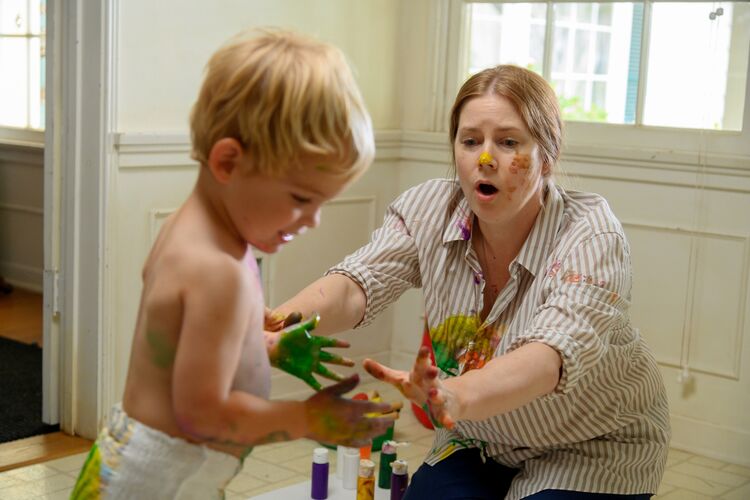
In playwright Bess Wohl’s Baby Ruby , heavily pregnant Josephine’s knowledge of babies appears to come mostly from Instagram. “Nothing’s going to be any different,” she breezily assures the guests at her baby shower. She scoffs when she sees her husband reading a parenting book. “I don’t need some clichéd advice,” she says. “I can do this perfectly.” She ends up losing readers when, overwhelmed by the demands of caring for her newborn, she neglects to post new content for a month.
When Die My Love ’s Grace (Jennifer Lawrence) and Jackson (Robert Pattinson) arrive at a dilapidated, rat-infested house in rural Montana, the plan is for her to write “the Great American novel” while he works and records his album. “You can write all day, every day,” Jackson says. They christen their new house with animalistic sex on the dusty, leaf-strewn floor, and in the next scene, she is visibly pregnant. Months later, Grace sits down to write, only to drip breast milk onto the page. (Director Lynne Ramsay has cited The Shining — another horror movie about a frustrated writer — as one of her inspirations.)
If these women are initially shocked by the challenges of motherhood, they are soon tortured by the suspicion that other babies are better than theirs: less fussy, more cooperative, and in the case of the Finnish mythology-inspired Nightborn , less troll-like. Within a few weeks of giving birth, Josephine’s casual confidence has been replaced by paranoia: She is convinced that her daughter’s incessant crying is not an expression of ordinary hunger or discomfort but a rebuke — evidence of her desire for a different mother.
It’s the double whammy of modern motherhood: What a young woman might once have learned from first-hand experience, she now picks up from contradictory TikTok videos and glossy Instagram reels of serenely smiling newborns and camera-ready new mothers. All of which suggest a standard of perfection that is not only unattainable but potentially destructive.
Mary Bronstein’s If I Had Legs I’d Kick You shows how perfectionism can veer into sabotage. Caroline, a severely depressed patient, spends every therapy session weeping over the possibility that she is an inadequate mother. When her therapist Linda (Rose Byrne) suggests she consider psychiatric medication, she sobs, “I’m breastfeeding! Do you want me to kill my baby?” Then she flees — abandoning her baby in the consulting room.
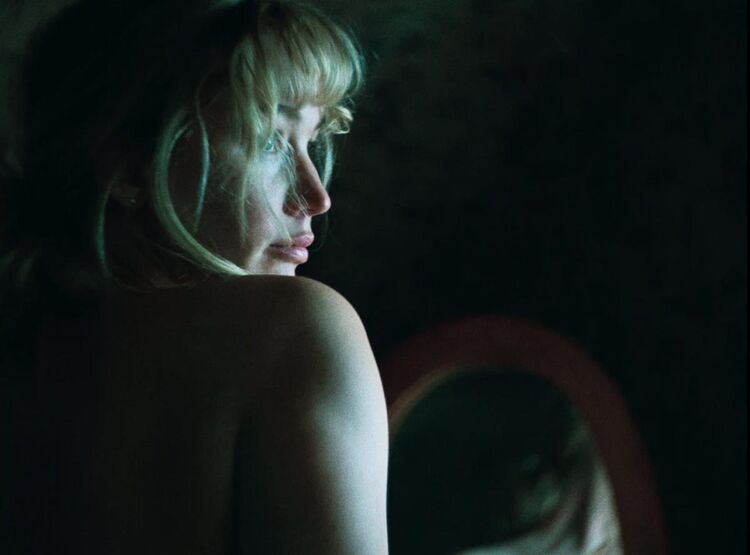
“A real mom would have baked a cake,” Grace chastises herself at the beginning Die My Love , as she samples a store-bought cake for her son’s six-month birthday. Over the next several months, as Jackson leaves her alone with the baby for longer and longer stretches, her mental state deteriorates: She squirts soap all over the bathroom floor, scratches off the wallpaper with her fingernails, throws herself through a glass door. By the end, she does bake a cake — to celebrate her homecoming from a psychiatric ward — then confesses to her guests that she shot her husband’s dog, walks into the woods, and sets her manuscript on fire.
Mothers are encouraged to trust their gut — they should be the ultimate authority on their children. Yet when intuition contradicts husbands or doctors, it is not a source of comfort but of conflict and isolation.
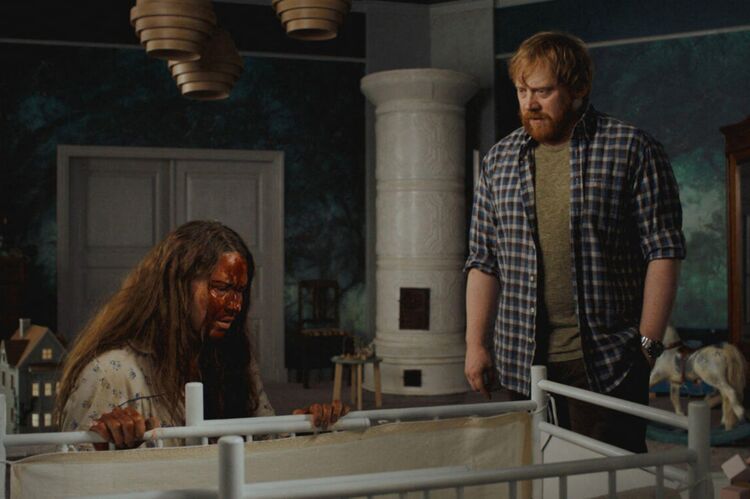
“For a lot of moms, this new creature can feel completely alien,” a medical professional tries to reassure Saga in Nightborn — dismissing her (well-founded) fear that there is something wrong with her son (spoiler: he is part-human, part-forest troll). When the unnamed mother in Nightbitch points out that her teeth are sharper than usual and there’s a patch of hair in the small of her back, her husband brushes her off. “You always think that something’s wrong with you,” he says, as she begins her metamorphosis into a dog.
The men in these movies range from bumbling (the father in Nightbitch refers to caring for his son as “babysitting”) to absent (the father in If I Had Legs I’d Kick You exists mostly as a disembodied voice on the phone) to perhaps conspiring to drive their wives insane ( Die My Love ’s Jackson adopts a baying, untrained puppy without consulting Grace). No matter how idyllic the relationships appear at the start, they deteriorate as the father’s and mother’s experiences diverge, and as the man proves himself incapable of understanding the woman’s transformation.
“I don’t know who you are anymore,” Nightborn’s Jon complains to his once-vivacious wife, who now spends her days pacing the forest in long nightgowns, feeding their troll-child cow’s blood. “What happened to my wife?” demands the husband in Nightbitch : He doesn’t recognize this woman who takes no interest in current events and never asks about his day. “She died in childbirth,” she rages back.
Did pop culture ever depict early motherhood as “sunshine and baby powder, little pastel mints and lacy frocks,” as the Nightbitch mother puts it? The pendulum has swung so far the other way that it is hard to remember such a time. Every week, about 59,000 people visit the Reddit forum r/regretfulparents to witness lonely howls from parents disappointed by their partners or bullied by their children or just mourning the loss of their old identities. In a viral trend, fed-up mothers film themselves screaming and smashing ice cubes, one by one, into a bathtub.
It’s possible that the modern postpartum experience is uniquely isolating; it’s also possible that the outpouring of these stories is the result of women gaining more of a voice in Hollywood. (In 2024 , 26.8% of the selections at major international film festivals were by female directors, up from 18.2% in 2015.) Rosemary’s Baby , meanwhile, was adapted from a novel by Ira Levin and directed by Polanski. It is a man’s fantasy that even a woman who’s been violated, betrayed and tricked into carrying the devil’s child cannot resist the lure of her baby’s cries.