The UK, for all its political instability and sluggish growth, recently got some good news: British students ranked in the top 10 across all tested subjects in the latest results from the OECD’s Programme for International Student Assessment (PISA). The UK was one of just eight countries to achieve that feat — 92 countries and cities participated — and also managed to buck wider downward trends by improving its average science score and avoiding a decline in reading.
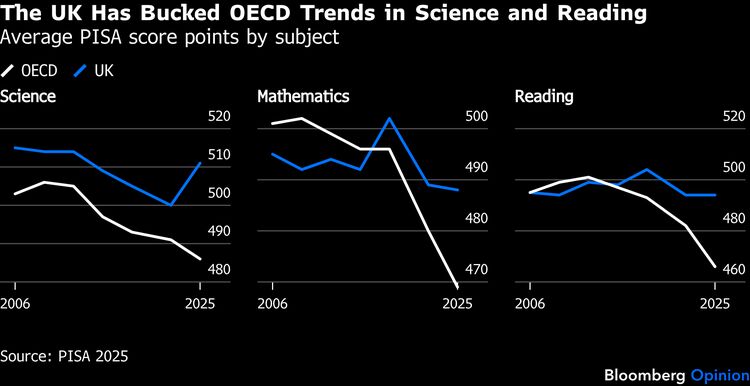
But dive deeper into the results and that straight-A feeling starts to fade. For one thing, the scores vary depending on what part of the UK you look at: England, which has stuck with a knowledge-driven curriculum rather than following Wales and Scotland’s trendy bets on skills and competency, outperformed the other three nations in all subjects. Even more worrying: A surprising gender split is emerging.
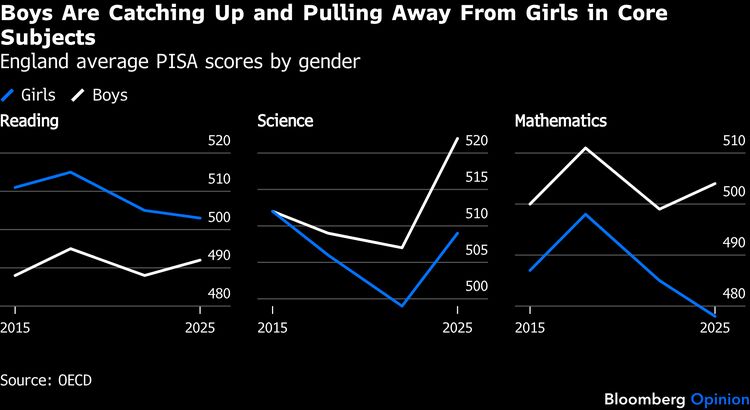
In PISA’s reading assessment, English girls’ average score declined slightly, while boys improved. Female students also experienced a significant drop in math scores and only a partial recovery in science. Boys pulled further ahead in both.
The US has seen a similar trend, but it’s not a global pattern. On average, girls in the OECD are ahead in both reading and science, while both genders have seen drops in mathematics performance. And the other UK nations — Wales, Scotland and Northern Ireland — don’t have the same gender gap as England (though they have much lower test scores overall).
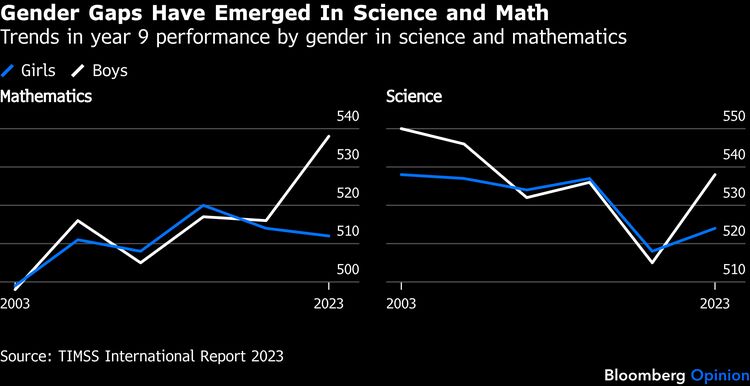
But the PISA results aren’t an outlier: In a 2023
study
by the International Association for the Evaluation of Educational Achievement, researchers found that a gender gap opened for students in England in year 9 — the widest gap seen in any of the 72 participating countries. In previous assessments, girls and boys had performed similarly.
English boys have now outperformed girls in securing the top grades at A-level (pre-university exams for 17- and 18-year-olds) for two years. Boys are pulling further ahead in math and have closed the reading gap in primary school, as noted by the Education Policy Institute think tank. Girls still perform better overall in secondary school, but their average attainment score is now the lowest since the measure was first introduced in 2019. Boys, meanwhile, have seen improvements.
Acknowledging this reality will require a sea change in academic thinking. Boys’ struggles have long been a key focus of UK education. In 1998, then-Chief Inspector of Schools Chris Woodhead called underachieving boys “one of the most disturbing problems facing the education system.” Almost three decades later, many people still share that view. Earlier this year, the Centre for Policy Research on Men and Boys launched the “ Boys’ Education Commission ” to “find out why boys are falling behind at all levels of education and how to ensure they thrive,” while a 2025 report from the Higher Education Policy Institute called for a “boy-positive ” environment in schools, as well as more funding and focus on improving male students’ education.
To be sure, there are still areas where boys lag. But the latest testing data makes it clear that girls need urgent attention. Why are young women increasingly falling behind? There’s no clear answer — but there are some clues.
In COSMO, a major 2021/2022 study of English youth , researchers found that 54% of students identifying as female reported high levels of psychological distress compared to 33% of males. More than twice as many girls than boys said they self-harmed — 23% vs 11%. Overall, female students reported lower wellbeing and motivation and greater loneliness and anxiety than their male counterparts. Other research has yielded similar results.
The sources of that stress to girls’ mental health are varied, but social media and its knock-on effects are the main suspects. A Japanese study linked mental-health differences between the sexes to girls’ loneliness and desire for thinness. The authors of a large-scale report on digital marketing and adolescents by the French Agency for Food, Environmental and Occupational Health & Safety, told The Conversation that “more girls than boys on social media are being bullied, and becoming victims of gender shaming.”
On the flip side, there’s been a great deal of media and political attention paid to the “manosphere” and its impact on teenage boys, helped along by TV hits such as Adolescence and Louis Theroux: Inside the Manosphere . Girls’ relationship to the internet hasn’t gotten the same scrutiny.
Of course, these are sprawling societal problems that can’t be entirely solved by (or blamed on) schools. So what can the education system do to better support young women? Increasing awareness of the problem would be a start. Schools and teachers should know that girls are at greater risk of mental-health problems, and that they may need more attention. And although a government social-media ban for those under the age of 16 is due to kick in next spring, it would be wise to arm teenagers with more digital literacy before they’re able to (legally) download TikTok and Instagram — especially given that many will find ways to circumvent the ban.
At the very least, schools have a responsibility to make sure they’re not one of the forces hurting young women’s ability to learn. And they have work to do on that front: The saddest statistic from the PISA report is that girls in the UK are significantly less likely than boys to say they belong at school. With that as a foundation, is it any wonder they’re falling behind?
More from Bloomberg Opinion:
- The UK’s Bedroom Generation Is a Ticking Time Bomb : Lara Williams
- Extreme Heat Is Making It Harder for Kids to Learn: Lisa Jarvis
- Britain Risks Creating a Lost Generation : Matthew Brooker
Want more from Bloomberg Opinion? OPIN <GO> . Or subscribe to our daily newsletter .