Brazil’s currency, stocks and bonds jumped on Monday as investors bet that Flávio Bolsonaro will become president and push through market-friendly reforms to lower interest rates in Latin America’s largest economy.
The Brazilian real strengthened 4.2 per cent against the dollar and the country’s main share index leapt almost 8 per cent to close at a record high after rightwing senator Bolsonaro won a first-round victory over President Luiz Inácio Lula da Silva in presidential elections.
Bolsonaro, son of the jailed former far-right president Jair Bolsonaro, won 47 per cent of the vote to Lula’s 45 per cent, well ahead of polling projections and putting him in prime position to win a run-off vote against the leftwing incumbent later this month. No first-round runner-up has gone on to win the presidential run-off since Brazil’s return to democracy in the 1980s.
Bolsonaro’s Liberal Party also swept key legislative seats and governor elections as Brazilian voters shifted to the right.
Investors have seen Bolsonaro as likelier than Lula to mount rapid spending cuts after the election and narrow a budget deficit that is running at close to a tenth of GDP, given high borrowing costs in the country.
Economists warn that Brazil’s public debt, at more than 80 per cent of national economic output, is unsustainably high and that excessive public expenditure is a factor behind the country’s elevated base rate.
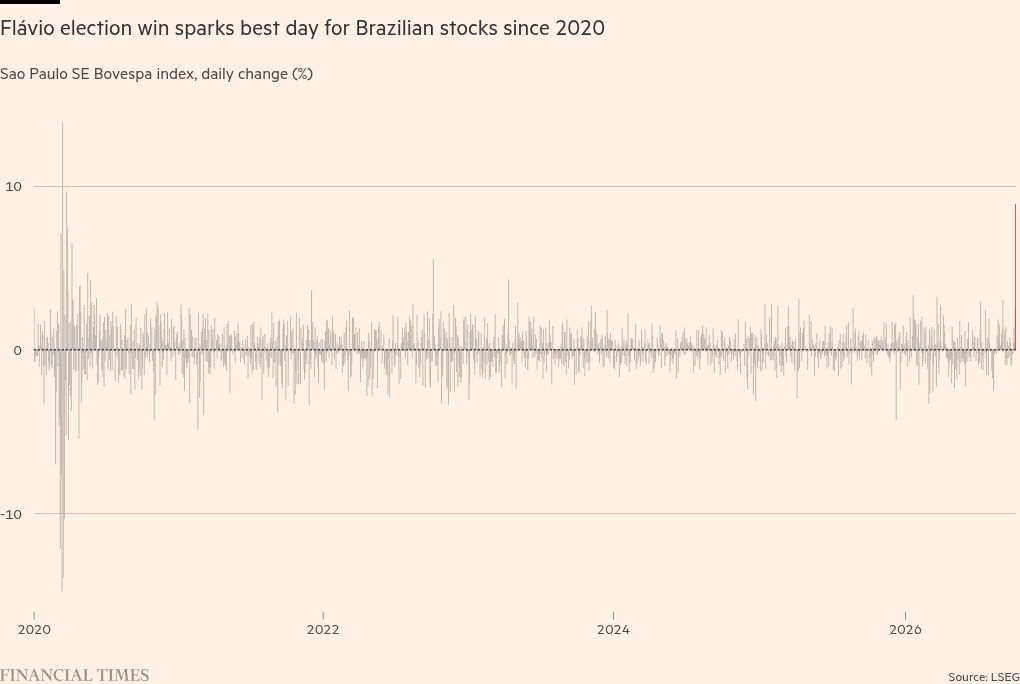
Investors are betting that the central bank will have more room to cut rates from 13.75 per cent, a level that has strained businesses and consumers.
“Fiscal credibility matters because Brazil is running wide deficits, public debt continues to rise, and interest rates remain high,” said Chris Kushlis, emerging markets macro strategist at T Rowe Price.
But “neither candidate will have a free hand” given the need to get fiscal reforms through the Brazilian Congress, he added.
Yields on Brazil’s euro-denominated international government bonds fell from 6 per cent to 5.8 per cent on Monday ahead of daily trading in its domestic debt. The cost of default protection on Brazil and Petrobras, the state oil company, also dropped.
The real has gained close to a tenth against the dollar so far in 2026, making it one of the best-performing currencies in emerging markets this year.
The Ibovespa index has risen by more than 40 per cent in dollar terms this year, almost double the gain of an MSCI gauge for emerging markets.
One of the strongest performers on São Paulo’s B3 exchange on Monday was state-controlled lender Banco do Brasil, which closed 11.5 per cent higher, while Petrobras rose 6.9 per cent. Investors have been critical of the Lula administration’s more interventionist approach to companies majority owned by the government.
Data visualisation by Ray Douglas