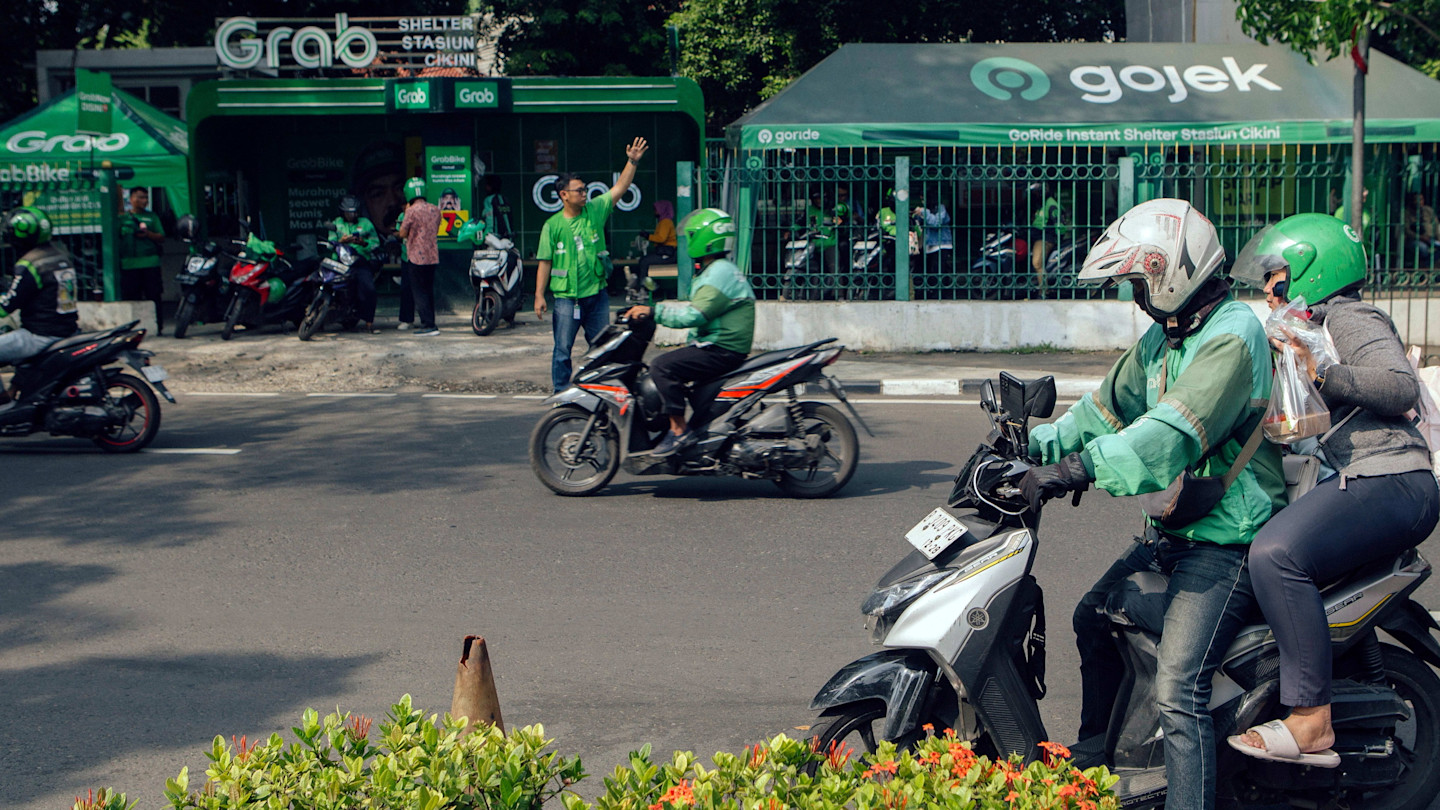
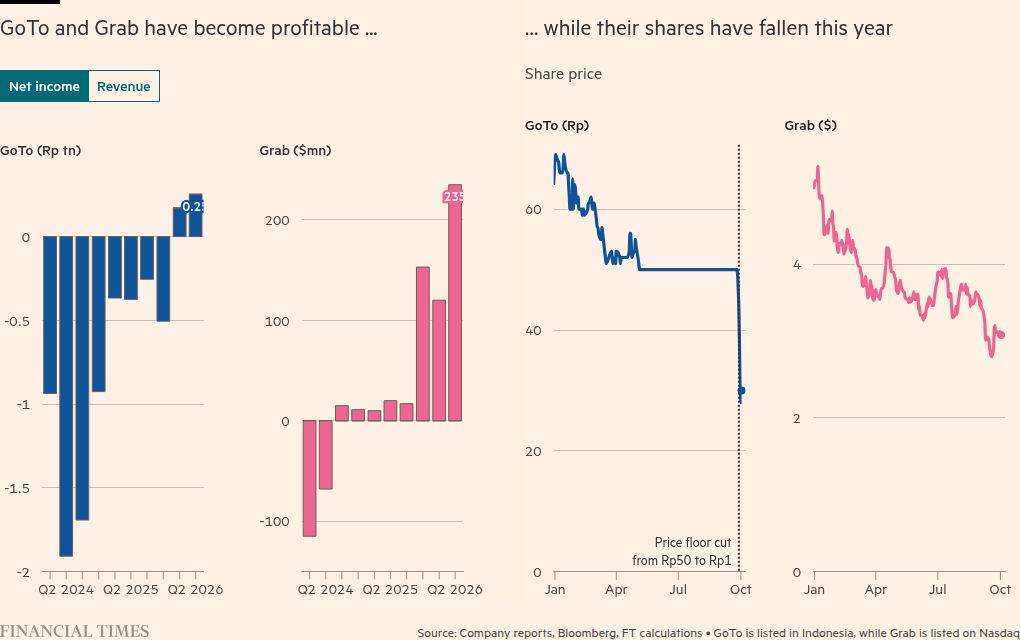
For a while it looked like GoTo could fall no further — the share price of south-east Asia’s second-largest ride-hailing company spent months stuck at the Indonesian stock market’s floor price of Rp50, less than a third of a US cent.
But last week’s reduction of the floor price to Rp1 has exposed the depths of investor disillusionment in a once-celebrated start-up that generated $1bn in revenues last year. GoTo shares closed at Rp29 on Monday, down more than 90 per cent from their 2022 peak of over Rp390.
GoTo’s woes highlight the growing pressure on south-east Asian ride-hailing and food delivery companies to offer a better deal to their drivers, following months of public protests and increasing scrutiny from national regulators.
The share price of Singapore-based Grab, the Nasdaq-listed regional ride-hailing market leader with millions of drivers and revenues of $3.37bn last year, has fallen 50 per cent in the past 12 months.
Grab and GoTo control about 85 per cent of the ride-hailing market in south-east Asia, according to Euromonitor International, and both are profitable. But analysts say the driver backlash in Indonesia, Vietnam, Thailand and the Philippines — sparked by fuel prices sent soaring by the war in the Middle East — will pile new pressure on their already squeezed margins.
“Life is tougher for a lot of these workers now . . . that’s why you start to see this sort of rising level of protests,” said Jiong Shao, an analyst at Barclays.
Governments in south-east Asia were looking at the commissions taken by the platform companies “very very closely, particularly against the overall backdrop of the weakish economies [and] rising fuel prices”, he said.
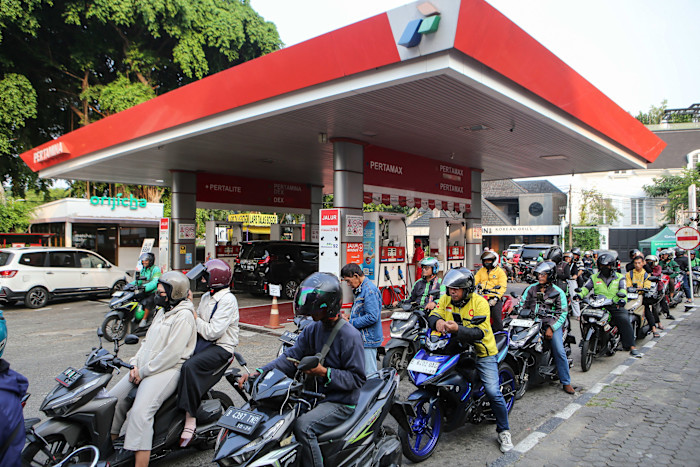
Ride-hailing and delivery drivers have become an integral part of south-east Asian economies, using taxis, tuk-tuks and motorbikes to ferry passengers, meals and groceries across the region’s often congested road network.
A senior executive at one ride-hailing company that operates in south-east Asia said the region was seeing more unrest than other markets because drivers earned less and were hit harder by the rise in fuel costs caused by the US war on Iran.
After months of demonstrations by drivers, Indonesia, south-east Asia’s largest economy, capped the commissions ride-hailing companies can charge at 8 per cent for two-wheeler drivers in July, far lower than the previous 20 per cent limit.
Jakarta is also preparing to introduce regulations on delivery fees charged by the platforms for deliveries of food and other goods.
In Vietnam, where ride-hailing commissions are not regulated, many Grab drivers briefly boycotted the app over company deductions they said were sometimes as high as 50 per cent of the fare paid by passengers.
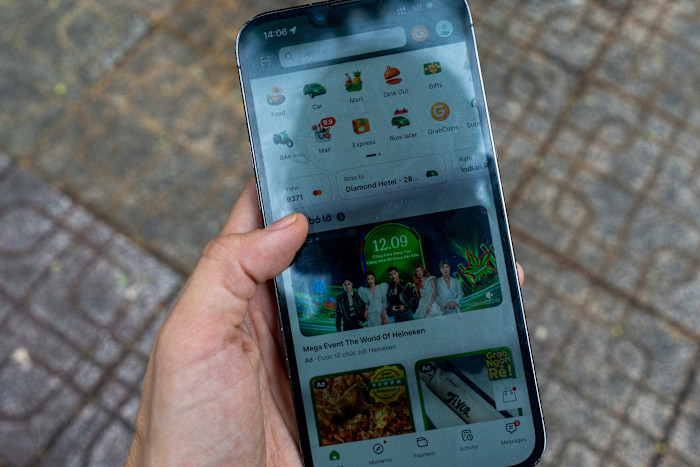
Following the complaints, Vietnam’s National Competition Commission ordered Grab and its rivals to disclose their policies on pricing, fees and deductions, saying they should ensure “transparency, fairness and a balance of interests between platform providers, driver partners and consumers”.
The ride-hailing companies classify their drivers as “partners”, not entitled to the benefits of full-time employees, even though many often have to work long hours to earn enough to live on.
Pham Mi Sen, deputy chair of the Ho Chi Minh City motorbike taxi drivers’ association in Vietnam, said the government needed to do more.
“By not technically employing, hiring or paying them a salary in the traditional sense, these companies evade the obligations that business owners typically owe to their workforce,” said Pham, himself a driver for Grab.
If drivers were really partners, he said: “We must have the rights like partners, the right to negotiate fares, working hours, bonus and penalty policies.”
Other countries have also vowed regulatory action to address driver concerns. Thailand said in August it was preparing new rules on commissions for ride-hailing and on-demand delivery services.
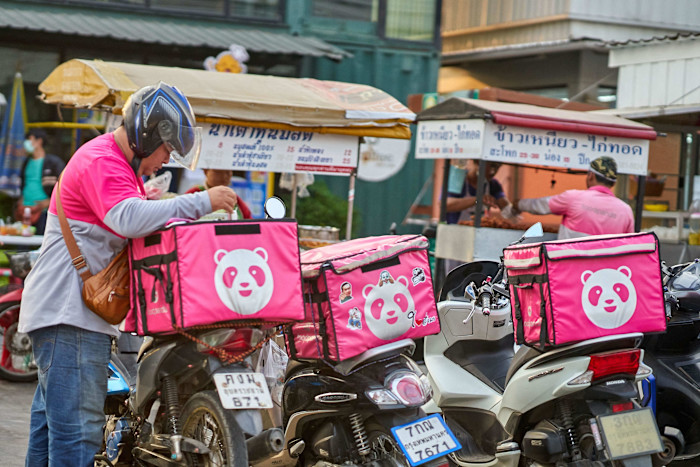
As the pressure from more regulation grows, Grab is diversifying. Last month it agreed to buy a controlling stake in Atome Financial for $1.49bn, betting heavily on the provider of “buy now, pay later” services. The company also this year stepped outside its home territory in south-east Asia for the first time by finalising a deal to acquire Foodpanda in Taiwan.
Grab, which became profitable for the first time in 2025, reported its strongest quarter in August this year with growth in revenues from deliveries, ride-hailing and financial services.
GoTo, which has already retreated from other regional markets to focus on Indonesia and Singapore, also hopes its consumer lending business will grow faster than its core services. In the second quarter of this year, the Indonesian company’s profits from financial services exceeded those from ride-hailing and delivery for the first time.
“It is a very sensible thing for them to diversify their business away from the core ride-hailing, food-delivery business and from certain countries if regulations become too tight,” said Barclays’ Shao.
Singapore has said it will not regulate commission rates or passenger fares. “The best way to improve the livelihood of point-to-point drivers is to help them ensure that the market is open and contestable,” transport minister Jeffrey Siow told Singapore’s parliament in July.
GoTo and Grab have been in talks for years over a possible merger, but the idea is on hold because of broader policy uncertainty in Indonesia, according to people familiar with the matter.
Asked about its policy on fees and commissions, Grab said its objective was “to maintain a healthy marketplace that balances user affordability with fair, long-term earning opportunities for our driver-partners”. It said it had provided temporary support to drivers to cushion them from higher fuel prices.
GoTo said it supported the new Indonesian commission structure and was helping drivers with the high cost of living. “We will continue to focus on the welfare of our driver partners as part of building a balanced, sustainable ecosystem that supports all stakeholders,” it said.