The war that was intended to deliver a swift overthrow of the Iranian regime is now in its eighth month, with no end in sight. So, what might happen next? My preliminary conclusion is that one should never underestimate human stupidity or human ingenuity. So far it is a rough draw between the two. How long will this last? That is the question.
In a devastating analysis, John Mearsheimer of the University of Chicago describes the war on Iran as “The Mother of All Strategic Blunders”.
Among other things, he notes, the US went into the war on the false claim that Iran was on the verge of acquiring a nuclear weapon; it thought air power alone would produce regime change, which has never worked; it had no contingency plan for dealing with Iran’s closure of the Strait of Hormuz. It has also failed to achieve any of its four principal objectives — regime change, ending Iran’s nuclear enrichment capability, ending its long-range missile capability and ending its support for Hamas, Hizbollah and the Houthis. The closure of the strait has done significant damage to the international economy and may do much more; and the US alliance structure (in the Gulf and elsewhere) has been damaged. All this, moreover, is only about half of the full charge sheet.
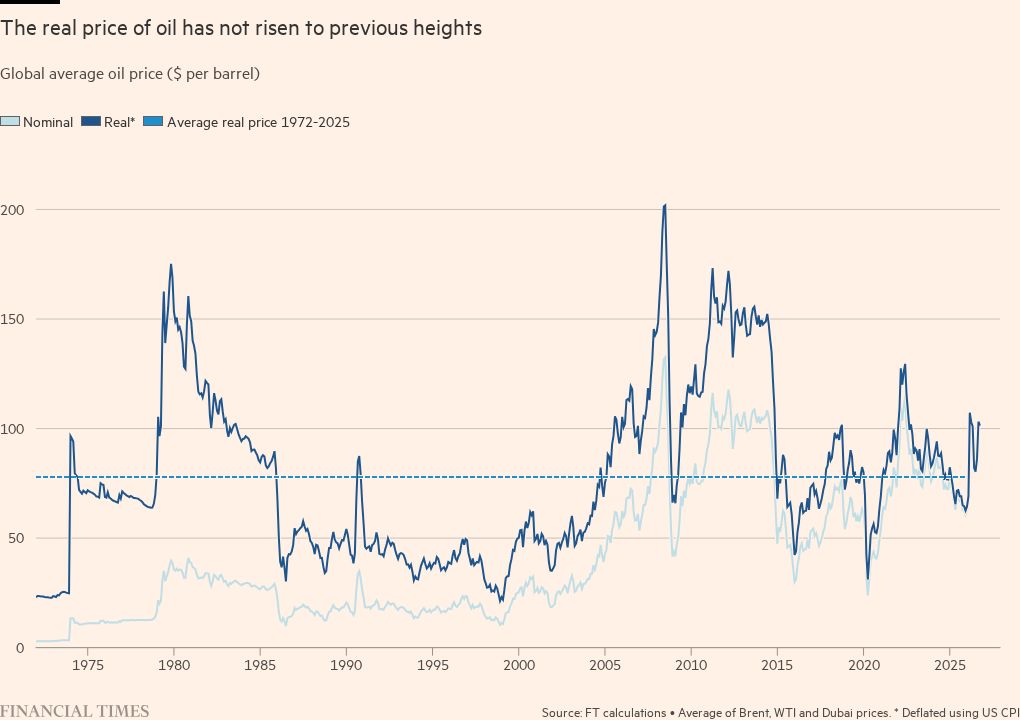
The stupidity is indeed impressive. Even now we cannot guess how it ends. Yet there is a counter-argument. The war may indeed be a strategic blunder. But the economic damage has been surprisingly modest. As Johannes Urpelainen of the Johns Hopkins School of Advanced International Studies noted in August, “Many experts initially thought that this supply disruption would send oil prices to USD 200 per barrel, causing massive inflation and a global recession. Instead, oil prices peaked at USD 126 per barrel in April 2026.” Today, the real price of crude oil is still near its long-run average since 1972. (See charts.)
How can this be, given that Fatih Birol, head of the International Energy Agency, said in March this was “the greatest global energy security threat in history”? The ingenuity is the answer.
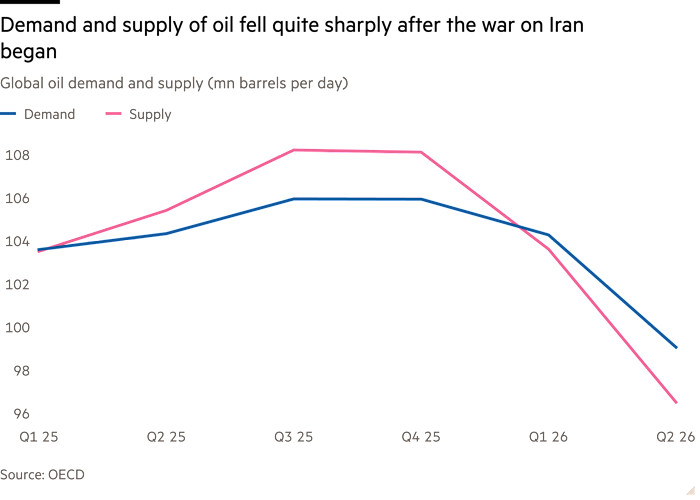
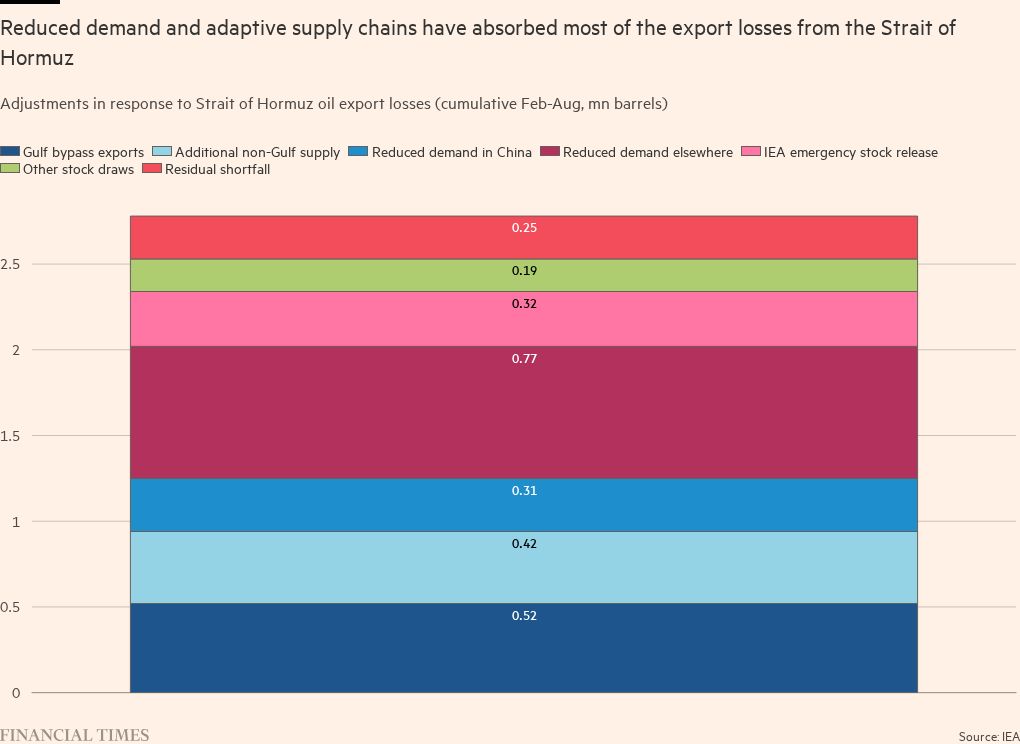
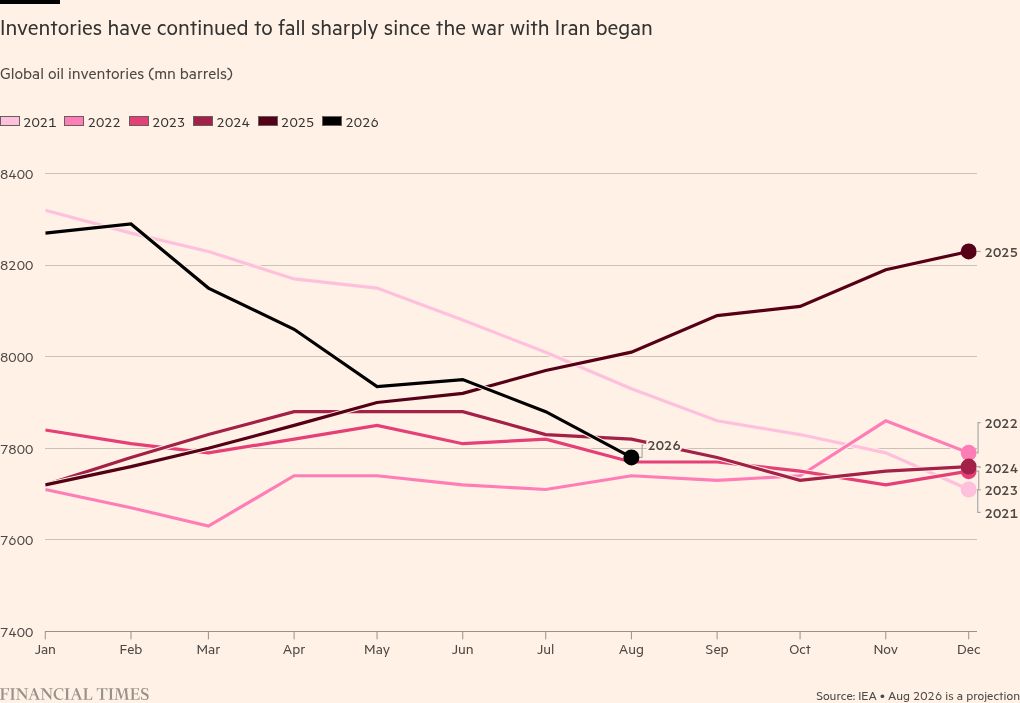
Urpelainen notes that: “First, the energy transition has reduced the global economy’s dependence on oil. Second, supply chains have proven resilient and adaptive. Third, producers outside the Middle East have acted fast to produce more oil and natural gas. Finally, drawdowns of global oil inventories have filled the remaining gap.” Flexibility is notably true of the Gulf. As former diplomat Mohammed Elsoukkary writes: “by the end of September preliminary estimates placed regional crude exports at approximately 16.3 million barrels per day, compared with 19.5 million in February, including roughly 9.7 million moving through Hormuz.”
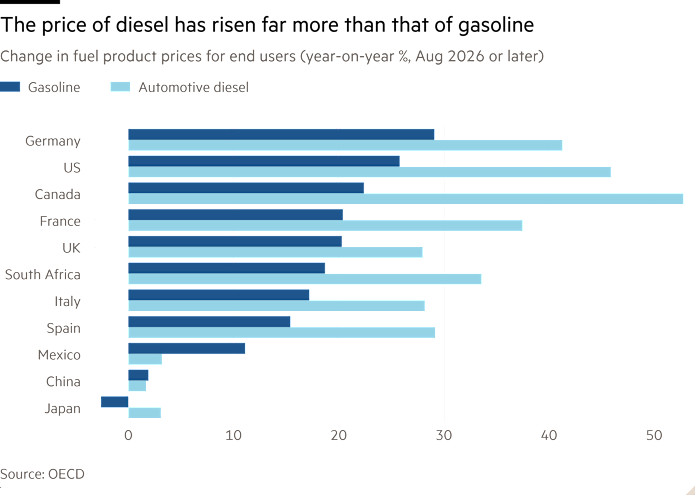
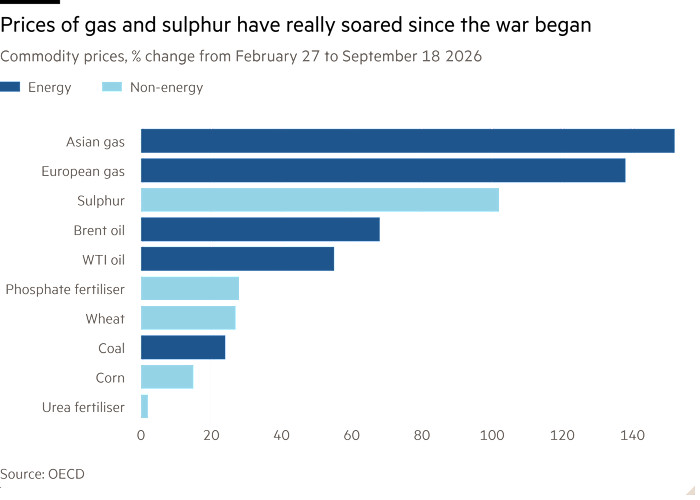
This is an impressive achievement. Yet do not forget that we consume products, not crude oil. There has been substantial damage to refineries in the Gulf. Moreover, refineries are set up to process specific crude oils, so shortages of products have emerged. One notable example is diesel. This even led President Donald Trump to consider a plan (now abandoned) to halt the US exports. But other products have also had bigger price rises than crude, notably natural gas and sulphur.
Nevertheless, the disruption to oil supply, oil prices and the world economy more broadly has, in truth, been quite surprisingly manageable. In terms of the overall economy, this is, as Nouriel Roubini notes in Project Syndicate, in large part due to the massive investment boom triggered by AI. But, for the future health of the world economy, it is not the level of investment, but its rate of growth, that matters, as does the ultimate economic contribution of AI itself. Surely at some point investment will slow. As to the economic contribution of AI (or indeed its doomsday properties), who knows with confidence?
There exist other sources of fragility. One, which I discussed last week, is the manageability of global debt at a time of rising interest rates. France, the UK and US are in the crosshairs. There is a particular risk for countries whose public debt is overwhelmingly short-term since, as a result, they enjoy little insurance against the impact of higher inflation on interest rates.
One of the biggest questions, then, is whether the stand-off between stupidity and ingenuity will continue. If it does, the energy shock at least should remain contained. But that cannot be taken for granted: the present situation, not least the drawdown in stocks, cannot continue forever. China’s noteworthy suppression of domestic demand might not last either. If these come to a halt, crude prices might jump to more disruptive levels.
A still bigger question is where the war itself will go. Might Trump greet the passing of the midterm elections as a chance to release his bellicosity? Then a lame duck, he might think it would be the right time to sort out those pesky Iranians. If so, how far might Iran be able (and willing) to go in damaging the oil infrastructure of its neighbours? What is remarkable, after all, is how much Gulf oil is still flowing. Might that again be disrupted?
Alternatively, could (or would) a post-midterm Congress halt such efforts? Or might Trump get bored with the whole thing and let hostilities peter out into an ill-tempered (and probably informal) ceasefire?
An advantage of arbitrary despots is that they can so easily get bored. I cannot imagine that Trump finds the war with Iran much fun any longer. Even he must also find it really difficult to believe that it has been a great triumph. After all, as Mearsheimer says, he has achieved none of his objectives. Iran is battered, but its ghastly regime and influence in the Gulf look rather secure. Trump will surely be tempted to declare victory and move on. The American people would be delighted. So, might it all end “not with a bang but a whimper”?