The US is gearing up for another quarter of bumper corporate earnings spurred by lavish spending on the AI build-out.
The robust growth should help Wall Street shrug off worries about the durability of the AI trade against the backdrop of rising borrowing costs but may do little to allay concerns about how reliant the record-high stock market has become on a small group of technology names.
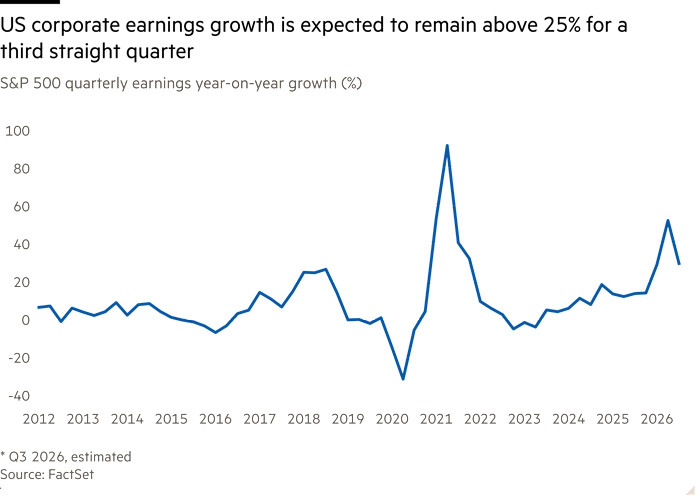
Reporting season kicks off next week, with S&P 500 earnings forecast to have risen 27 per cent in the September quarter from a year earlier, according to Goldman Sachs, propelled by companies at the centre of the AI infrastructure boom.
That would mark the third consecutive quarter in which earnings growth has exceeded 25 per cent — an unprecedented run outside of the recovery from financial crises, according to Manish Kabra, chief US equity strategist at Société Générale. Revenue growth is forecast to hit 12 per cent.
Investors are witnessing “the best earnings and margin growth in our lifetime” thanks largely to capital expenditure on the AI build-out, said Steve Chiavarone, chief investment officer for equities at Federated Hermes.
“People build up concerns . . . that get smashed in the face by earnings,” he added.
US stocks closed at a record high on Tuesday·, having largely shrugged off a sell-off in the Treasury market that began in mid-August and accelerated after the Federal Reserve last month raised interest rates for the first time in three years.
Longer-term borrowing costs have surged to their highest levels in more than two decades as a result. That has heaped pressure on the more interest rate-sensitive segments of the American economy such as financials, real estate and utilities, as well as smaller businesses and consumers.
Still, all 11 S&P 500 sectors are expected to report earnings growth, according to FactSet. The data provider also notes that a record-high 72 S&P 500 companies have issued positive earnings guidance for the September quarter, while the number of groups issuing negative guidance is at its lowest in five years.
Some market watchers expect the good times to keep on rolling. “Neither recent macroeconomic data nor signals relating to the AI investment boom point to a slowdown,” said Ben Snider, Goldman Sachs’ chief US equity strategist.
US energy companies are expected to post bumper profits thanks to the spiralling energy prices triggered by the closure of the Strait of Hormuz that have punished American consumers.
A 30 per cent jump in the price of West Texas Intermediate oil in the third quarter means US-listed energy majors are expected to report a 114 per cent year-on-year jump in quarterly earnings growth, up from a forecast of 79 per cent growth at the end of June, according to data provider FactSet.
Marathon Petroleum and Valero Energy are tipped to be among the main beneficiaries.
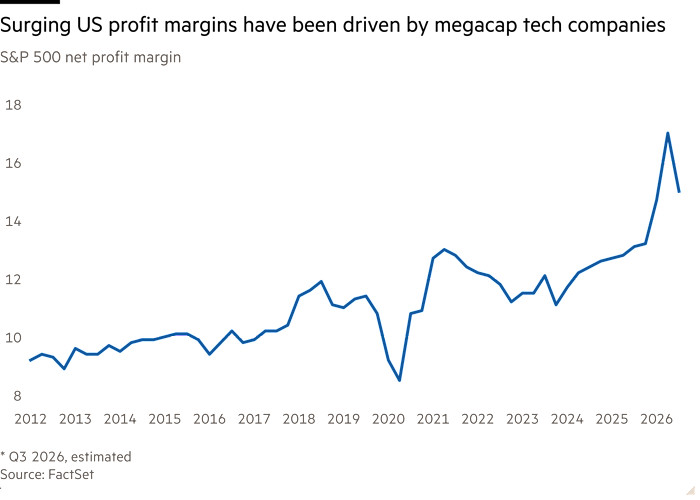
But the bulk of the market’s earnings growth is again set to come from Big Tech, analysts say. Chip group Micron last week gave a preview of things to come when it reported net income of $37.7bn, up from $3.2bn a year before.
A small group of large tech stocks — including Meta, Alphabet and Broadcom — is also carrying the broader equity market as rising government borrowing costs and resurgent energy prices weigh on other sectors.
Micron and Nvidia are expected to account for more than one-third of the market’s total quarterly earnings expansion, Goldman estimates.
That is fuelling concerns about the narrowness of the earnings growth and the AI-related names underpinning the stock market’s highs, with several of the companies often customers of and investors in the others.
Market breadth has plunged to its lowest since the dotcom bubble as investors continue to pump money into an increasingly narrow range of AI-linked stocks.
Analysts at Goldman expect capital expenditure by the so-called hyperscalers to have grown at an annual pace of 116 per cent in the September quarter, marking an acceleration from the June quarter’s 87 per cent expansion.
Any signs of slowing investment growth would spell trouble for the US economy, according to Pimco economist Tiffany Wilding.
“Economic resilience would then become more dependent on AI-driven productivity gains arriving quickly enough to replace the fading [spending],” Wilding wrote in a note this week.