
The writer is director of market intelligence and co-founder at Energy Aspects
This year has shown more clearly than ever that there is no single price of oil. The futures contracts quoted everywhere as “the price” certainly can’t be considered that. Physical crude prices have always diverged somewhat from futures but the gap has never been this large.
According to Argus Media Group data, the Brent futures price is now only about 60-70 per cent of the landed crude cost in Asia compared with about 90 per cent usually. And it represents only 50 per cent of the diesel price, versus the usual 80-90 per cent of the price.
Between 2007 and 2019, the standard deviation of the spread between the spot price for Brent and futures was about $1 a barrel. This year, it has risen to nearly $8 a barrel and even exceeded $20 in September, highlighting how ineffective futures are at capturing the true state of physical balances.
And that is even before the cost of shipping, which has increased by anywhere between five and 10 times compared with levels before the Iran war. Prices for Atlantic basin crude landing in Asia are five times higher than prewar levels, primarily driven by higher freight costs.
The value of a barrel of crude oil increasingly depends on where it is, when it is available and how easily it can reach the refinery that needs it. Flows through the Strait of Hormuz have recovered from their lows of about 2mn barrels a day in April to about 11mn. Total Middle Eastern flows (including on pipeline bypasses) are now about 2.5mn barrels a day below their prewar levels. But vessel availability is constrained and barrels are taking longer, more complicated routes to reach buyers. A barrel crossing Hormuz is not necessarily a barrel readily available to the marginal refiner.
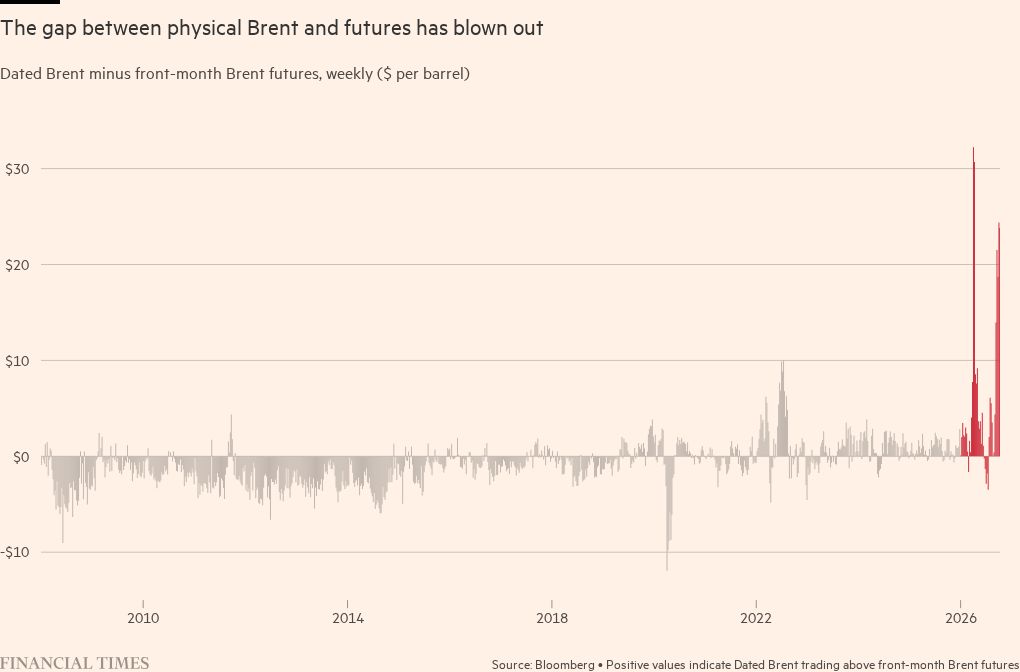
Not only are futures increasingly unreliable as a proxy for genuine supply and demand, they are also no longer useful as a hedge either and further disconnected from the fuel prices that drive inflation.
There are several reasons for this. First and foremost, the constant jawboning by the US administration to get prices down has left fewer participants in the crude market, according to our data. The view that the US will do whatever it takes to lower prices before elections has dominated sentiment. So despite global crude stocks falling about 650mn barrels since the conflict began, according to Kayrros inventory data, traders are scared to hold long positions — largely because the volume of bearish headlines coming from the administration, leaving prices at the mercy of algorithm-driven trading.
Secondly, the increase in flows through Hormuz is entirely driven by ship-to-ship transfers of crude, a costly process that has pushed shipping costs to record highs with the “very large crude carrier” market in uncharted territory since early September.
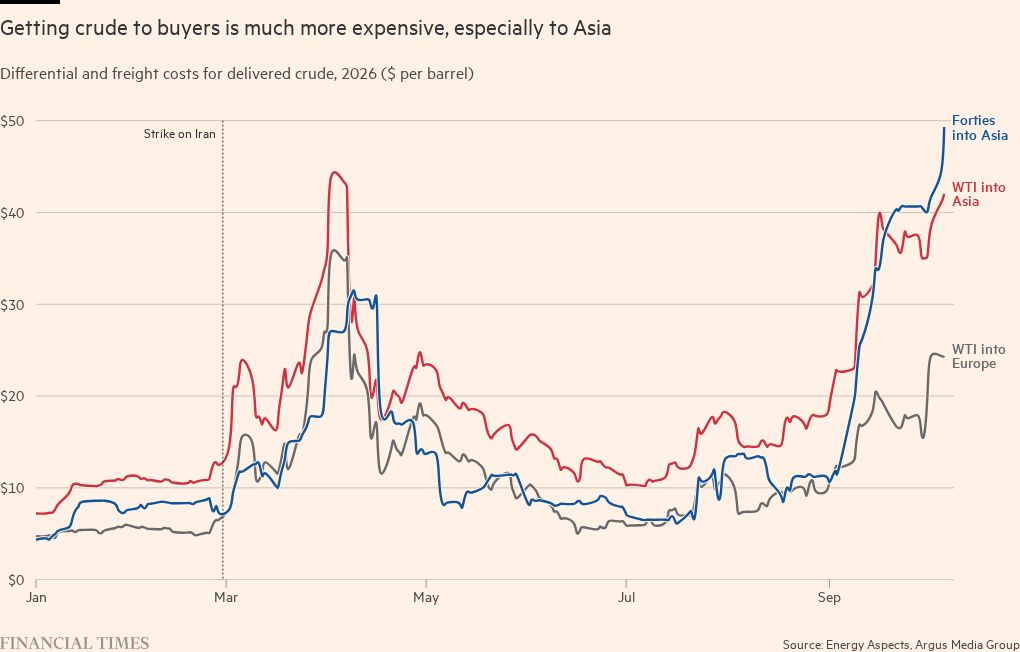
The bottom line is that the infrastructure needed to move crude and products has become constrained and expensive. Higher Hormuz flows reduce the risk of outright shortages but cannot restore the buffers or flexibility that previously kept the marginal barrel cheap. And given the reliance on ship-to-ship transfers, the more oil flows via this route, the higher the floor is for shipping rates, which feeds through to the prices we pay at the pump.
Finally, the shortage of global refining capacity outside of China, the constant attacks by Ukraine on Russian refineries and the shutdown of regional export-oriented refineries in the Middle East have meant products such as gasoline, jet and diesel are at record-high prices.
This is why products have been trading at double the price of crude during the past few months, something that has never happened before. Ultimately, diesel and gasoline drive inflation, not crude oil. Crude has always been used as a proxy because it moved in tandem with products and was the biggest driver of product prices. That relationship has now broken down. In fact, since May, 10-year US Treasury yields have correlated more closely with diesel prices than crude prices, for the first time ever.
That is why the US government has now turned its attention to calming diesel prices. Yet, in all the government’s efforts to keep crude futures prices lower in the belief it would keep the bond and equity markets in check, the real price of oil has run away. It is not that those who believed oil would be $200 due to this conflict were wrong — it was just the choice of financial instrument that was incorrect.
Robert Campbell contributed to this article