
An apartment block for retirees has sprung up nearby. A banner announces that units are selling like hot cakes. It features a photo of three smiling oldies raising wine glasses on a sun-drenched terrace. Only a wisecracking Italo-American granny is needed to recreate a scene from the 1980s TV sitcom The Golden Girls.
In the past, someone might have driven past thinking: “That would do for mum/dad/me (when the time is right).” Fewer of them think it these days. Retirement flats have acquired an unenviable reputation in the UK.
“There have been a lot of horror stories in the media about people who have been left with sizeable ongoing costs [on an apartment] although their loved one no longer lives there,” says Jeremy Porteus of the Housing Learning and Improvement Network, a membership organisation.
The other issue is hefty drops in the resale value of some new-build retirement flats.
I only became excited — and I use the term advisedly — about retirement flats when I had trouble obtaining price data. Four decades in journalism have taught me that when potentially damaging financial information is scarce, it may mean an industry wants to keep it that way.
So I sat down and knitted my own data from the raw yarn of price histories for individual retirement flats published by Zoopla, a housing portal. I was shocked by what I found.
First, I should explain the focus of my toil. I investigated apartments in purpose-built blocks created, for the most part, by private developers. These buildings have an age threshold for residency and facilities ranging from a few shared spaces to resident wardens and on-site restaurants. The flats are leasehold properties, a form of tenure the government may ban or at least restrict.
I found that over the past 26 years the retirement flats in my sample rose by an average of just 2 per cent a year in nominal terms between first and last sale price. That is pretty dreadful. Consumer price inflation has been higher and has itself been healthily outstripped by growth in prices for dwellings of all types.
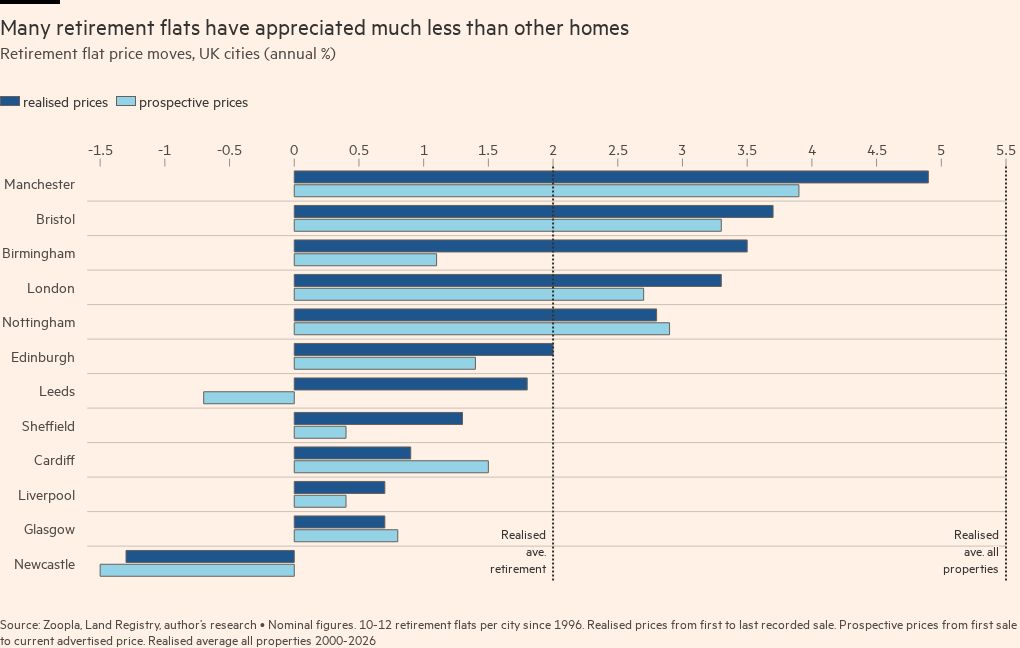
Prospective price increases — the gap between first sale and prices currently advertised by owners — are typically even lower than realised price rises for the same properties. This reflects a weakening in the market for retirement flats in recent years. Averages conceal some individual shockers. Price drops of 30-40 per cent are not unusual.
Caveats apply to my home-knit numbers. Many price histories were incomplete and my sample was accordingly limited. Moreover, many flats that I included started as new-build properties. Prices for these tend to fall for a few years after the first sale, which makes comparisons with general property prices imprecise.
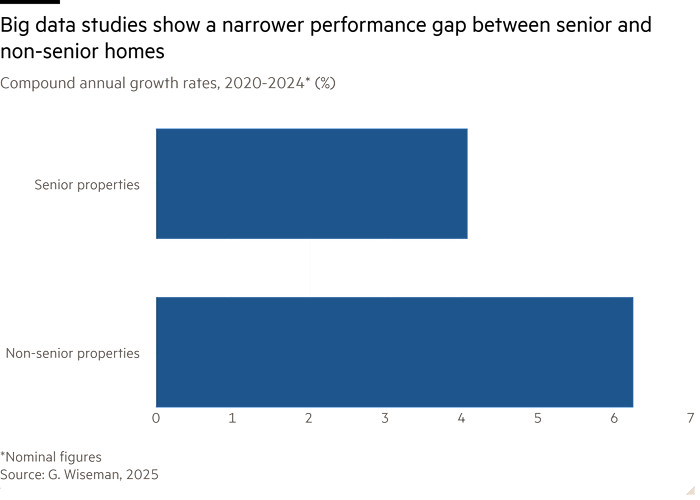
Fortunately, a comprehensive study conducted in 2025 by Gus Wiseman, a Cambridge university real estate master’s graduate, confirmed the price underperformance of retirement dwellings. He also showed that new-build retirement flats lose value at twice the rate of other new builds after five years or so.
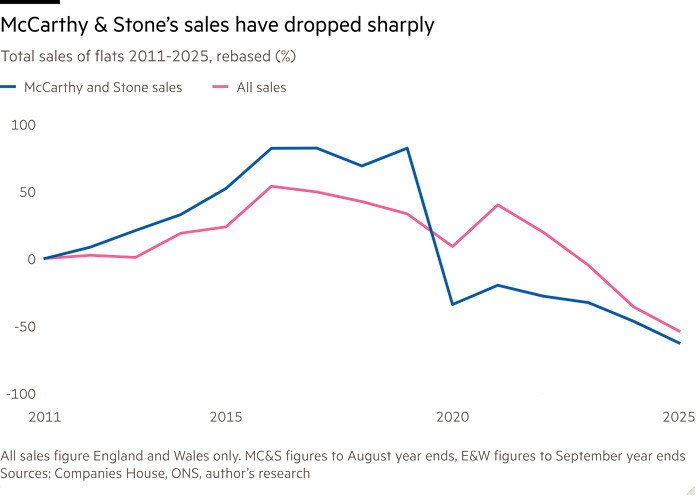
Critics have suggested reasons for the big price drops. They say high annual service charges at old-school developers such as McCarthy & Stone — jocularly known as “the Granny Stacker” to City investors back in the day — can deter potential buyers of pre-owned properties, especially since charges can run to five figures when you also factor in ground rent and council tax and are payable even when the property is empty.
In an email, the company responded: “The later living market faces the same challenges as the wider housing market and, of course, some apartments have been impacted. But even in this market, we are continuing to see many of our apartments go up in value.” McCarthy & Stone said it believed that its service charges delivered “exceptional value”.
Maybe. But would an alternative approach better align the interests of leaseholders and the freeholder? Increasingly, retirement complex developers charge a lower service fee and aim to recoup losses plus a margin by claiming a percentage of resale proceeds that is agreed upfront.
“We are seeing that many people prefer to pay more at the end with a cheaper entry price and greater certainty on charges,” says Michael Voges of Associated Retirement Community Operators, a trade body which supports this business model.
My research left me with two big objections to retirement flats. First, to assess value sensibly, the purchaser has to balance initial, recurring and final costs against unpredictable longevity. This is difficult to do, regardless of whether the developer takes profits upfront or over many years.
Second, retirement flats have historically been a bad investment. The market for them is accordingly stagnant and requires reform. We need larger, cheaper retirement communities with a better balance of incentives for occupants and operators.
The qualifier is that heirs are the most vociferous victims of current weak resale prices for new-build apartments. They are understandably distressed by steep monthly service charges on vacant properties they struggle to sell.
However, the elderly relatives who left them the property had priorities beyond residual value when they purchased it. These may have included safety, services and perhaps a tipple in the sun with new friends. That advertising banner cannot be pure fiction.
Readers from communities where multiple generations share a dwelling may meanwhile smile at the knots we Anglos tie ourselves in to avoid it.
“It amazes me that you expect your old people to live alone,” a South American friend once told me. “Back home, we all live together.”
“Peacefully?” I asked.
“Oh no!” he laughed. “Everyone argues like crazy. But where I come from, family is family.”
Jonathan Guthrie is a journalist, adviser and author; [email protected]