Stock market reforms don’t come much more brutal. Japan’s Topix, followed by about $1tn of funds, has ditched almost 700 companies because they’re too small. The cull is designed to make the survivors a simpler and more attractive investment proposition. It is an opportunity, too, for AI-enabled funds to prove their worth among the ejected minnows.
As elsewhere, Japan’s stock market wealth is concentrated in its biggest companies. But its indices are sprawling things. The Topix, preferred by money managers to the better-known Nikkei 225, currently contains more than 1,600 companies ranging from mighty $272bn Mitsubishi UFJ Financial to $22mn Prored Partners, a management consultancy.
The Topix’s myriad small fry are fiddly and expensive to trade — and have virtually no effect on index performance anyway. The scale of the issue is writ large in exchange operator JPX’s overhaul: the 683 companies it has named for potential eviction only account for 3 per cent of the index’s total market capitalisation, and that’s after an earlier cull of roughly 500 even smaller companies in 2025.
Smaller companies the world over have been rendered less accessible to investors who tend to put their money in passive index trackers, rather than pay for active managers more likely to seek an edge in niche segments. MSCI’s Japan index, for example, covers 85 per cent of what it deems Tokyo’s investable market with just 167 companies.
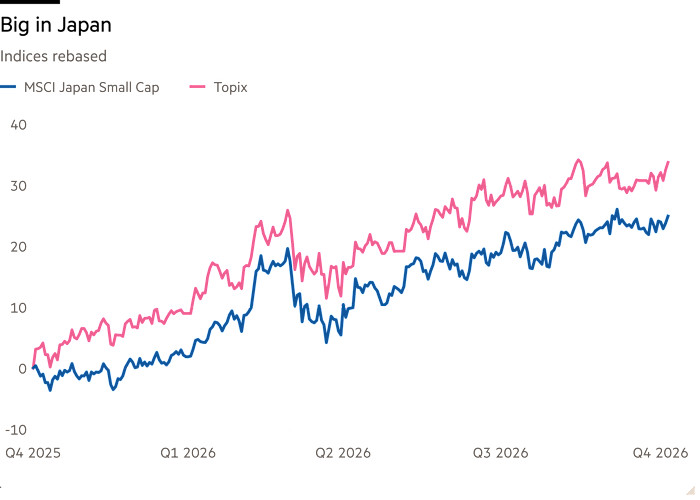
Sifting through small caps is a lot of work: BlackRock counts more than 6,000 of them, while MSCI’s All-World small-cap index has more than 5,600 companies from 47 countries and its smallest constituent is valued at just $6.2mn. But help is at hand: finding needles amid haystacks is a task for AI and its ability to crunch thousands of company reports and utterances.
The number of potential opportunities may be on the rise. The AI frenzy isn’t just boosting suppliers of chips and electricity. Bottlenecks are appearing in unexpected locations and Japanese manufacturers’ deep involvement in so many supply chains may result in unexpected windfalls. Meanwhile, AI tools — with their potential to cut costs and increase productivity — may over time reduce the inefficiencies of being a minnow compared to a whale.
Early adopters of this idea are looking smart. In February, Rotterdam-based Robeco launched a global small-cap exchange traded fund combining AI with quantitative models to pick stocks. So far, its offering is up 13 per cent, against 9 per cent and 3 per cent respectively for MSCI’s All-World and global small-cap gauges. BlackRock, too, has been touting its use of large language models and other technology to identify “non-obvious” links and themes between small-caps across the world.
Index huggers will doubtless still prefer the newly streamlined Topix. But for a new generation of tech-enabled investors, there should be plenty of interesting material among the offcuts.