At a time of geopolitical tension and bond market volatility, the UK’s economic and public finance outlook is shrouded in uncertainty. No system of fancy equations will enable the Office for Budget Responsibility to produce perfect forecasts for the Budget. And no agentic John Maynard Keynes will reliably tell John Healey what he should do. Everything instead rests on sound judgments from both the fiscal watchdog and the chancellor.
By far the most consequential decision the OBR needs to make is to set the potential level of GDP at the end of its five-year forecasting horizon. This is an informed judgment, complicated this year by movements in its underlying drivers. The Office for National Statistics has revised productivity growth up and hours worked down. It has also revised the path of net migration down and is now advising everyone to focus on tax records rather than surveys to discern employment trends. These are weaker.
The OBR would be well advised therefore to judge that the potential growth of the UK economy is just a bit worse than in March, with hours and productivity growth cancelling each other out, while the scope for more employment growth is more than offset by lower migration. Together, these broad assumptions would generate a little less tax revenue than previously expected.
On top of that, the inflation profile will be higher due to the prolonged energy shock the UK has suffered in 2026. This will raise the costs of pension and welfare payments in future and is unlikely to generate a corresponding amount of additional tax revenue. The final piece of bad news is that higher interest rates will raise forecasts of government debt-servicing costs by roughly 0.3 per cent of GDP by the end of the decade.
You might notice that I have been able to talk about the economy and the public finances without any mention of fiscal headroom in billions of pounds. The final OBR judgment should be to ditch this unhelpful invention, follow the letter of the law and start reporting on the sustainability of the public finances as economists rather than officials seeking to get themselves noticed.
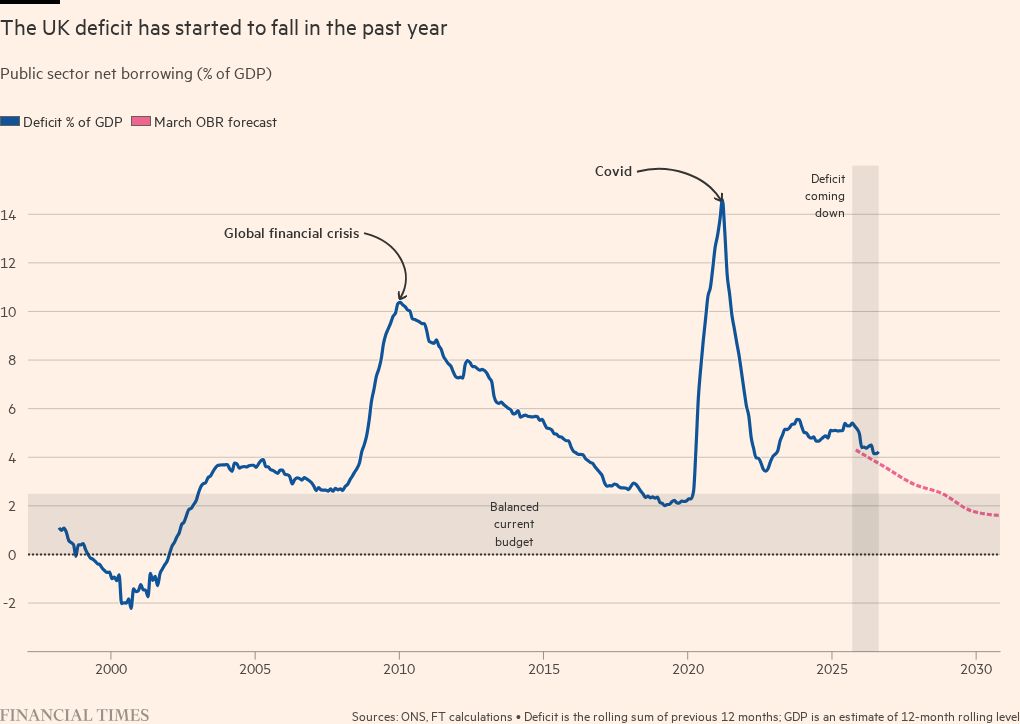
Putting this all together, the news Healey will receive from the OBR is likely to be unwelcome but not disastrous. The forecast path of deficit reduction will be slower and debt-servicing costs higher, but the UK will still be set to balance its current budget and stabilise its debt-to-GDP ratio by the end of the decade.
The chancellor’s core judgment will be to decide how to respond; the prime minister and his cabinet colleagues are fizzing with ideas but have few plans ready for implementation. It would be reasonable in these circumstances for Healey to deliver a steady-as-she-goes Budget so long as he meets the following conditions.
Any fiscal loosening in the early years of the forecast to meet Andy Burnham’s pledge to give people a bit of breathing space needs either to be credibly temporary or to be matched with spending cuts or tax rises in later years. That means there must not be a sustained discretionary fiscal loosening. It is OK for deficit reduction to be slower because the world has become more difficult, so long as the UK government does not aggravate the trends.
The deficit must also stay on a downward path. This will mean that any cost-of-living breathing space is followed by some tougher fiscal years towards the end of the parliament. Healey would be wise to put his political capital behind that necessity.
Finally, the chancellor should outline his longer-term strategy for tax and public spending. The aim will be to provide some reassurance to financial markets so that speculation can be held in check. Details are not necessary. These are difficult times in public finance. There is nothing more important than demonstrating the UK is facing them with sound judgments on both the forecasts and policy.