
In February Goldman Sachs invited top hedge fund executives to a 500-acre resort outside London. The Wall Street bank delivered a clear message: you are no longer our rivals but among our most valued clients.
The meeting underscored what has become an inescapable reality on Wall Street. US banks are generating record trading profits. But they are not the ones doing the trading.
Firms such as Jane Street and Citadel have aggressively expanded into banks’ traditional turf, dominating the core business of market making as well as placing big bets on market moves. But their insatiable demand for financing to juice those trades has made them irresistible clients for lenders and a powerful engine for profits.
In market making, “banks are struggling to compete”, said Mike Webb, Barclays’ global head of liquid financing. “But financing is a thing that banks do and there is a big moat around it.”
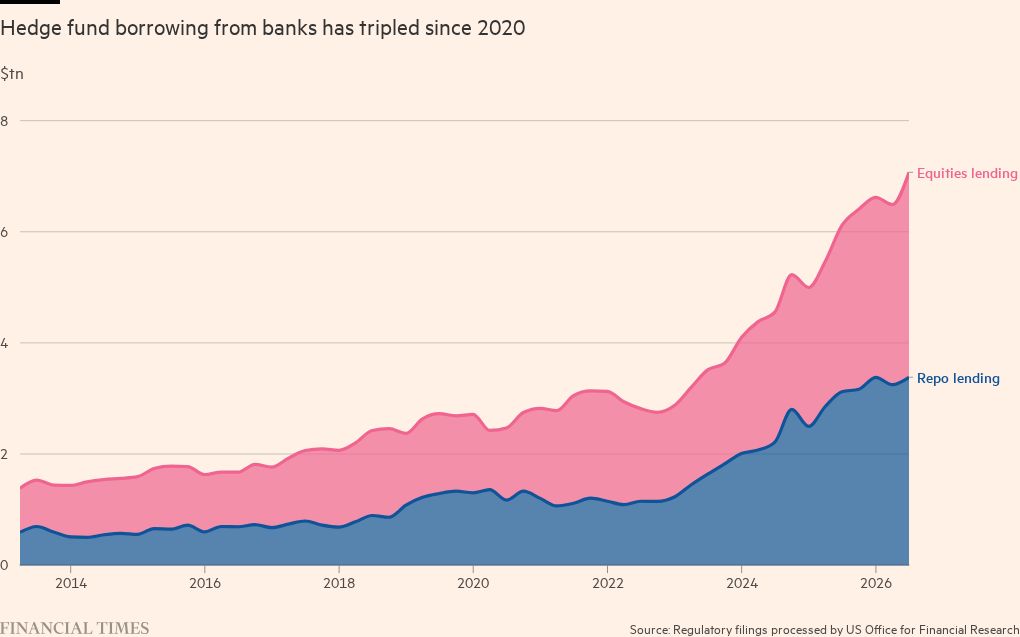
The moat is built on credit lines that lenders provide to trading giants that run into trillions of dollars. Hedge funds’ borrowing from banks has tripled since 2020, and the revenues from financing have turned prime brokerage into one of Wall Street’s fastest-growing businesses.
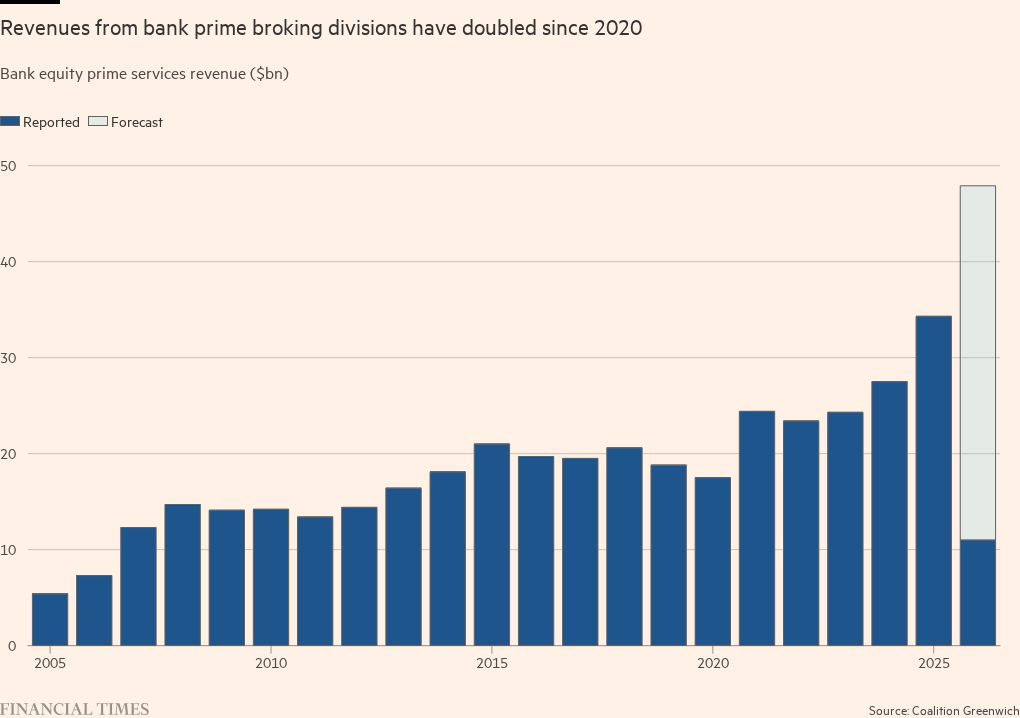
Revenues from equity and fixed income prime broking — two of the main ways that banks lend to hedge funds — are forecast to hit $47.9bn this year, according to an analysis by industry data provider Coalition Greenwich.
However, as banks have leaned into the trading boom, they have inextricably bound their fates with their biggest clients — giant multi-manager hedge funds such as Citadel, Millennium Management and Point72, and proprietary trading firms including Jane Street and Hudson River Trading.
The sheer size of the exposures has alarm bells ringing at regulators. Prime brokerage balances increased about 40 per cent over the previous year alone, the Bank of England said in July.
“It has just grown and grown and grown,” said one regulator. Has it become too big? “When you see a chart that keeps going upwards, you do have to naturally ask yourself.”
Prime brokerages were long seen as an unglamorous and quiet part of banking that acted like a back-office function. That changed with the 2008 financial crisis and the subsequent regulatory overhaul, which curtailed the ability of banks to take risks with their own balance sheets.
Much of the speculative trading that once used to take place on banks’ prop desks migrated to the hedge fund industry, while market making — a lower-risk activity — became the purview of high-frequency trading firms and later specialist market makers.
The result of post-crisis regulation was unexpected. While policymakers succeeded in moving much of the risk-taking outside the banking system, Wall Street lenders gradually became more reliant on revenues linked to this type of trading activity than before.
The key attraction of servicing hedge funds and trading firms is recurring revenues. Investment bankers can spend years courting executives such as Elon Musk in order to secure a one-off payment for advising on an initial public offering. But acting as prime broker to Citadel, Millennium or Jane Street offers a steady revenue stream that can generate as much as $200mn per year after trading costs, said three executives at bulge-bracket banks.
Martin Moloney, deputy secretary-general at the Financial Stability Board, said: “If anyone thought that by making sure banks were properly capitalised that we would make the problem go away . . . that would have been a naive view.”
Prime services revenues will have leapt from 10 per cent of banks’ equities revenues in 2005 to about 38 per cent this year, according to Coalition Greenwich — and those figures exclude the vast derivatives services banks provide.
“People are increasingly understanding that as non-banks take positions, they actually use the assistance of banks to do that,” he added.
How hedge funds juice their bets
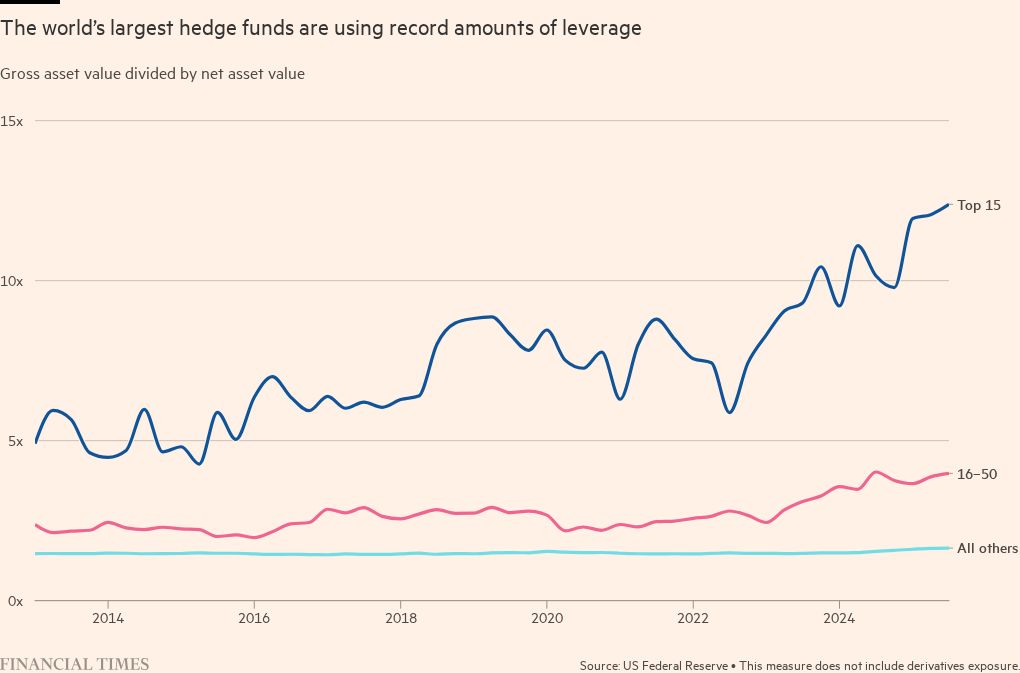
Top-50 hedge funds borrow $3 to juice their bets for every dollar of money they manage, according to data from the US Federal Reserve. But for the top 15, that rises to $11 of borrowing, the data shows.
Those figures probably understate the true amount of leverage because they do not include derivatives exposure — which is built into the contracts themselves.
One bank executive said that when derivatives exposures were taken into account, the largest hedge funds were 20 to 25 times levered.
Market makers can have greater leverage: as much as 40 times, according to another bank executive, because they are perceived as lower risk than hedge funds placing big wagers.
Goldman Sachs and Morgan Stanley are the biggest players in the business, with JPMorgan Chase third, according to hedge fund executives. But as prime broking revenues have exploded, they have faced stiffer competition from Wall Street rivals Citigroup and Bank of America, as well as challengers in Europe including BNP Paribas, Barclays and ABN Amro.
One of the biggest drivers of growth — beyond simply the expansion of the hedge fund industry — has been the rise of a small number of mega hedge funds and trading firms. Large multi-managers made up more than a third of the industry’s trading activity last year despite managing less than a tenth of its assets, according to Goldman.
Because the managers are sophisticated players with hundreds of trading teams across a spectrum of asset classes, they have an inbuilt diversification and level of risk management that has allowed banks to justify ratcheting up their lending.
Webb at Barclays said: “An institutional-quality hedge fund or asset manager is a sophisticated organisation with a liquidity-management function that reports directly to the founder.”
Fewer, bigger clients are also simpler to manage. “It’s easier to know a smaller set of clients really well,” Webb added.
Scale helps banks too. The more trading flow they have, the easier it is to match one client’s long position with another client’s short — a crucial balancing act known as internalisation.
That means the bank can finance both sides of the transaction without having to borrow or source stock in the open market, eliminating one of the costliest parts of the business and boosting margins.
But the growing scale of a few clients at the top of the industry has also shifted the balance of power, according to people familiar with industry practices, with clients pushing for far more favourable lending terms.
Lock-up terms, the length of time a prime broker commits to providing financing before it can withdraw credit, have gradually lengthened.
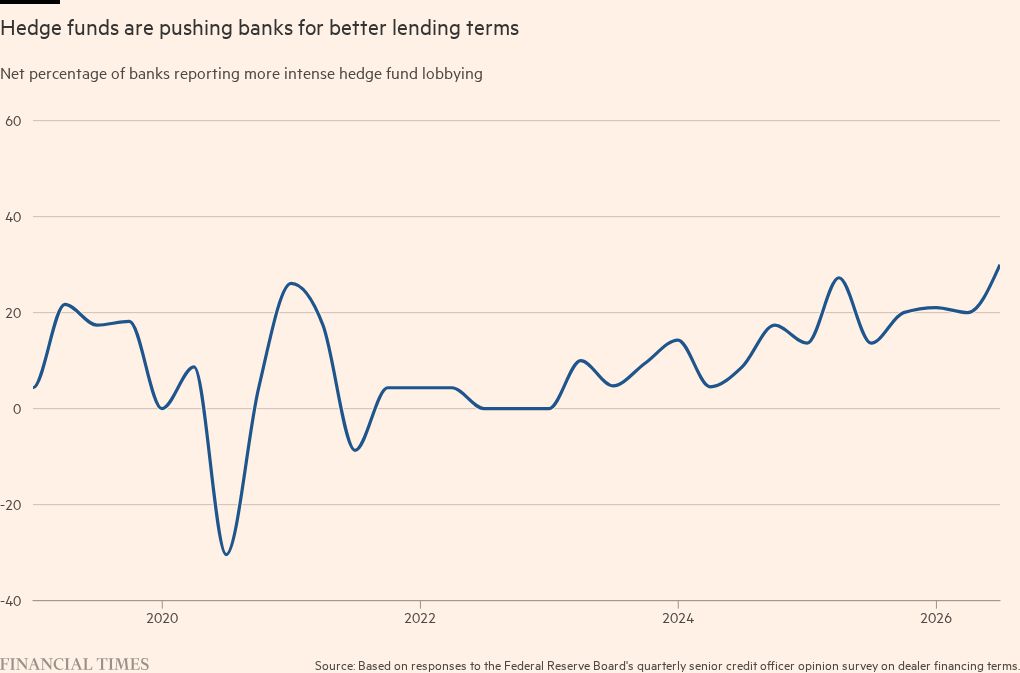
Commitments that typically lasted two weeks went up to 30 days, stretched to three months and more recently to half a year for some of the industry’s most coveted clients. That means a bank cannot cut back its financing or demand more margin than agreed at the start of the contract without giving increasingly lengthy notice.
Some regulators see this as intense competition steadily weakening safeguards put in place in case things go wrong, especially because banks often have limited transparency into their clients’ broader activities and true risk profiles.
Big trading firms and hedge funds typically disclose as little as possible about their relationships with rival prime brokers, which they say is necessary to protect their intellectual property and prevent leaks.
Large counterparties will often provide an overall leverage figure for their business across multiple prime brokers, according to the bulge-bracket veteran, but banks do not know how that leverage is distributed or the concentration across their positions.
Prime broking’s biggest blow-ups

Prime broking has become a highly lucrative business, but it can also be fraught with risk.
Prime brokers lose money when their clients take losses so large that they burn through a cash buffer required by the bank known as ‘margin’. If, after taking losses, a client misses a margin call, prime brokers seize the underlying positions and conduct a fire sale to neutralise the risk.
The most famous blow-up might be the collapse of Long-Term Capital Management in 1998, a hedge fund founded by former Salomon Brothers bond trader John Meriwether. LTCM negotiated terms that meant it paid zero in initial margin to its prime broker Bear Stearns when it initiated some trades.
It racked up $1.3tn in off-balance-sheet derivative notional exposure against a capital base of less than $5bn in 1997 — and received a $3.6bn bailout from commercial banks the following year after the Federal Reserve intervened.
More recently, there was the default of Bill Hwang’s family office Archegos Capital in 2021.
Archegos entered into highly leveraged derivatives agreements with its prime brokers to bet on companies including ViacomCBS and Baidu.
His firm used its desirability as a client to negotiate high leverage with each bank, while refusing to disclose details about the size of similar positions across all its prime brokers. The $5.5bn loss sustained by Credit Suisse, one of Archegos’s prime brokers, contributed to a loss of confidence in the lender which resulted in a sale to its rival UBS.
This year, prime brokers narrowly escaped another debacle when AI-focused hedge fund Situational Awareness got into trouble after a rally reversed.
Banks had lent billions of dollars to the hedge fund’s 24-year-old founder and were exposed to a brutal unwinding of those trades — until Citadel stepped in to buy its portfolio of public stocks, sparing their blushes.
Prime brokers insist standards have tightened in recent years, with greater scrutiny around leverage and more robust risk controls. But some regulators disagree on whether banks have fully learnt broader lessons around liquidity despite previous blow-ups.
Moloney of the Financial Stability Board said: “I recognise that many of the major participants would say we have very robust collateral and risk-management systems in place, and that is good as long as it lasts.”
“But competitive pressure can erode those risk controls and you need to be extremely careful about them because their impacts can be cross-border and they can trigger much wider problems across the financial system.”
Additional reporting by Martin Arnold. Visuals by Louis Ashworth