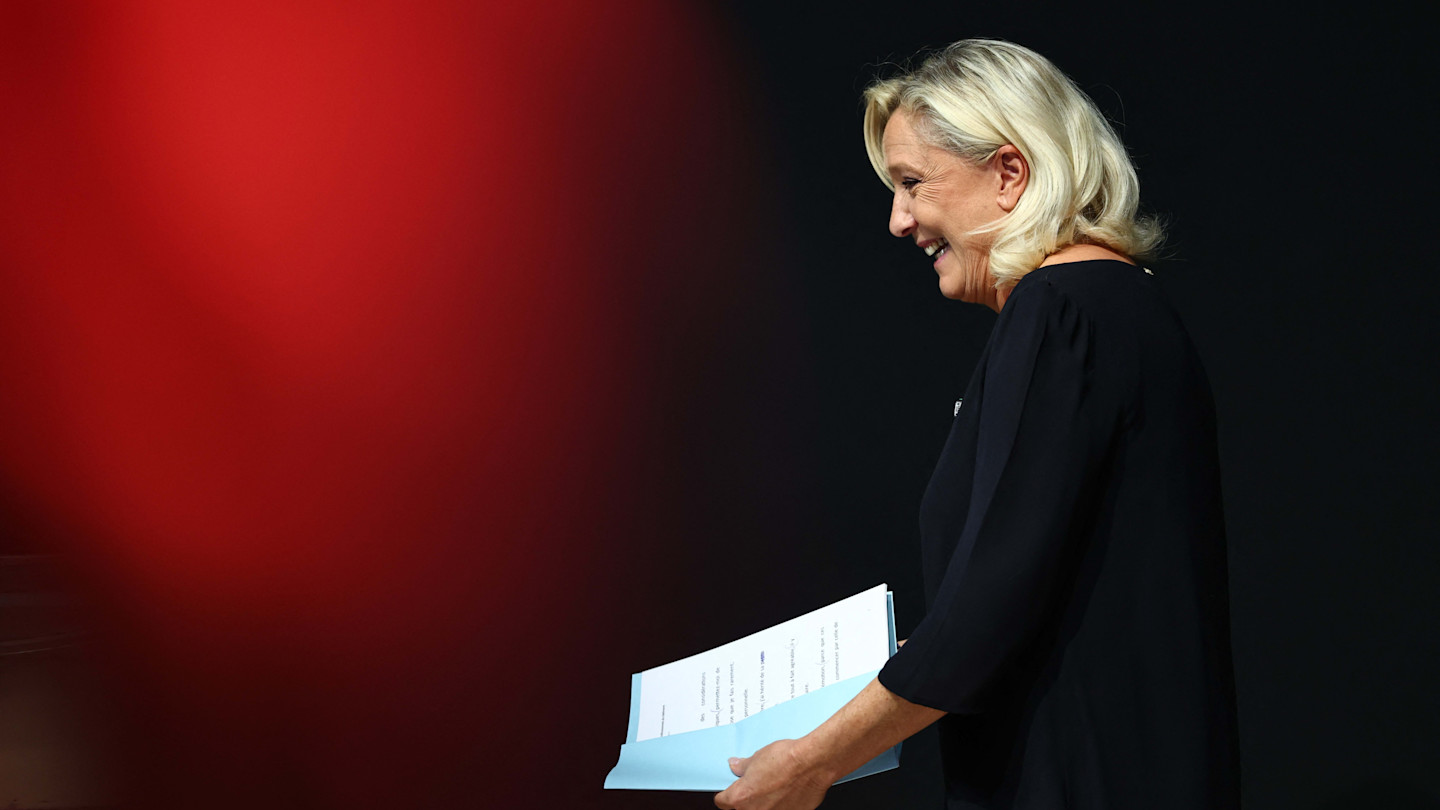
Who had on their bingo card that Marine Le Pen, leader of France’s far-right populist party and the frontrunner for next year’s presidential elections, would call for new pan-European taxes? Or commit to reaching net zero before 2050 (“an ethical and economic imperative”)? Or that her party would claim financial markets lower the borrowing costs of the French state whenever she appears in “the Anglo-Saxon press”? Me neither. So here are some reflections on the weirdly through-the-looking-glass economic speech Le Pen made on Tuesday.
The Rassemblement National (National Rally), Le Pen’s party, has manoeuvred towards claiming the mantle of fiscal responsibility for some time — at least since before the latest accusations of youthful antisemitism by Jordan Bardella, the party’s number two. So, presumably, the move was not motivated just by a desire to change the conversation. Instead, it fits with Le Pen’s long agenda of “de-demonising” the party founded by her father, who was never shy about his rightwing extremism.
Still, anyone who has followed populist politics over the past decade or four could suffer a real hit of cognitive dissonance listening to her speech (video recording here). A central part of the proposal is a referendum on a “golden rule” that would make it impossible for the legislature to pass a budget with a deficit that exceeded the level compatible with shrinking the public debt-to-GDP ratio. That level would be calculated by independent experts.
As presented by Le Pen in an op-ed last week, the rule would demand fiscal consolidation by 0.5 per cent of GDP each year until the ratio came down to 60 per cent. Those parameters could well have been designed to match closely what a group of elite economists set out as necessary earlier this year. (More on this from Ben Hall.)
This is very much not what we are used to calling a populist economic policy offering. Of course, it’s wrapped in the predictable railing against elites who have betrayed the people by governing the country badly. And the goal of fiscal consolidation is presented, in good populist fashion, as recovering lost national sovereignty (fair enough, if you think of sovereignty as freedom of action). But the content of the plan looks, let’s admit it, serious. The numbers add up.
That is not saying it’s credible, in the sense that it is going to happen. Le Pen and her sidekick also presented their “counter-budget” and longer-term plans for actually meeting the golden rule (and then some, she claimed). Here the old populism briefly reared its ugly head: savings will be made by spending less on immigrants! But the RN says much more can be found from reorganising the state administration. That is standard centre-right fare, and not exactly wrong: the French state certainly has bloat that good policy would reduce. But, of course, promises to find “efficiencies” in the state administration of prosperous countries often fail, either by not finding much to cut, or by actually ruining the state’s ability to do the things it has to do.
But the point here is that the plan is non-credible in the ways all politicians are non-credible. In electoral contests, they overpromise; in the dilemmas of governing, they underdeliver. Unlike what we should often fear from the far right, these are not the sort of flaws that undermine the republic or overturn liberal democracy. If France’s populist right has turned into just an ordinary flawed political force, playing within the rules, we should sit up and notice, especially given what some other movements from that end of the political spectrum are up to elsewhere in Europe, let alone across the Atlantic.
The surprises don’t end there. There is a mix of ideas here, some legitimate, some silly, some unrealistic. But they are not, in many cases, what we expect from this wing of the European populists. For example, Le Pen wants a rebate on France’s contributions to the EU budget. Good luck, you have the right to try of course. More interesting is the endorsement of a harmonised pan-EU tobacco tax to be paid straight to the EU. With Eurosceptics like these, who needs euro-enthusiasts?
On domestic policy, there is the usual red meat (a flat tax on incomes, lower taxes on fuel and energy) but also the complete opposite (subsidies for clean cars). There is also the good idea of cutting taxes on production — ie business taxes that just add to costs rather than being assessed on profits. (On this particular issue, Le Pen beats the European Commission for economic competence — Brussels is doubling down on its idea of a lump-sum tax on big corporations).
I was particularly interested in two policy proposals involving the European Central Bank. Le Pen’s opposite number on the populist left, Jean-Luc Mélenchon, has infamously said the ECB should cancel the French bonds it holds from its asset purchases. Le Pen professes the orthodoxy that honouring the public debt is a moral duty. But she calls for the ECB to intervene to bring down state borrowing costs.
There are two ways of reading this. One is as a standard populist and irresponsible call for something — monetary deficit financing — that would end in tears, and in any case be illegal under the EU treaties. Another is that Le Pen is signalling that she would not see it as a subjection of French sovereignty to the globalist overlords if the ECB were to implement its “transmission protection instrument” even though this would come with strict conditions on national fiscal policy. Her choice of words, I think, suggests a positioning to be able to play by the European rules (the italics are mine):
It is indispensable to enter a discussion with the ECB so it can intervene to lighten the burden of yields. From the moment France takes back control, the ECB must intervene so Eurozone countries achieve financial room for manoeuvre to invest in our sovereignty, defence and technological catch-up.
And immediately after these words, she goes positively woke:
The ECB must also fully accomplish its mandate to help states finance the energy transition and respect the Paris agreements. We are accumulating an ecological debt that is much more perilous than any financial debt, because it puts in danger our survival in dignified living conditions. Climate warming itself has inflationary consequences. Helping to finance hundreds of billions in necessary investments for decarbonisation is an ethical and economic imperative. By granting financing at low rates to every serious structural project, without fraud or conflict of interest, that allows realising carbon neutrality, the ECB will be within its mandate.
To top it off, she says she wants to reach net zero before 2050.
This policy — to use a dual-rate system to boost green transition investments — is heterodox, to be sure, and has so far been associated with the progressive left. It is also a good idea (as I have explained before), and has been mentioned as a possibility by several ECB board members.
The bigger point, however, is that by embracing activist policy for a green industrial transformation, Le Pen sounds greener than the 2019 vintage of European Commission president Ursula von der Leyen.
How to make sense of this?
One possibility is that ahead of next year’s presidential election, Le Pen judges that she has cemented her support among the third or so of French voters who have committed to her, are protest voters or who were previously disengaged — so the challenge is not to lose the next 25 per cent who would take her over the top. A bold commitment to fiscal rectitude is a pitch to the conventional centre-right — and leaves its native candidates on the back foot. Either they match her rule (and look like copycats while granting her leadership on the issue) or they don’t (and leave her as the sole fiscal responsibility candidate).
Another (compatible) possibility is that she now realises she is sufficiently likely to win this thing and that it’s time to turn her mind to how she will govern. The dog will have caught the car — and then what will it do? If so, this is about building a mandate for policies that may be necessary in order not to be the plaything of events.
Of course, it could be that this is all pretence, and that if the RN wins, the de-demonisation and pitch for responsibility will evaporate and the old nasty party will show its true nature. There are many in France who fear this. So I accept that it is wishful thinking to expect that we just may be seeing the civilising force of liberal democracy, through which the prospect of real power can domesticate (or alternatively destroy) fringe, protest and anti-system parties, as we have seen in the Nordics, Italy and elsewhere. It may even demonstrate the force structurante of the EU — that maligned, over-democratic bureaucracy with too many veto players, but which in the end is a sovereignty enhancer for each of its member states.
As I said, wishful thinking, but wishful thinking could turn out to be true. If it is, we should recognise the achievement of European democracy, and grudging congratulations will be in order all round.
Other readables
● In my latest FT column, I write that France’s sabotage of EU sanctions policy last month undermines its call for strategic autonomy.
● Philip Augar is right to say lenders protest too much about possible taxation or lower interest on their central bank reserves.
● While European leaders panic about Chinese exports, one German car company is happy to invest at home. Perhaps what some call “China shock 2.0” is just a Schumpeterian structural transformation after all?