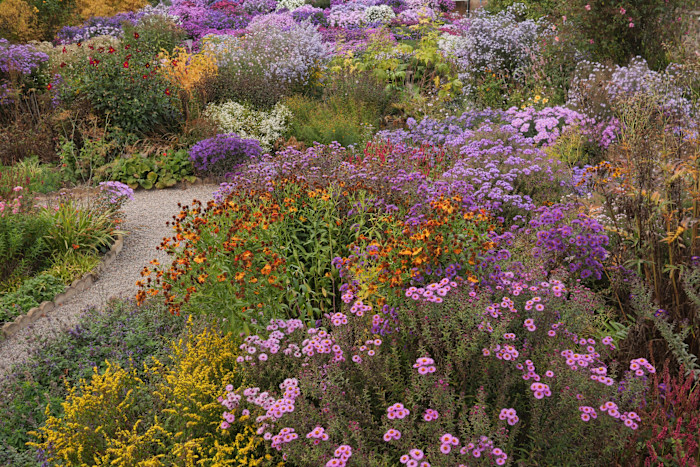
During the persistent heat and drought, I was apprehensive when looking forward to autumn. September and October are marvellous months for flowery gardens, but the unrelenting summer seemed set fair to scorch their mainstays to death. There are exceptions, but not many. At ground level autumn crocuses are well able to survive dry heat and the bulbs of little yellow sternbergias revel in it. Their brilliant crocus-like flowers have never been better as they thrive in dry sunny soil, especially below walls. What, though, about the daisy-flowered asters, as all of their kin used to be called until botanists split them up? They include Michaelmas daisies, which are still wonders on this October weekend.
By early August the leaves on my beloved Aster ‘Little Carlow’ were wrinkling and turning brown at their edges. They looked like casualties in waiting, victims of Mother Nature’s cruelty and likely to die back without any flowers in their shade of electric blue. For years I have grown two of ‘Little Carlow’’s cousins, both of which like dry soil too: tall ‘Chieftain’ and tallish ‘Aldebaran’, each with spires of lavender blue flowers. They usher in the garden’s blue period, but by mid-August they were being scorched to bits.

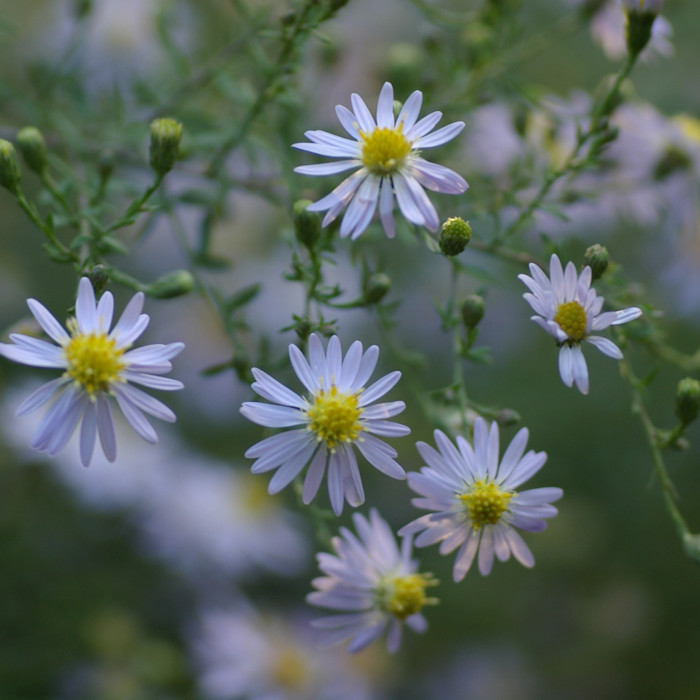
Other daisy-flowered winners seemed unscathed, especially those bluish siblings, Aster x frikartii ‘Mönch’ and frikartii x ‘Wunder von Stäfa’, a variety which is less floppy. ‘Mönch’ is more often seen and ranks as my top border plant in this difficult season: it has grown through whatever the sun has thrown at it. In August, it began to open its blue-lavender flowers on stems which spill forwards near the front of flowerbeds. It is a marvellous mainstay, bred by Carl Frikart in Switzerland in 1918. As the Mönch, Eiger and Jungfrau mountain peaks were near his nursery, he honoured each of them with a hybrid daisy: ‘Mönch’ is the winner. It is not so good in clay soil, but it thrives in others. It is best when not crowded by neighbours, a mistake readily made as its plants look small when bought in 9cm pots, the size which is cheapest and best. They then grow up to 3ft high and wide. I have dotted single plants of ‘Mönch’ in the front of beds around my garden so that they lead the eye on.
They cheered me up in the drought, but so did others, especially two small-flowered daisies, one being Eurybia x herveyi ‘Twilight’, which begins the blue season in July, and the other being ‘Hon Vicary Gibbs’, which is about to end it at a height of 4ft. I feared, however, for the New England and New York asters, also Symphyotrichums in up-to-date lists.
Two years ago I benefited from a day with the ultimate authority Paul Picton, whose Old Court Nurseries at Colwall, near Malvern, Worcestershire, continues to be a place of pilgrimage for aster lovers. It is the holder of an unrivalled national collection and, as it is a top favourite of this column, I decided to visit and see if the drought has dimmed its autumnal brightness. Maybe my plants had been lucky.
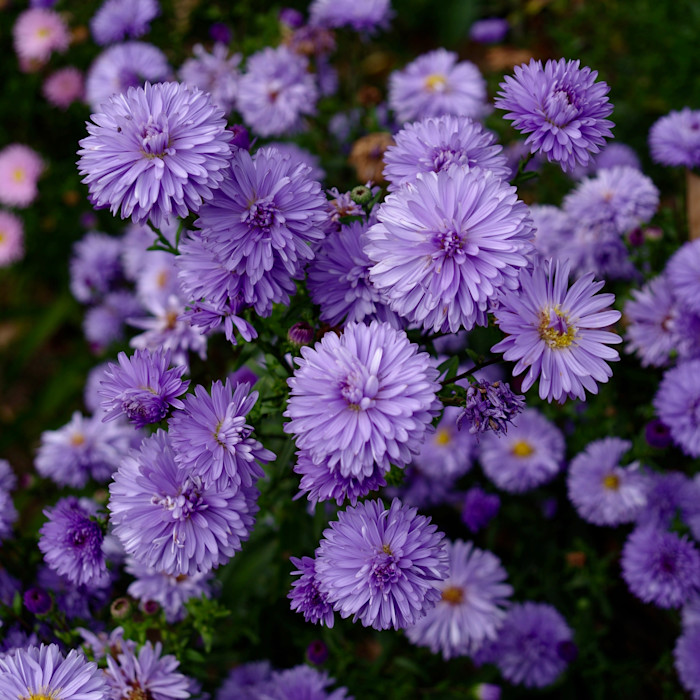
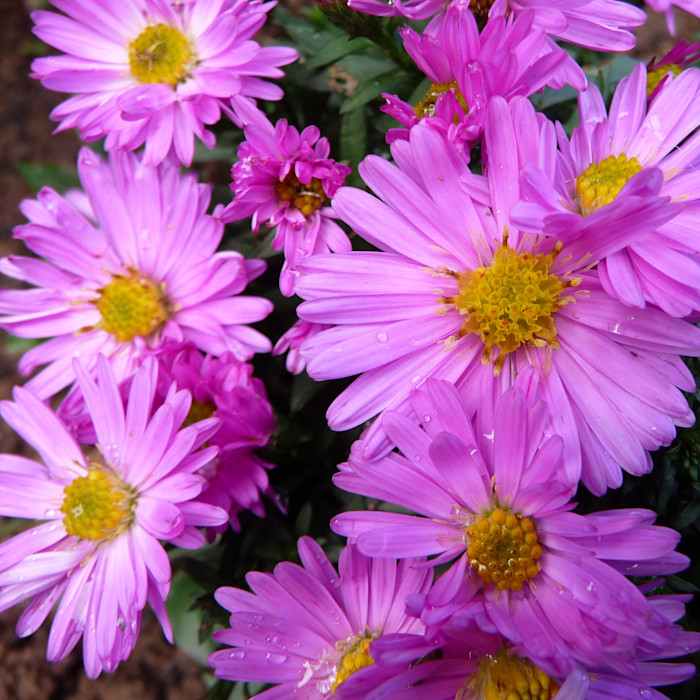
It has not been dimmed at all. Hundreds of fine daisies, ranging from deep purple through pink to white, from ‘Marie Ballard’ to ‘Rosebud’, ‘Faith’ to ‘Sam Banham’, are flowering flat out, tended by the third generation of the Picton family, Helen and her husband Ross Barbour. I had expected to see shrivelled stems and that hazard of New York asters, mildew. I found a few scorched edges and some dried leaves on lower stems, but only the ‘Countess of Dudley’ had turned half brown, and she is a rare variety anyway, originating before 1935.
As a national collection, the Colwall asters could be watered legally using a hosepipe. Maybe that concession explains the state of the big borders, packed with Michaelmas daisies in full flower. On previous visits, when guided by the maestro Paul Picton himself, I have picked on red ‘Winston Churchill’, not least for its name, only to be steered discreetly away as if others are even better choices. This year, going solo, I admired ‘Rufus’, an excellent red-purple, and the low-growing pink ‘Rosenwichtel’ which has just come into its fullest flower. Among whites I went for tall ‘Albanian’, but remembered that the maestro coaxed me two years ago to buy ‘Sandford White Swan’ instead. It is a double white with a pink flush to its buds and is already a star in my border with very little watering. As for double blue ‘Ada Ballard’, it is irresistible, mildew or not. Well-rooted plants of these and many others are on sale at the nursery for £9.50 each, whereas email-ordered plants for delivery next spring will cost £7, though smaller at first (oldcourtnurseries.co.uk).
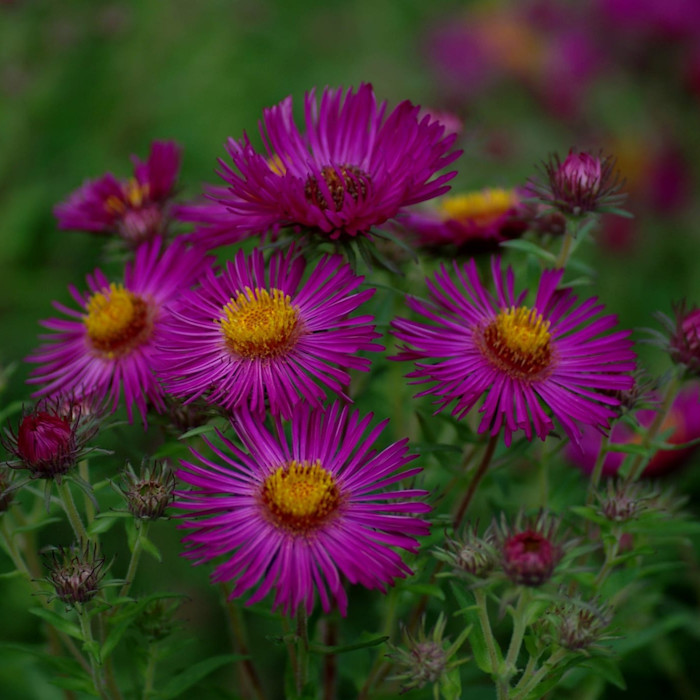
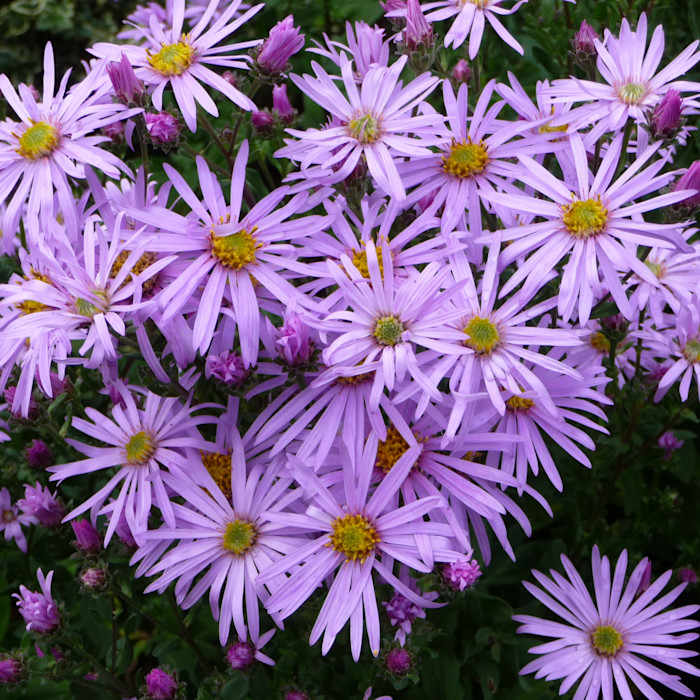
Hold fast to three principles. To minimise any risk of mildew, choose the New England asters, Symphyotrichum novae-angliae’s varieties which are better in dry years and need little staking. At Colwall I added ‘Primrose Upward’ to my New England collection as it has impressive flowers of pale purple-red and reaches a height of 5ft, ideal for the back of a dry border. Otherwise, go for Europe’s amellus varieties, for cordifolius ones with sprays of flower and for tough Aster pyrenaeus, best known for the pale lilac ‘Lutetia’ which copes well with dry years.
Like other great families of plants, asters, as gardeners still call them, are not standing still. Even ‘Lutetia’ has an excellent newish cousin, ‘Cotswold Gem’, which stays upright and has pink flowers. Since 2024 a mildew-free one named ‘Paul Picton’ has been added to the amellus range, a lilac-blue of a modest height which is surely special to deserve the name. Do not settle for second best. Old Court Nursery’s collection transforms ideas of what is available.
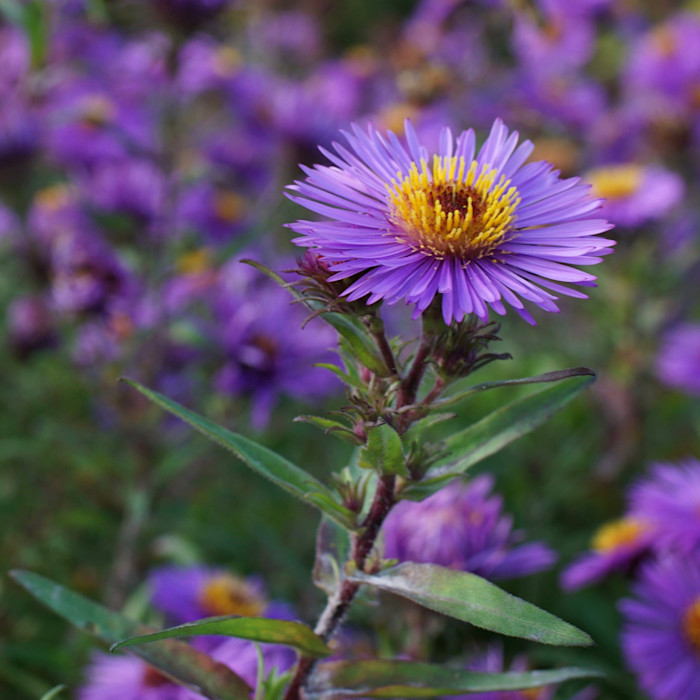
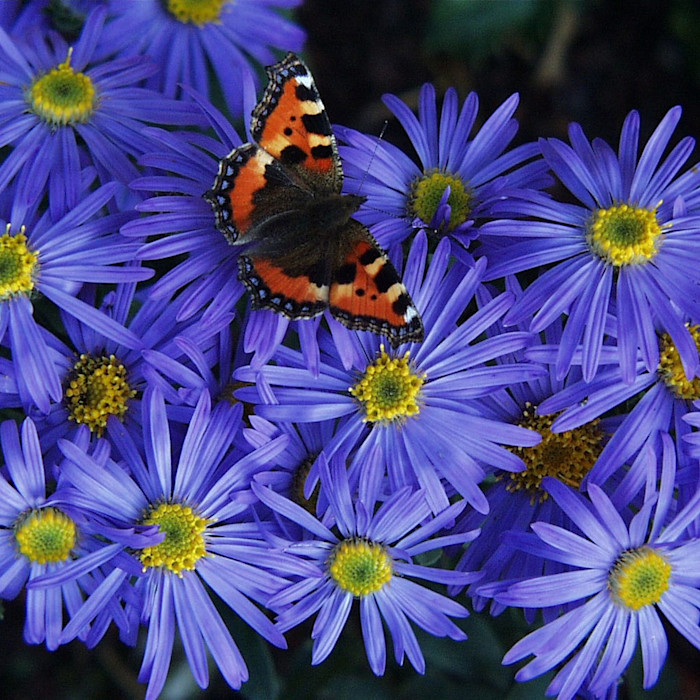
Droughts are surmountable, but slugs and overcrowding are not. In winter and spring, slugs attack the core shoots on many asters: they need to be eliminated, especially as winters have become warm and wet, encouraging them to fast breed. In early summer be careful not to allow other border plants to flop over your daisies. They greatly dislike such a canopy. In big Edwardian gardens, entire borders were given over to Michaelmas daisies, a sight seldom seen now except in the Pictons’ national collection. Edwardians had far fewer aster beauties than we do, but they had hit, perhaps by accident, on a good idea: segregated daisies were never elbowed out by other neighbours.
To embark on the best choices, consult Old Court’s excellent catalogue for 2027. It sets out the basics with clear authority and presents hundreds of options for gardeners to enjoy. Never think that the aster season is brief, a one-week wonder in September. ‘Twilight’ starts it in July and ‘Mönch’ flowers then too. Among the easy New Englanders, ‘Barr’s Violet’ and lovely tall ‘Violetta’ are at their best in October, as is the reliable ‘King George’. ‘Algar’s Pride’ is a fine New Yorker for October too. So are magenta pink ‘Twinkle’ and tall white ‘Sam Banham’ among many others. I came home with ‘Oktoberlicht’ in a plastic bag, a small-flowered white which lights up this month. Give aster-daisies space, thought and a visit: there is much more to them than Michaelmas Day.
Find out about our latest stories first — follow @ft_houseandhome on Instagram