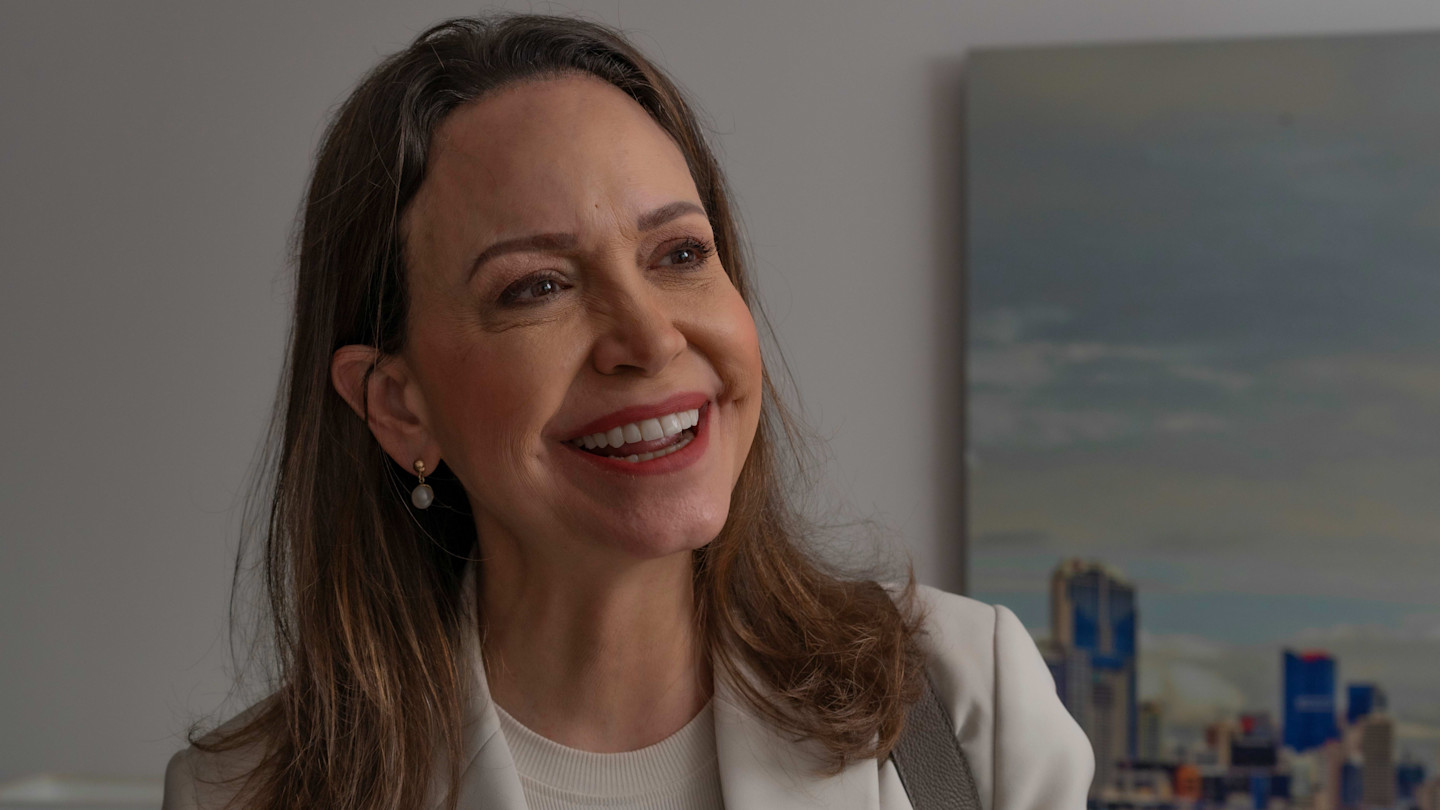
Exiled Venezuelan opposition leader María Corina Machado has called for presidential elections next year, even as she acknowledged “differences” with the US over the timeline for a democratic transition in a country with some of the world’s biggest oil reserves.
There was “more than enough time” to prepare for an election by July, Machado, the winner of last year’s Nobel Peace Prize, told the FT in an interview.
She also called for “transparency” in the management of proceeds from Venezuela’s oil sales, which are being overseen by Washington.
“The US government and the Venezuelan people all agree that the only way to make this sustainable and a real victory is to turn Venezuela into a stable democracy,” said Machado.
Opposition leader María Corina Machado says she intends to return to Venezuela and be part of a transition to democracy
Machado, currently based in Panama, has not returned to Venezuela since she left in December to receive the Nobel Peace Prize in Oslo. In early January, US special forces arrested Venezuela’s authoritarian former president Nicolás Maduro in a dramatic night-time operation.
The Trump administration has said it wants to see a political transition, but it has not outlined a timetable for elections. Machado remains Venezuela’s most popular politician, but Washington backed Maduro’s deputy Delcy Rodríguez, who is now the acting president.
“Things could move faster and steadily without any risk of instability in the country,” Machado said. “I think where there is a different assessment is in the pace, in the timing. I’m saying I believe we can move ahead and we’re ready.”
Maduro and his wife Cilia Flores — who was also arrested — remain in jail in New York awaiting trial on drug-trafficking charges, which they have denied. US authorities this week added torture conspiracy charges·. Their trial is expected to begin next year.
Some members of Venezuela’s opposition have become increasingly frustrated with the US approach, including a recent deal to hand over control of part of the country’s vast oil reserves to a private company backed by the Pentagon.
Washington has been managing the proceeds from Venezuela’s oil sales since January, but the Trump administration has not disclosed how much it has collected or disbursed.
Asked if she would like to see more transparency, Machado said: “Certainly, and I think that’s something that Venezuelan people are demanding as well.” She added that large-scale investment could be unlocked with a “legitimate” government.
But Machado risks being sidelined if she openly breaks with the Trump administration. She has made at least seven unsuccessful attempts to return in recent months with boats and planes cancelled at the last minute for unexplained reasons, her team said.
“It’s obvious that the regime does not want me to go back,” Machado said.
She dismissed suggestions, however, that Washington was blocking her return. “The secretary of state [Marco Rubio] has said publicly and privately that I have the absolute right to return to Venezuela,” she said. “I think the US understands that my presence in Venezuela would be a strong signal that the transition plan is working.”
Machado said that she would back a proposal to hold elections on July 24, the birthday of Venezuela’s independence hero Simón Bolívar. “Bolívar is Venezuela’s liberator and is a figure that unites our nation and many other nations in the region, so I think that’s a beautiful date,” Machado said.
A survey by local polling group Meganálisis this month projected she would win 61.2 per cent of the vote, against Rodríguez’s 3.1 per cent.
“The presence of the United States is what’s keeping Rodríguez in place and moving in one direction,” Machado said.
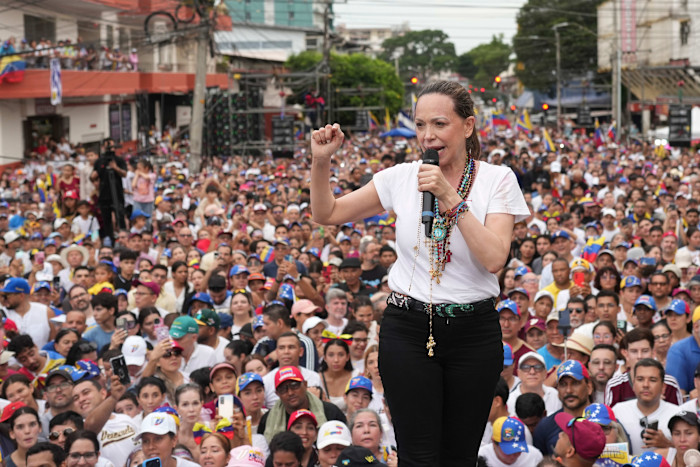
Machado’s supporters have staged marches in recent weeks calling for her return. “We Venezuelans want her to come back and defend our rights,” said Rina Palma in Caracas, where crowds of thousands shouted for “elections now”.
“María Corina faces a real dilemma: go back without Trump and work it out as she goes, or take on the country that’s calling the shots in Venezuela,” said Edward Rodríguez, a Venezuelan political analyst.
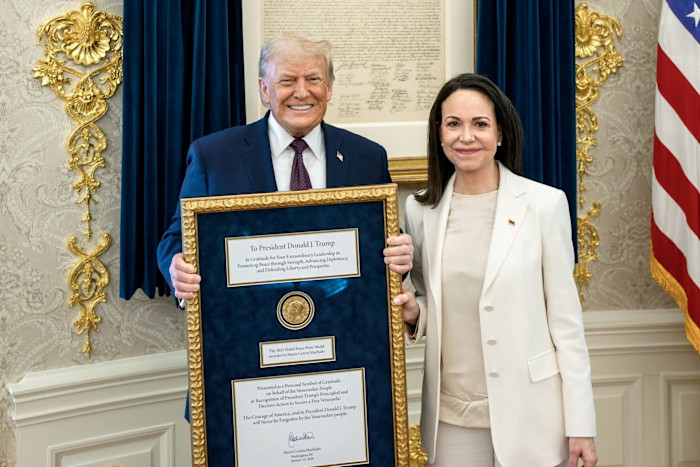
Earlier this week, Trump described Machado as “a very fine woman”. He also referenced her gifting him her Nobel medal, which he is known to covet, during their meeting in January.
The prize had a “unique effect in unifying” the country, coming “in perhaps one of the darkest hours” of its repression, Machado said.
“It was like an injection of strength because we felt we were not alone,” she said.