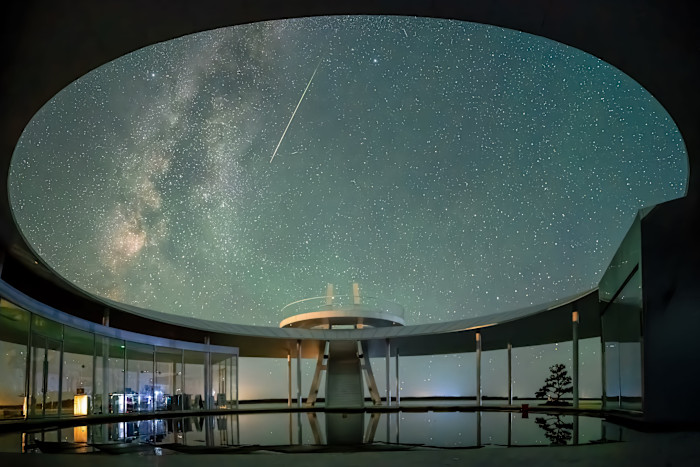
I love this time of year, when the days shorten and darkness casts its double spell. All humans have a primal fear of the dark, because it confronts us with our mortal frailty, but for many of us it also holds the promise of delight, adventure and transformation. In our small valley in the Blackdown Hills, on the Somerset-Devon border, the dark can be intense, and when I stand in the lane under a clear night sky the mix of powerful emotions I feel — awe, enchantment, curiosity — is probably no different from those felt by my distant ancestors.
That eternal human curiosity has given rise to some exquisitely beautiful artefacts, and an eclectic range of them are included in Night Maps, an exhibition which opens at London’s Warburg Institute this month. The single most desirable object must surely be the pocket globe, made in 1731: a terrestrial sphere nested inside a celestial one, the whole thing encased in alligator skin, and small enough to hold in the palm of your hand. The 18th-century man of substance could have not just the world, but the universe, in his pocket. I would trade my mobile phone for one any day.
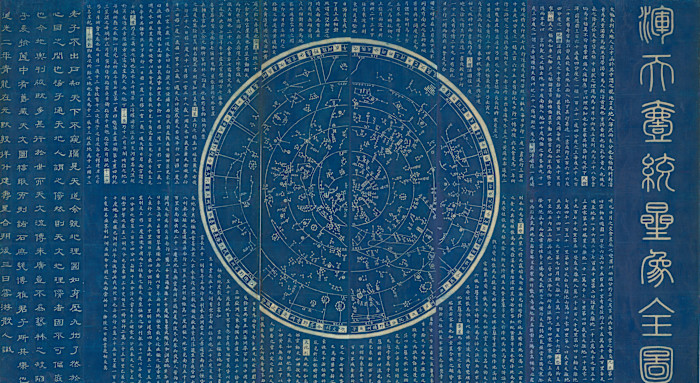
A star map, drawn in China in 1822, acts as another kind of status symbol. I’m drawn to this as a work of art — crammed with careful detail and coloured in a gorgeous Prussian blue — but in ancient times maps like these had an important function, providing a heavenly mandate for the emperor. His administration was neatly reflected in the order of the skies, where there was a “celestial bureaucracy” complete with ranks and offices very like those on Earth. There could be little room for doubt about the rightness of your authority if it was written in the stars.
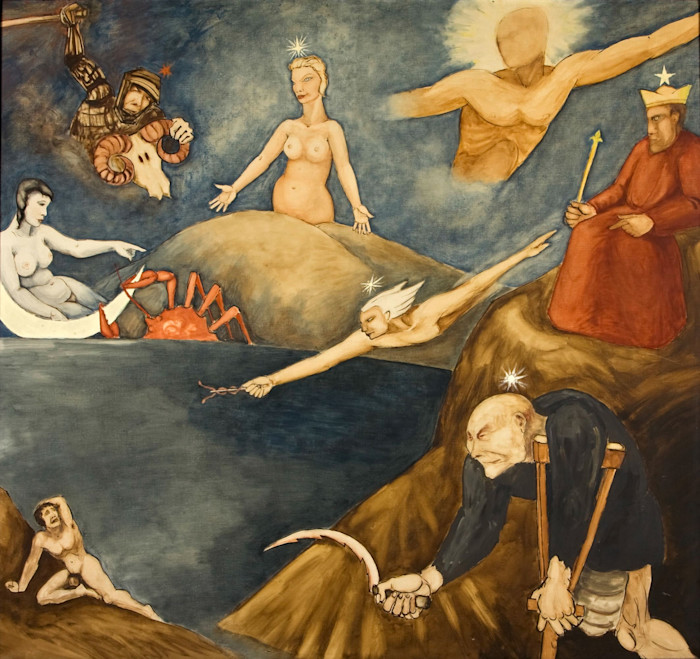
A lot of things have been written there over the centuries. Ever since people first drew lines between stars to make figures and symbols, they have invested them with significance. Constellations once provided a seasonal calendar that guided the preparation of the soil and the sowing of crops; and they offered prompts for the stories people told as they travelled or rested under night skies.
Joining the dots is a defining human activity, a way of understanding our place in the world, locating ourselves in space and time. The scattered points of our daily experience must be joined and rejoined if we are to make any sense of our lives, individually and collectively. It is a moment-by-moment work of creative connection that goes on in the memory, the intellect and the imagination, without which we would be utterly lost.
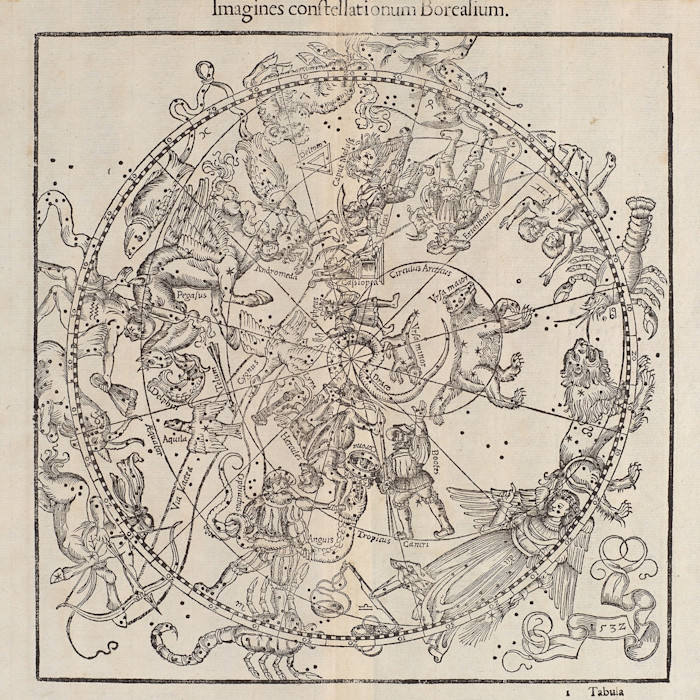
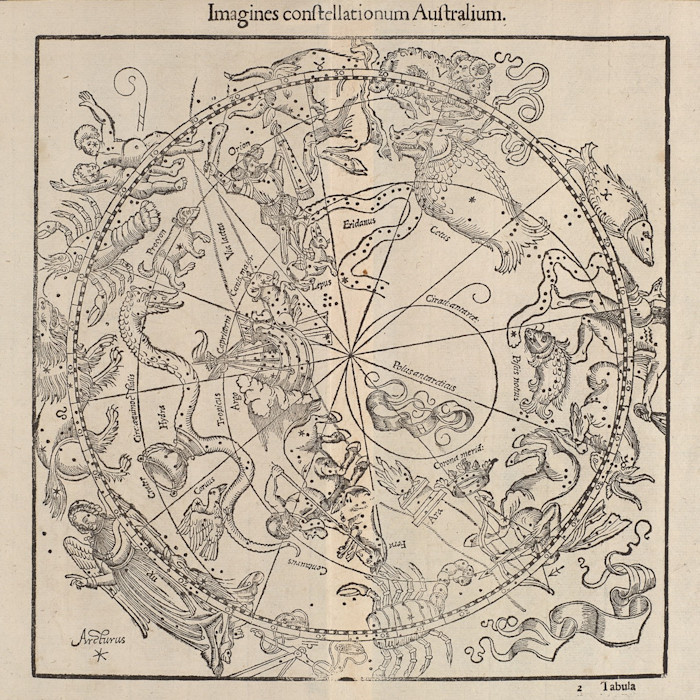
To the earthbound observer like me, beset and bewildered by change, the constellations feel reassuringly timeless. But there is always room for new interpretation. The exhibition includes maps drawn by Johannes Honter in the 1500s, which show the heavens thickly populated with the usual mythical figures — Hercules, Orion, Andromeda and so on — wearing the Germanic fashions of the day: doublet and hose, puffed sleeves, chunky boots or shoes with curly toes. Bears, lions and serpents prowl between them, and a ferocious Pegasus comes thundering out of the clouds. It may not be an entirely friendly environment, but it looks sociable, and perhaps this was the point — to make the heavens more recognisable to Renaissance viewers, even if some of its inhabitants were on the scary side.
Looking at Honter’s images, I’m reminded of something CS Lewis wrote about medieval cosmology: that looking at the heavens was like looking up at a towering building. It was imagined, he tells us, as a structure “in which the mind can rest, overwhelming in its greatness but satisfying in its harmony”. It was certainly large, but its edges were defined; it rang with heavenly music, and was full of light. The darkness experienced by medieval people was merely the shadow cast by our own planet.
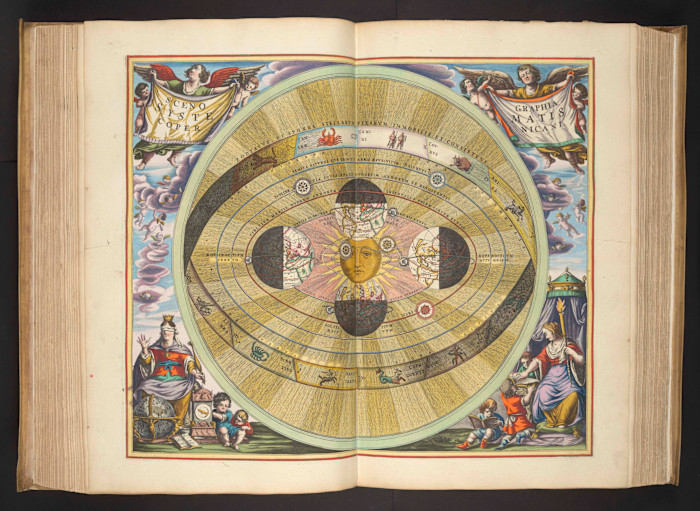
By contrast, our modern concept of “space” is characterised by silence and existential loneliness. Science speaks to us in outlandish numbers beyond our comprehension: stars in a galaxy are counted in billions, and the distances between galaxies are so huge that we need a special unit, the light year, to measure them. The numbers themselves have become a kind of storytelling, as fabulous as tales of gods and mythical beasts.
Science and fantasy are intermingled in the work of Emmy Ingeborg Brun, a self-educated amateur astronomer whose papier-mâché globe, painted to represent the surface of Mars, is on display here. It was made at the dawn of the 20th century, a time when there was intense interest in the “red planet”, and the American writer Percival Lowell had popularised the idea that Mars was criss-crossed by canals deliberately engineered by an alien civilisation. These canals found their way into Brun’s designs, along with other features such as oases and areas of vegetation. She also incorporated lines of text, one from the Lord’s Prayer (“Thy will be done on earth as it is in heaven”) and another from a contemporary socialist slogan (“Free Land. Free Trade. Free Men”).
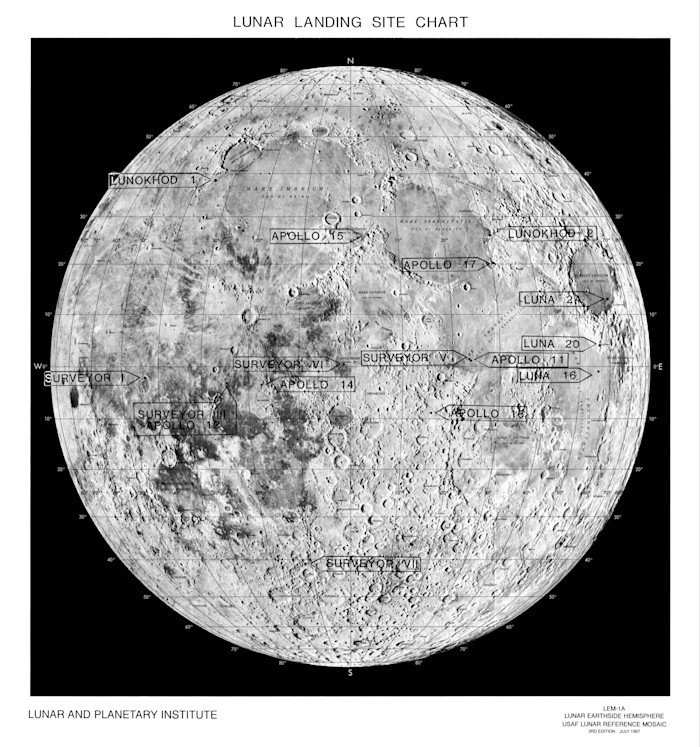
She made these globes between 1901 and 1910, while she was in a psychiatric hospital, where she had been committed by her brother for reasons unknown — perhaps he saw her fascination with Mars, or her transgressive beliefs, as signs of madness. They’re an extraordinary outpouring of creativity, fusing science fiction and politics with astronomy, in which she projects her vision of a utopian society on to that mysterious otherworld.
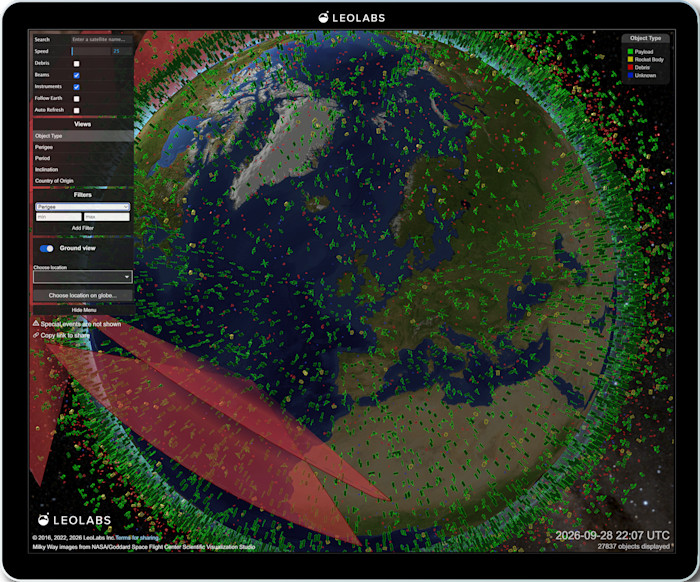
In our over-illuminated times, it takes effort to fall under the spell of darkness. In recent decades we’ve done our best to blast it out of existence. And, seen from some vantage points, our own planet looks like a science-fiction otherworld: a computer simulation in the exhibition (LeoLabs’ “Low Earth Orbit Visualisation” from 2026) shows it besieged by thousands of orbiting satellites, each coated with reflective metal plating like a mirror. I couldn’t help wondering what Brun would have made of this vision of the future, in which we fill the sky with machines so that we can watch ourselves. She might conclude that earthlings don’t care about the stars any more.
But she’d be wrong. Campaigning organisations have sprung up, dark sky tourism is booming, and our language has made room for a new word, “noctalgia”, to speak of the lovely dark of night that was once our birthright and the grief felt at the loss of it. All over the world, in places beyond the range of street lights, floodlights and security lights, we go on gazing at the sky as we have always done, and teaching our children to look up and join the dots.
‘Night Maps’, October 21-April 17, Warburg Institute, London, warburg.sas.ac.uk
Jean Sprackland’s ‘‘Night Vision: In Search of the True Dark’ is out now in paperback
Find out about our latest stories first — follow FT Weekend on Instagram, Bluesky and X, and sign up to receive the FT Weekend newsletter every Saturday morning