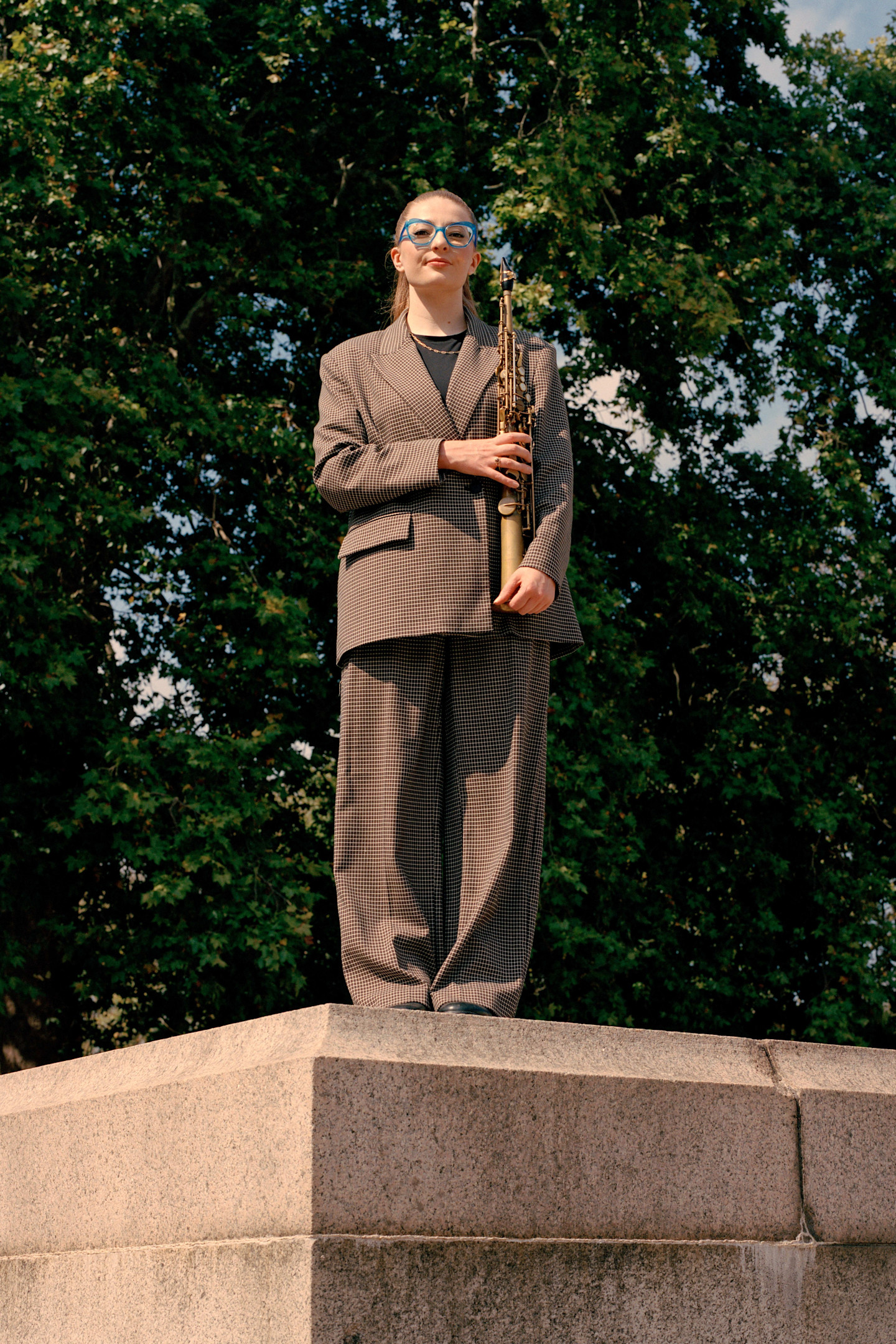
Jess Gillam strides on to the stage at the Royal Albert Hall, shimmering in a silver trouser suit and looking ready to party. It is September, the end of Proms season, and the saxophonist is here for the premiere of Gwilym Simcock’s new triple concerto for saxophone, horn and cello — a work as hectic and rhythmically complex as it is colourful.
The thought of playing it would cause many musicians to break out in a cold sweat, but for Gillam it is a natural fit, capitalising on the virtuosity and extrovert energy that has been her calling card since reaching the BBC Young Musician of the Year final in 2016.
In person, that energy is palpable. When I meet her backstage at the Royal Albert Hall, ahead of the Prom, she greets me with an ear-to-ear smile. Alongside the warmth, though, is a sense of authority sharpened by her crisp dress sense and statement spectacles. Still only 28, Gillam has packed more into the past decade than most manage in a lifetime.
In 2018, she became the youngest soloist to perform at the Last Night of the Proms, receiving an MBE three years later. She has commissioned and premiered many new saxophone works. Then there is her side hustle on BBC Radio 3, This Classical Life, where she interviews fellow artists about their favourite music.
Does she ever find time to unwind? “I’m trying to make time for friends,” Gillam says in her rich Cumbrian lilt. “The years when many people were making friends, I spent focusing entirely on music. And now I’m realising I need people.” But she also confesses: “I’m not the world’s best relaxer.”
Lately, free time has been particularly scarce as she was preparing her latest album, Shine. Released this week, the record showcases her love of “emotionally direct” repertoire, blending new music with arrangements of classical, folk, art pop and jazz. Most striking is the age of some of the material, the earliest being Spiritus sanctus vivificans by the 12th-century German Benedictine abbess Hildegard von Bingen, arranged here for saxophone by the British composer Geoff Lawson.
One might assume that this piece of plainchant would be worlds away from the sultry slide of the saxophone, but its appearance here isn’t unprecedented: in the 1990s, Norwegian saxophonist Jan Garbarek teamed up with early-music vocal quartet the Hilliard Ensemble to record medieval works.
For Gillam, the music lends itself to the improvisatory approach associated with the saxophone. “[On the manuscript], Bingen gives you note heads and that’s all, so there’s a lot of space for interpretation,” she says. “Originally, my aim was to sound as pure and vocal as possible, like a soprano . . . Then I ended up bending the pitches and moving freely between them.”
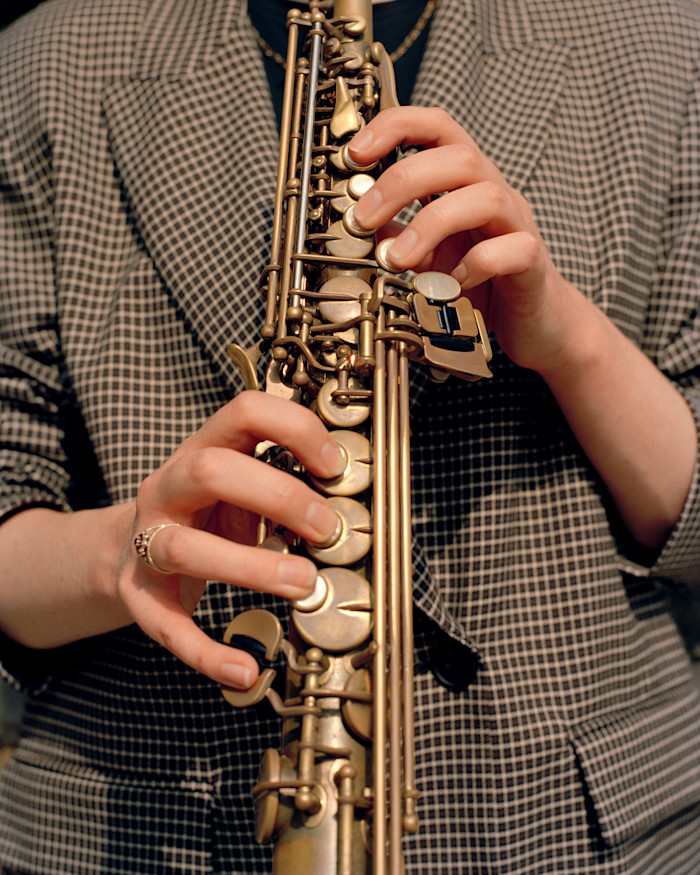
But how does an instrument less than 200 years old accommodate nine centuries of repertoire? Easily, according to Gillam. “What I love about the saxophone is its dynamic range and colour palette. It can be an absolute powerhouse and even take you to a brash, ugly place, but it can also play unbelievably quietly and sound so ethereal . . . I try to encourage people to see the saxophone as a saxophone, rather than just the sum of all [we associate] with it.”
That love of exploration defines Gillam’s career, explaining why, alongside performing with major international orchestras, she has formed her own hybrid band, the Jess Gillam Ensemble, a cross between a jazz trio and a string quartet.
Yet, unusually for a saxophonist, classical music remains her anchor. “I’ve always loved the structure and clear framework of [the classical system],” she says. Does the shortage of original classical saxophone repertoire frustrate her? “Sometimes I wish we had an equivalent to the Mendelssohn or Tchaikovsky violin concertos, but it’s also a great advantage: we get to be part of building the repertoire.”
Gillam was seven when she fell for the saxophone. Her father, who ran a tea room with her mother in the Lake District town of Ulverston, also taught drums and percussion at the Barracudas Carnival Arts Centre in nearby Barrow-in-Furness, where several instruments were on hand. “I tried them all, but the saxophone was the only one I connected with; luckily, I made a sound straight away.”
Her parents quickly turned her enthusiasm into disciplinary leverage. “If I misbehaved at home, they’d put the saxophone on top of the fridge and I wasn’t allowed to play it,” she says. “They also had a deal where I contributed financially to my [musical education] by working in the tea room or busking.” Did that help or hinder her? “It encouraged me to value music,” she says, adding that her family’s formidable work ethic left a lasting mark: “I’m not someone who does things by halves.”
At 18, Gillam entered the Royal Northern College of Music. She later chose to leave her course to manage a booming concert diary, eventually completing a masters at the Guildhall School of Music during the pandemic. Did early fame carry its own pressures? “I try not to think about it too much because I often end up feeling quite terrified of a lot of the things that I get to do,” she admits. From someone so seemingly self-assured, this sounds surprising, but she insists that she does not necessarily feel as confident as she looks: “I need to project confidence so everyone in the room feels comfortable . . . but it’s not always easy.”
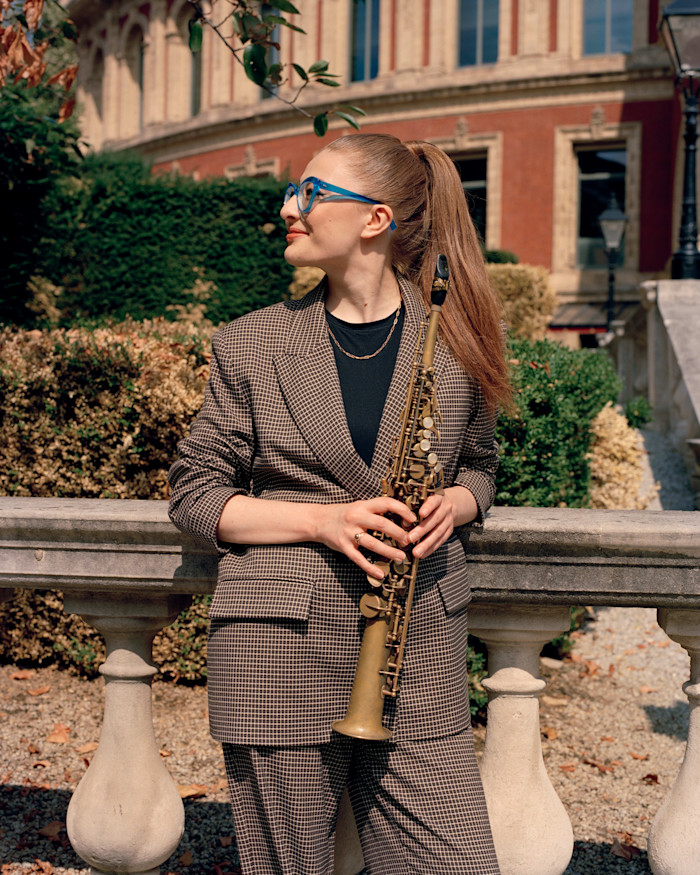
What steadies her, she explains, is “remembering that my performance is not really about me; it’s about shifting my focus to the music and the exact sound I want to create”. Still, in a career that demands so much time practising in isolation, how can you prevent ego and self-absorption from creeping in? “[What kept me grounded was] growing up in my parents’ tea room, having to go to every table with a smile, no matter what. And also being raised in a close-knit community where you’re only ever one person away from knowing somebody — you say good morning to everybody. That’s how I try to approach every scenario.”
Nowhere is that more apparent than in her Radio 3 show, which comes across as a casual listening fest with friends. Gillam punctures the idea of classical composers as demigods; instead, she makes a point of interviewing classical artists alongside musicians from other genres: “I find some music outside the classical sphere just as profound and effective.”
Does she believe that the world of classical music suffers from pretentiousness? She answers cautiously: “Because classical music is so revered . . . it can definitely feel siloed,” she notes. “I’ve gone through iterations of ‘I should love this piece’ or ‘I should love this composer’. Now . . . I just try to carve out my own genuine opinions.”
She admits that this candour can feel “embarrassing”, leaving her exposed, but she believes that it’s important to have “a real conversation”. As she puts it: “Formality has its place, but so does feeling relaxed, open, human and joyful. I don’t think we get enough of that in the world.”
‘Shine’ is out now on Decca
Find out about our latest stories first — follow FT Weekend on Instagram, Bluesky and X, and sign up to receive the FT Weekend newsletter every Saturday morning