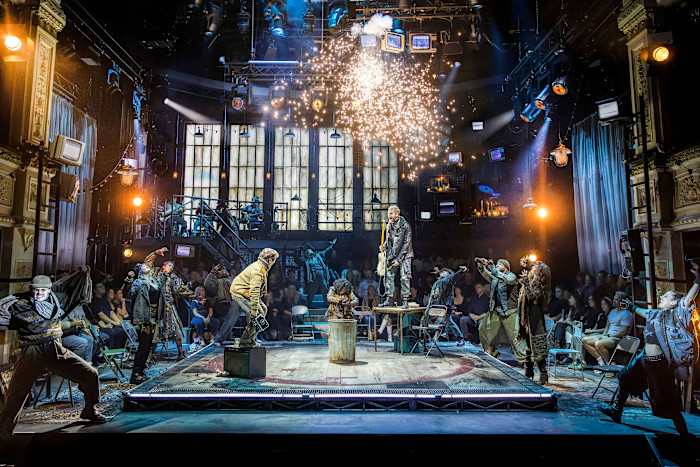
On the day we meet, Luke Sheppard has three shows running simultaneously in London’s West End. A 30th-anniversary revival of Rent opens just as My Son’s a Queer finishes its third West End run, and Paddington the Musical continues to charm audiences at the Savoy each night.
Sheppard, 40, has become one of the busiest directors in the business. His productions vary in scale and style — Starlight Express had a cast of 40 roller-skating round a converted warehouse pretending to be trains, while My Son’s a Queer is a solo autobiographical show about coming to terms with one’s sexuality — but almost all of them have brought in awards, critical acclaim, money (& Juliet is one of only a handful of musicals to have recouped on Broadway since the pandemic) or, in the case of Paddington, all of the above.
None was a sure-fire hit. None had a particularly starry cast. Each cracked some kind of formula that turned what were often commercial calculations into unashamedly populist, joyful productions made with artistic integrity.
“A lot of the shows that I work on are what some people would describe as ‘in the commercial sector’,” says Sheppard as we squeeze on to a balcony at the Tom Stoppard Theatre, the only unoccupied space as Rent enters the frenzy of final previews. “It’s easy to meet people who look down on those as being less worthy. And I think musical theatre is often looked down on as less worthy too. I remember being told for years and years, ‘If you want to direct musicals, you’ve got to prove that you are a proper director by directing plays’.”
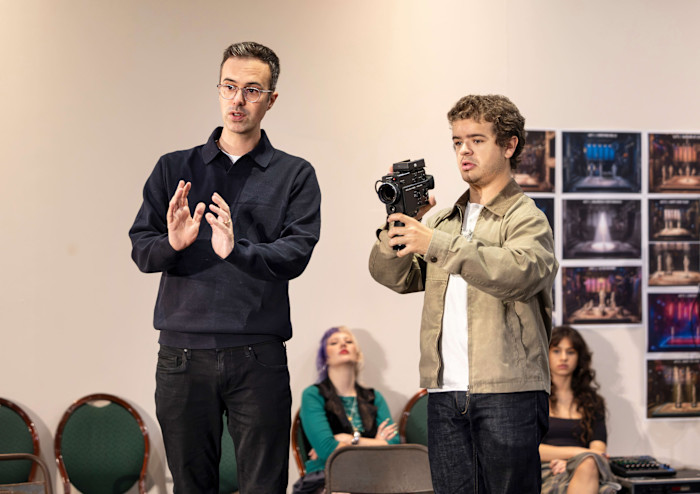
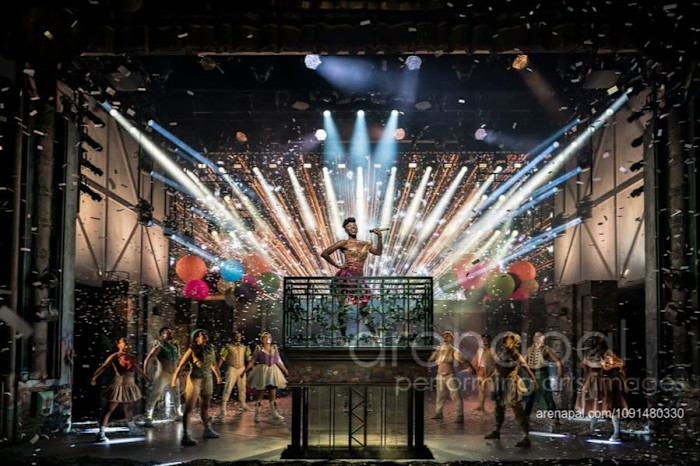
Sheppard ignored that advice. Each show he creates is a small act of insistence that populism and artistic merit can coexist. “Not all expectations were high for & Juliet,” he says wryly of the 2019 musical featuring pop megahits, which imagines that Juliet did not kill herself after Romeo’s death but instead went to live a happy life in Paris with Anne Hathaway. “But I’m naturally drawn to work that aims to reach a lot of people. I always think of my grandmother, my mother, my sister, my niece in the audience, and wanting to make something that works across those generations.”
Days away from press night, you wouldn’t know that dozens of jobs and millions of pounds rest, in large part, on his shoulders. One producer I speak to calls Sheppard “the ultimate diplomat”, and he certainly has the diplomat’s technique of shifting the conversation away from annoying questions about budgets and bad reviews to more positive things.
When I ask whether he worries about a show’s finances: “I’m very fortunate that the producers I work with don’t ever burden me with that.” The most important thing for him is that, “on press night, you’ve got to be able to look your colleagues in the eye and go: we are so proud of this.”
His gentle voice and considered way of speaking suggest a director who is far from the ranting, raging type of the old school. “I would hope that most people I work with would agree with you. Because I was trusted to take on quite big projects at a young age” — his first major job after a drama degree was assisting on Matilda the Musical at the Royal Shakespeare Company — “sometimes I would find myself one of the youngest people on the creative team. I learnt quickly that you can’t just go around shouting and asking for what you want, because people will tell you to go away.”
A couple of early successes set the snowball rolling. In 2015, In the Heights by Hamilton composer Lin-Manuel Miranda became a surprise hit and went on to win three Olivier Awards. Several other Sheppard shows have started life in tiny theatres and transferred to the West End. If there is a secret to his success, he reckons it is in bringing that small-scale energy to big-ticket productions.
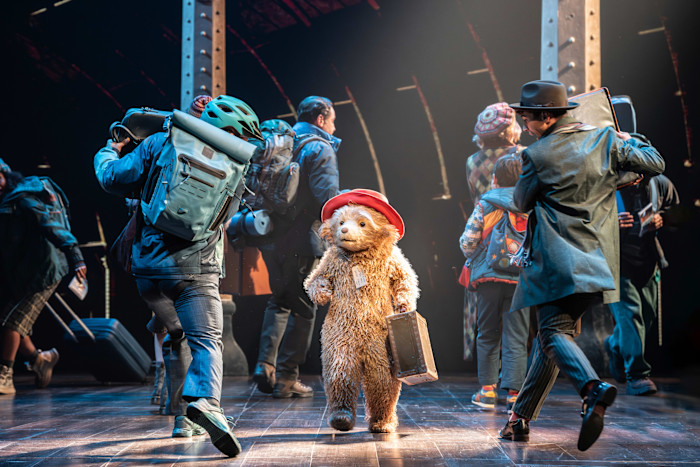
Even for Paddington, Sheppard insisted on stripping things back to basics. “We built our own little theatre in Three Mills [studios] and did a kind of off-West End mini-production as a workshop.”
What clearly matters, too, is having a director who cares. There is an endearing sincerity to the way he talks about his shows. Take Rent: “I listened to it as a teenager in my bedroom. Hearing the lyrics to ‘I’ll Cover You’ sung by two characters who were outside of the mainstream presentation of love, in a way that was deeply romantic . . . the lyrics to that song are baked into my soul.”
That unapologetically uncynical approach got him the Paddington gig — though only after an 18-month audition involving, he thinks, eight separate interviews with the producers. “It felt like a dating process.”
Producer Eliza Lumley had seen & Juliet. “She said: ‘I am doing a thing, I can’t tell you what it is, but I think you might be the right person for it.’ I went into full investigation mode.” When he found out she was working on Paddington, Sheppard “mounted a bit of a campaign”.
“I have to feel in my bones that I am the right person for that show at that moment. Paddington is a shining example of that. I really love this city. I remember the [London] Olympics in 2012 and how it felt. I thought back to that time and I proposed the thesis: wouldn’t it be amazing to make a show that tries to build on that spirit? It’s the sense of kindness at the centre of it.”
Sheppard may be gentle, but he is ambitious too. He imagines himself one day directing something on the scale of an Olympic opening ceremony, and would “really, really love” to do a film. “The challenge is that those require a huge amount of investment, and it would be a gamble to hire me.” He smiles. “I remember a film producer said to me, ‘At the moment you’re investible up to this amount’,” — he sets his hand at chest level — “‘but the trouble is that the films you want to make need you to be investible up to this amount’” — he moves it up to shoulder level. What were the amounts? “I’ll let you use your imagination.”
Diplomacy prevails. It is only when we discuss theatre ticket prices that Sheppard becomes more candid. In the weeks around Paddington’s opening, there were headlines decrying £250 top-tier tickets. “It was just a very skewed kind of angle on the whole thing,” he says. “We talk about [pricing] all the time. If you want to see Paddington for a reasonable price, you can. You just have to book in advance. It requires forward planning.”
This comes from a man who knows how to forward-plan. He looks at his phone and, gently but firmly, tells me he is late for an audition nearby. Even though it is 6.30pm on a Friday and he has spent an exhausting day finessing Rent, there are roles to fill for the new Paddington cast that takes over in October. The bear hits Broadway early next year too.
Meanwhile, & Juliet opens in Utrecht and Stuttgart this week, and he has ambitions for two previous productions: The Little Big Things, the musical he directed in 2023, and What’s New Pussycat?, a jukebox musical. Based loosely on Henry Fielding’s 1749 novel Tom Jones, it features the music of, why not, Tom Jones but has no connection to the 1965 movie What’s New Pussycat? beyond its title song.
Everything else on the slate is “top secret”, he says as we race down St Martin’s Lane. Even if his canvas does continue to expand, Sheppard is certain that he would never entirely abandon the aesthetic of the small space that has served him so well. “It’s a balance,” he says, walking briskly, “but sometimes you can tell the clearest story with just a room full of great actors, a ladder and a light.”
‘Rent’, Wyndham’s Theatre, to May 29, rentthemusical.com
‘Paddington’, Savoy Theatre, booking to February 13, paddingtonthemusical.com
Find out about our latest stories first — follow FT Weekend on Instagram, Bluesky and X, and sign up to receive the FT Weekend newsletter every Saturday morning