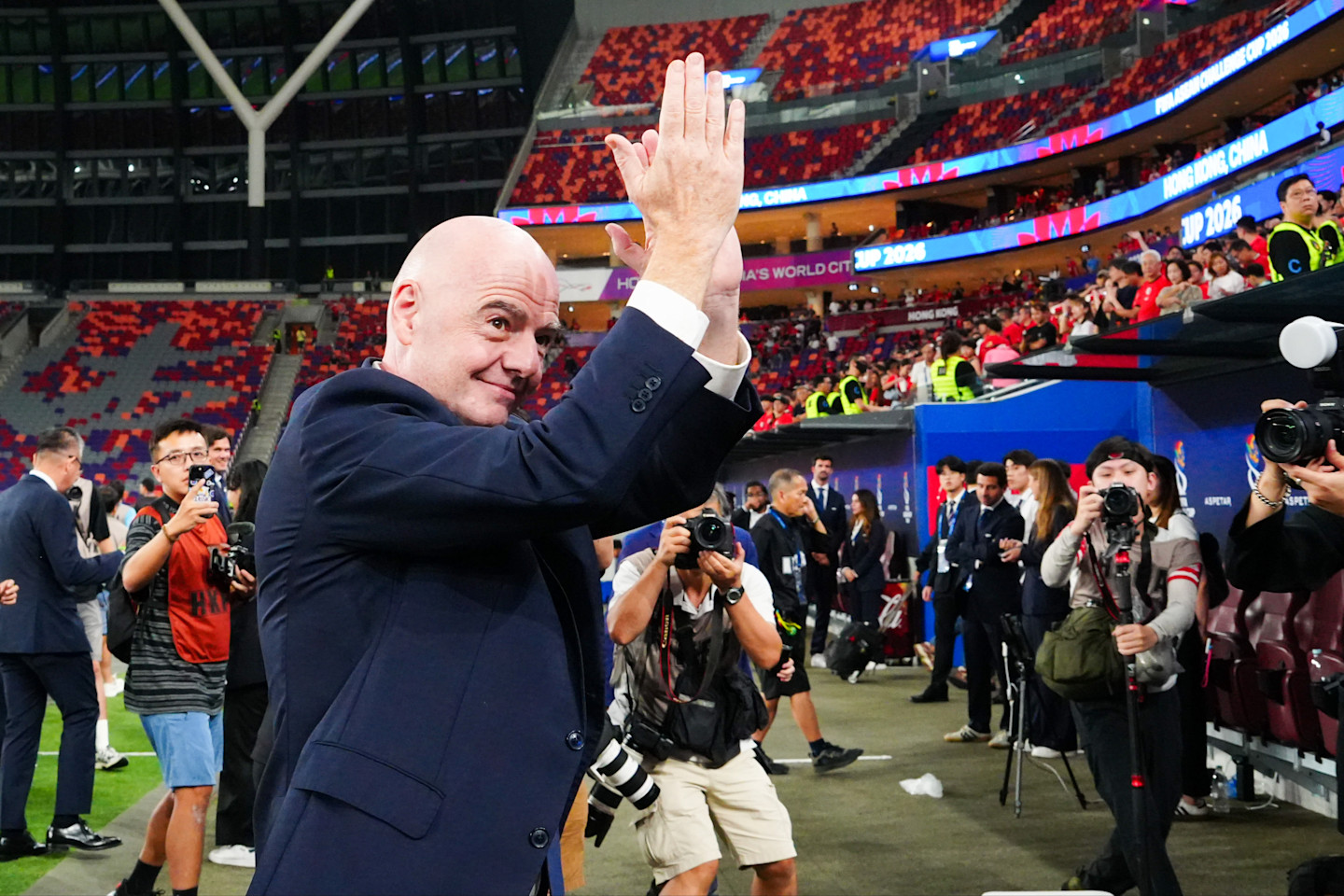
Gianni Infantino looks the perfect villain. There’s the egg-like dome, the unflagging grin, often directed at Donald Trump, and the uncomfortable match of tailor-made suit with white trainers. The Swiss son of a railway station worker spent this summer’s World Cup flying around North America on a Qatar-owned jet, attending 44 games in 39 days. Each time he appeared on the stadium video screen, spectators jeered — partly because he had jacked up the prices of many tickets to thousands of dollars each.
Will Infantino survive as Fifa president?
Back then, Fifa’s president with his $6mn pay package seemed impregnable, heading for his third straight unopposed re-election next year. But he hit a crisis in late July, when his plan to sell a stake in the World Cup leaked. Fans were repulsed. The European, Asian and North and Central American confederations called for his ousting. Former Swiss footballer Ramon Vega said this week he will run against Infantino in March’s presidential elections. Stronger candidates are expected to declare before the deadline of November 18.
Yet Infantino will probably survive. In fact, he might be exactly the Fifa president that most of the world’s football associations want.
Infantino was born in Brig in the Swiss Alps in 1970. In his own telling, he had jaundice as a baby and needed a blood infusion to survive. After the Red Cross scoured Europe for two matching donors, a helicopter delivered the life-saving fluid to Brig’s hospital. Infantino says the story made the front page of the Swiss tabloid Blick.
That’s his self-image: a born fighter. He’s certainly a self-made man. Brig lies just across the border from Italy, in the canton of Valais, and his parents were poor Italian immigrants. Vincenzo and Maria each at different times ran a kiosk at Brig station, with Gianni sometimes in tow. In 2022, in his notorious “Today I feel . . . ” speech, delivered just before Qatar’s World Cup, Infantino said he could feel Qatari, African, a migrant worker, gay, female and more “because I know what it means to be discriminated . . . at school, I was bullied because I had red hair and freckles . . . Plus I was Italian, so imagine.”
He loved football, and ran a team for Brig’s Italians, but played the game poorly. His sister Daniela recalled, “He once said he had two left feet.” His only assets were brains and ambition. He excelled at school, was a gifted linguist even by Swiss standards, and studied law.
He began working for Europe’s association Uefa in 2000. Both Uefa and Fifa are headquartered in Switzerland, and recruit from a caste of hardworking, efficient, multilingual Swiss bureaucrats. Infantino rose to be Uefa’s general secretary — football’s traditional role for the person who does the work while the president, in this case the Frenchman Michel Platini, glad-hands with A-listers. Another workaholic from the Valais, Sepp Blatter, was Fifa’s general secretary before becoming president in 1998.
The Swiss news magazine Republik interviewed 84 people who knew Infantino, and reported: “Something we kept hearing: . . . Infantino pushes himself to the foreground out of a need for social revenge, which is why he seeks proximity to rich and well-known people.” Miguel Maduro, hired by Infantino to chair Fifa’s governance committee in 2016 but soon sacked with other ethics officials when the president’s reformism waned, found him “smart but so eager to impress that I detected a certain level of insecurity”.
When Blatter’s reign collapsed in 2015 amid corruption scandals and FBI raids, Platini prepared to take over. Then scandal felled him too. A desperate Uefa anointed Infantino as its candidate. As ever, he was underestimated. But in his speech at the crucial Fifa congress in 2016, switching between six languages, he promised reforms of the rotten organisation, and spoke the winning line, “The money of Fifa is your money! It’s not the money of the Fifa president. It’s your money.” Delegates from around the world gave him an ovation.
Infantino understood the central fact about Fifa: it’s a patronage system. Almost all its income comes from one source: the men’s World Cup, started by Fifa in 1930. That income is divided among the 211 national football federations. Each member association, regardless of size, was entitled to up to $9.2mn over the four-year cycle up to 2026.
The system fails India, the country where football has most scope to grow, while overfunding the Caribbean island of Montserrat (population 4,300). Nicholas McGeehan, director of the campaign group FairSquare, says, “I’ve spoken to a couple of people in development and told them the model, and they don’t believe you when you tell them how it works.” The model makes no sense as a way to develop football. But it makes perfect sense as a way for Fifa’s incumbent president to please poor federations, especially as Montserrat has one vote in Fifa’s council, the same as India.
Most national federations live off Fifa’s funding. Infantino, justifying the unprecedented ticket prices at the last World Cup, said, “Without Fifa, there would be no football in 150 countries.” Some federation presidents use Fifa’s funds to maintain fields or train referees. Others pocket the money themselves.
Infantino’s Fifa sometimes punishes corruption. For instance, last month it slapped a life ban on Vincent Cassell, longtime president of Montserrat’s federation, for “abuse of position, systemic conflicts of interest” and misuse of Fifa’s funds. Fifa’s then ethics committee had first prosecuted him in 2011.
The problem is that it punishes selectively and untransparently, says Maduro. The ethics committee sometimes buries cases without explanation. Federation presidents who run into legal trouble in their own countries are often not sanctioned by Fifa. It’s usually unknown whether Fifa even investigates them, as the ethics committee is not obliged to disclose its doings. Maduro says, “The rules are not enforced equally. It is a system of rules without the rule of law.”
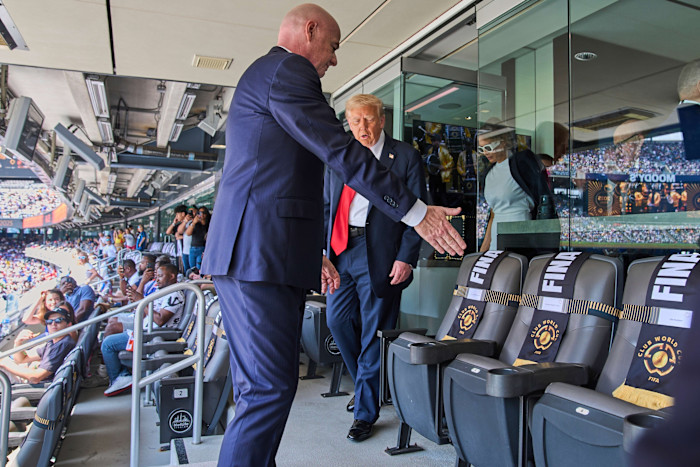
The same goes for disciplinary cases against players. Cristiano Ronaldo was initially banned for Portugal’s first two games of the World Cup after receiving a red card in qualifying. Fifa rescinded the suspension. Notoriously, it did likewise for the US striker Folarin Balogun, after Trump phoned Infantino with the request.
In short, Infantino operates like a typical 21st-century autocrat: growing rich from what should be a position of public service, winning serial elections unopposed and ruling almost solo. The best way to find out Fifa’s policies is to follow his personal Instagram account. Fifa’s congresses typically rubber-stamp his decisions, with most votes nearly unanimous, says Alex Phillips, longtime former official of Fifa, Uefa and, until recently, secretary-general of the footballers’ trade union Fifpro. “And the four that vote against, it’s normally because they pressed the wrong button on the electronic voting thing.”
Infantino held no press conferences between 2023 and 2026, and recently responded to a journalist’s factual query with the text message: “Fuck off mate”. Like other autocrats, he stretches term limits. Fifa’s presidents are only supposed to serve three terms, but he’s now running for an apparent fourth. He said his first term from 2016 didn’t count, as he was completing Blatter’s truncated final term.
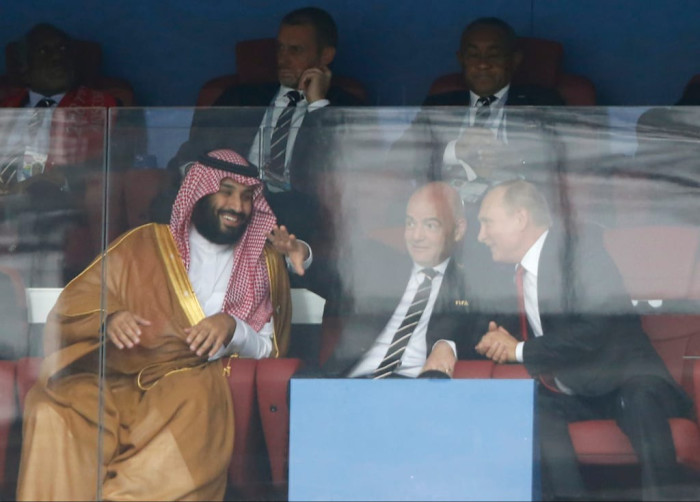
No wonder he seems happiest among fellow strongmen. An enduring image of the Infantino era is of him joking in a VIP box in Moscow with Vladimir Putin and Saudi crown prince Mohammed bin Salman at Russia vs Saudi Arabia, the opening match of the 2018 World Cup. When Putin awarded him Russia’s Order of Friendship a year later, Infantino called it “an incredible, unbelievable honour”.
Infantino, like his predecessor, is an eternal Swiss type: the hotel concierge, “der Portier” in German, friendly, multilingual and unideological. He always remembers his guests’ names. Above all, living in a country where money flows through, der Portier knows which of them can afford the hotel bills: in the 19th century the British, later the Americans, then Russians, and currently Gulf Arabs. While their money lasts, no matter where they got it, der Portier treats them with respect.
Infantino relentlessly defended Qatar when it hosted the 2022 World Cup, then orchestrated the controversial award of the 2034 event to Saudi Arabia. The presidents of national federations who notionally choose the host joined by video link. When the unopposed Saudi bid was announced, they approved the decision by applauding with their microphones turned off. “The video wall clapped in silence,” wrote James Montague in Engulfed: How Saudi Arabia Bought Sport, and the World. Lise Klaveness, president of Norway’s federation and Infantino’s most outspoken opponent inside football, notes: “We didn’t clap.”
After Infantino invented a “Fifa Peace Prize” and awarded it to Trump at last year’s World Cup draw, apparently breaching the organisation’s duty of political neutrality, Norway backed FairSquare’s request to Fifa’s ethics committee to investigate the matter. The committee’s instant reply, says Klaveness, was, “We will not give you any information.” In a system of selective justice, the leader can break the rules.
Despite it all, by mid-July about 200 national federations had endorsed Infantino’s re-election. Under personalised rule, everyone seeks the leader’s favour, hoping that he will give them goodies (such as the right to host tournaments). His grip on power seemed absolute.
Everything changed when news broke of his plan to sell a 20 per cent stake in the tournament for $4.2bn to investors led by Joshua Kushner, brother of Trump’s son-in-law Jared. Infantino gave national federations just 53 days to weigh the offer, promising them an immediate sweetener if they accepted it: $20mn each. That’s nearly a quarter of Montserrat’s GDP.
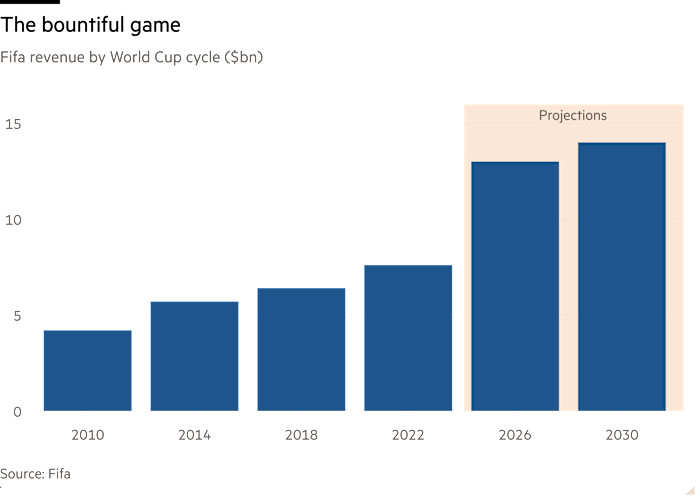
The outrage inside football was fourfold. First, many consider the World Cup a sacred event, which should be above commerce. Second, Infantino didn’t seem to have asked anyone else’s opinion or sought rival offers. Third, Fifa, a non-profit with $6bn in cash reserves, didn’t need the money. Last, the price seemed remarkably low. The proposed sale valued the most popular tournament in sports at $20bn — only $5bn more than revenues for the last World Cup cycle.
Infantino had over-reached. Finally, his opponents dared to act. Uefa led the charge, declaring, “The World Cup is not for sale.” European federations said they would boycott Fifa’s tournaments until he withdrew the plan. He did, almost immediately. Emotionally, it felt like global football’s long-awaited revolution. And yet the king is expected to survive.
That might surprise fans, especially those from wealthy European football economies. But fans aren’t represented on Fifa’s council. Nor are players, coaches or referees. To understand Infantino’s support, it’s essential to view him from the perspective of the bulk of Fifa’s electorate: presidents of football federations in places that barely have a football economy. Many of them think he’s doing a good job.
For a start, his energy is rare in a sport where decision makers often owe their positions to family or political connections. He’s a president who works like a general secretary. Blatter had kept a bed beside his presidential office; Infantino replaced it with exercise machines. His jetting around the World Cup might have struck fans as entitled. To football officials, it looked vigorous.
He has grown global football, expanding the Club World Cup with Saudi funding, as well as the men’s and women’s World Cups. Westerners in particular opposed the expansion of the men’s tournament from 32 teams to 48. But this summer’s edition was a success, and the 2030 World Cup will probably feature 64 teams. That means more income, and more spots for small nations. Cannily, Infantino has also multiplied the number of committees inside Fifa. Federation presidents with committee roles enjoy lavish per diems, luxury hotels, selfie opportunities with ex-footballing greats, and the chance to oversee, say, the Beach Soccer World Cup in Seychelles while general secretaries and volunteers do the actual work.
Fans hated the World Cup’s high ticket prices, and the “hydration breaks” that interrupted games so that TV broadcasters could show more ads. But federations appreciate the extra money. Infantino’s biggest critics tend to be countries — notably England, Germany and the Nordics — that have enough.
Their criticisms also carry whiffs of entitlement and hypocrisy. Take Uefa’s sonorous statement opposing the Kushner deal: “The World Cup cannot be treated as an investment product . . . Football’s future cannot be dictated by the expectations of those whose first duty is to maximise financial return.” Well, most big European football clubs are treated as investment products, bought and sold by owners hoping to maximise financial return. Uefa ruthlessly monetises its Champions League. Why shouldn’t the World Cup offer poor countries some financial return?
Nor can Uefa easily paint Infantino as an unaccountable autocrat when the confederation’s own president, Aleksander Čeferin, who likes to be called “President Čeferin”, had his term limits waived. As for the English, well, their Premier League is now mired in its own scandal after Manchester City, dominant team of the past 15 years, was found to have dodged financial rules by artificially inflating its revenues by over £900mn.
Many westerners believe that autocracies such as Russia, Qatar and Saudi Arabia shouldn’t host World Cups. But many in the global south think that’s because the west still feels it owns the tournament. Infantino, though European himself, fights the anti-European culture war. He moved to Qatar before its World Cup, and defended the monarchy against western criticisms: “I think for what we Europeans have been doing for 3,000 years around the world, we should be apologising for the next 3,000 years.” He has even acquired a smidgen of Arab identity, taking Lebanese citizenship through his wife Lina.
Many outside Europe welcome the rise of football’s new power brokers, Qatar and Saudi Arabia. The duo help fund the game, partly through the sponsors Qatar Airways and Saudi Aramco. And Trump’s circle produced the financier who backed Infantino’s latest moneymaking scheme. Few federation presidents know or care that it undervalued the World Cup. If Infantino launched the scheme without consultation, well, most of their countries (and football associations) are autocracies too.
Infantino is likely to win re-election. The European, Asian and North and Central American confederations officially oppose him, but some of their members have publicly broken ranks. Mexico, for instance, is backing him. Admittedly, his supporters are fickle. Phillips says: “They don’t particularly like Infantino as a person. I was in Vancouver at the Congress [in April] when he said, ‘I’m standing as a candidate next year,’ expecting the whole room to rise in unison. There was some Fifa guy telling the [ex-footballer] ‘Legends’ at the front to stand. But I look round to the rest of the hall, and there were, like, 15 people standing. He was visibly shocked.”
Qatar and Saudi Arabia remain in his corner. Each helps fund dozens of poor federations, and influences their votes. Qatar came out for him almost immediately after the scandal broke, while the 22-member Union of Arab Football Associations, run by Saudi Prince Abdulaziz bin Turki al-Faisal, last week “reaffirmed” its support for Infantino. Still, Stanis Elsborg of Play the Game, an initiative run by the Danish Institute for Sports Studies, says of the Gulf states: “If they at some point can count to 106 [votes] without Infantino, I don’t think their loyalty is so much with him.”
Even if he loses, few believe that his successor would reform Fifa’s decades-old patronage system. Norway this week filed complaints about Infantino’s conduct to two Fifa committees. But Klaveness says, “If you go to election now and say to Montserrat or whoever, ‘I don’t want to give you any money,’ why would they vote for you? I think that will be the logic of any new president, that you have to distribute equally.” Uefa says every federation should immediately be paid $10mn from Fifa’s reserves. Infantino has cleverly co-opted the proposal.
Some critics of Fifa hope that pressure for reform will come from European countries. They are football’s kingpins, winners of five of the last six World Cups. Europe generates 70 per cent of the global football economy, notes Infantino. The Europeans abandoned their threat to boycott Fifa competitions after he dropped the Kushner plan. However, if European associations refused to play these competitions until he left or Fifa was reformed, the rest of the world would have to listen.
But the Europeans won’t walk out. Corruption in Fifa is at least 50 years old, and the European hypothesis has been on the table since the early 2000s, yet Europe has never boycotted a tournament. There is only one World Cup, it’s the biggest prize in football, nearly a century old, and Fifa owns it.
Even if several European countries set up rival men’s and women’s “World Cups”, these would never have the status of the original. The main effect would be to damage football’s best competition. Most European fans and players would be unhappy. In football and elsewhere, Europeans have repeatedly been unwilling to make sacrifices for their supposed principles.
Infantino is flying around the world on a jet provided by Qatar Airways, wooing federation presidents and touting reforms of Fifa’s governance. He’s a redoubtable fighter. Phillips says: “He’s probably the person who wants to be the Fifa president more than anybody else in the whole world.”
Simon Kuper is the author of ‘World Cup Fever: A Footballing Journey in Nine Tournaments’
Find out about our latest stories first — follow FT Weekend on Instagram, Bluesky and X, and sign up to receive the FT Weekend newsletter every Saturday morning