In a year of global bond market turbulence, France is in the hot seat.
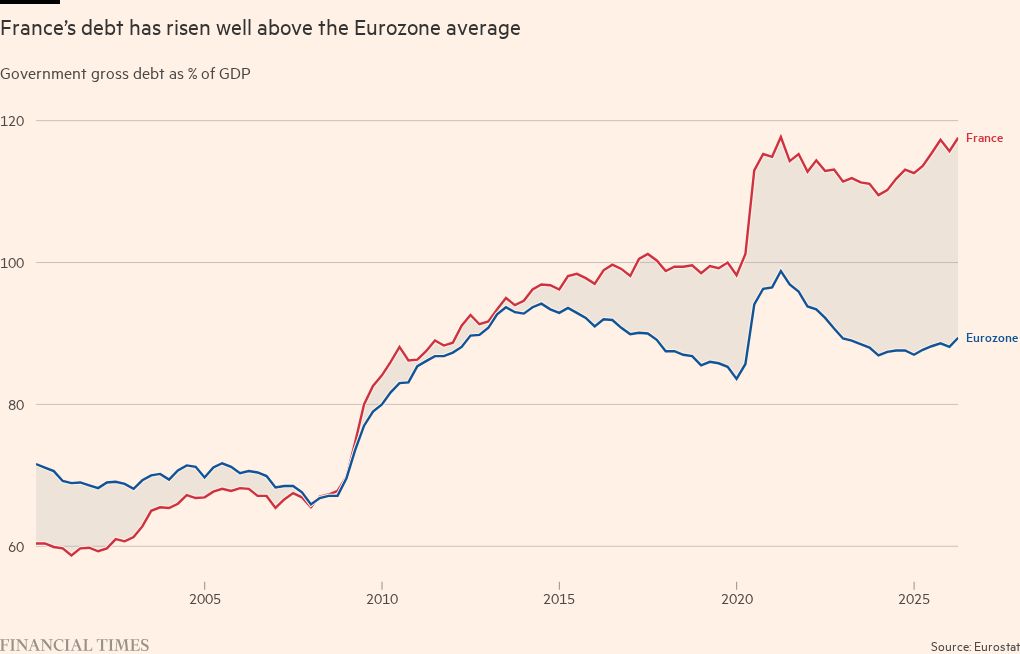
Like other Eurozone members, the country is facing higher energy prices and tighter monetary policy. But France’s debt is high; it is rising faster than in most other Eurozone countries and its unruly politics are complicating the path to fiscal consolidation. In the past few weeks, this has fuelled a sharp sell-off in French debt.
Speculation about a potential European Central Bank intervention in the markets is premature for now. Rate-setters have signalled that the moves in French bonds are warranted. In the absence of signs of contagion or disorderly markets, the bar for them to change their mind is very high.
After next year’s presidential election, France’s fiscal stand-off with the markets might transform from being a chronic weakness to something more acute. The question of whether and when the ECB’s “transmission protection instrument” should be deployed is therefore likely to become a live issue for the bank’s next president, even if it isn’t right now.
What are the political hurdles to France’s fiscal consolidation?
The first pressure point will be whether the government will be able to pass next year’s budget. France has been in breach of the European Commission’s fiscal rules since 2024. In 2026, the government expects the budget deficit to hit 5.4 per cent of GDP, well above the Commission’s 3 per cent threshold.
Last Thursday, the government presented a draft bill envisioning a deficit of 5 per cent of GDP for next year. The bill needs to survive the legislative process, but Prime Minister Sébastien Lecornu does not have a parliamentary majority, so any attempt to put it through a standard vote would be very likely to fail.
The government could force the budget through without a vote using a constitutional provision known as Article 49.3 or via a procedure known as “ordinance” which would bypass parliament entirely, though there are legal risks around its use.
Following this year’s Budget debate, the fiscal hurdles facing France will keep coming. In April 2027, the country will elect its next president and the prospect of a win by a populist candidate is rattling investors’ confidence in the country’s longer-term prospects.
The current frontrunner in the polls is the far-right Rassemblement National, with far-left La France Insoumise and centrist candidates polling a distant second.
On Tuesday, RN leader Marine Le Pen announced that if elected, she would support a referendum on the introduction of fiscal rules mandating an annual reduction of the deficit below the debt-stabilising level, implying cuts of about 0.5 per cent of GDP each year for the next five years and a debt target of 60 per cent of GDP.
The party also presented a large-scale package of spending cuts. Charlotte de Montpellier, senior France economist at ING, said: “While it is encouraging that Le Pen has recognised the need for fiscal restraint, the current plans are not credible and some of them are not legal.”
France’s centrist candidates are also running on a platform of fiscal sustainability, with former prime minister Édouard Philippe proposing raising the pension age further than President Emmanuel Macron’s thwarted plans envisaged. The problem for recent ministers, according to Michel Nies, Europe economist at Citibank, was that, “having governed for the past decade and repeatedly failed to cut borrowing, their credibility is low”.
Meanwhile, far-left candidate Jean-Luc Mélenchon has called for the cancellation of France’s debt held by the ECB and rejected the principle of a fiscal rule. He is unlikely to win France’s two-round presidential election process, but his contributions to the debate add to the sense that the country is reluctant to get borrowing under control.
There is yet more political risk in the picture. Given the current parliamentary gridlock, the winner of April’s presidential contest is expected to dissolve parliament and call fresh elections. If the new government does not get a majority, it will raise the prospect of yet another fiscal stalemate — which could go on for years.
How have markets responded so far?
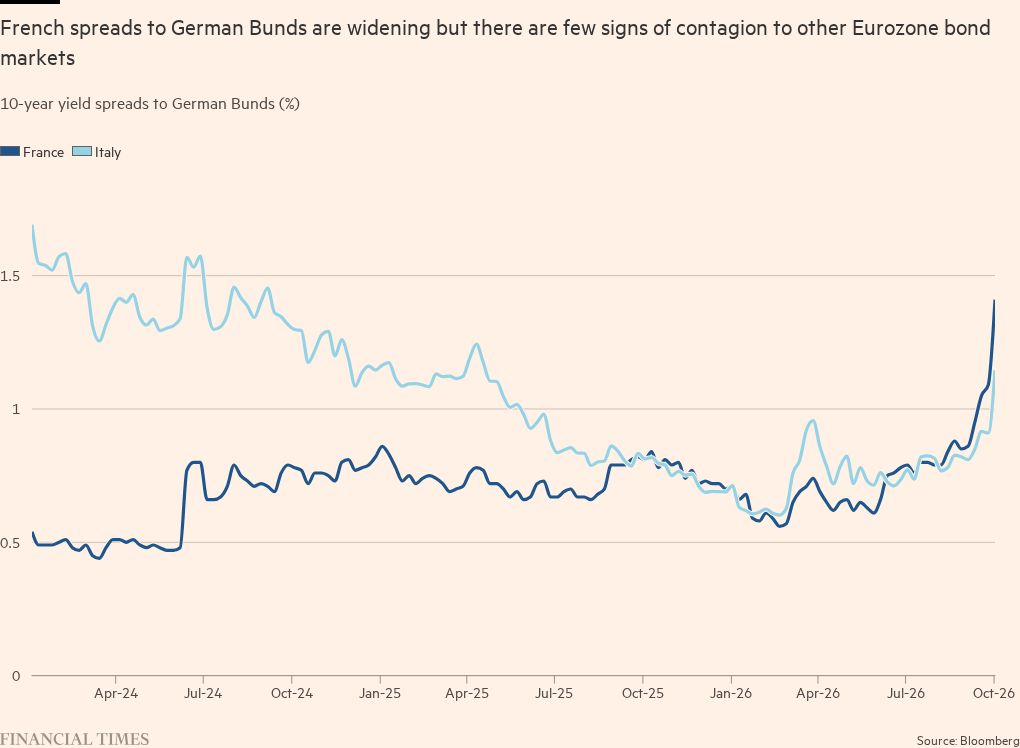
French bond yields have risen sharply in the past few weeks and the spread between the French 10-year yield and maturity-equivalent German Bunds last week reached its highest level since late 2011.
But these are not crisis levels. French spreads are below the levels seen in Italy only about two years ago. And the spread between Italian and German bonds has also risen visibly since the summer.
What will the ECB do about it?
The surge in French yields is tightening financial conditions in the country, so one argument is for the ECB to keep monetary policy looser than otherwise at the margin. But with yields in other Eurozone countries contained and the euro’s recent decline against the dollar, the case for a monetary adjustment is weak. The ECB will set interest rates with an eye to its price-stability mandate and the impact of its rate path on France’s public finances will not be a consideration.
Another option is for the ECB to halt quantitative tightening and hold the balance sheet at its current size by offsetting the roll-off of maturing bonds with new purchases. Between December 2025 and June 2026, the average monthly roll-off of French bonds amounted to about €10bn a month, according to Banque de France estimates.
“The biggest problem with this proposal is the optics. Amending QT in the midst of this bond sell-off would look suspiciously like fiscal dominance,” said Nies.
The ECB’s ultimate tool to protect the Eurozone against fragmentation risks is the transmission protection instrument, which has never been used. It allows the central bank to make unlimited purchases from member countries experiencing unwarranted and “disorderly” sell-offs in their sovereign paper.
It would be a big step to activate the TPI and France does not at present meet the criteria that the ECB has outlined as key “inputs” for it to be deployed. Eligible countries must not be on the Commission’s excessive deficit procedure and it must have a favourable opinion of their fiscal trajectory. Neither of these criteria at present applies to France, which was judged earlier this year to face “high fiscal sustainability risks in the medium term”.
With these conditions unlikely to change soon, the TPI would be difficult to implement in its current form and almost impossible to administer if the French political system could not implement a credible fiscal tightening programme. This makes life easy for the ECB. It will simply refuse to help.
But if France can persuade the Commission that the fiscal trajectory is improving, the next ECB president is likely to face a more challenging set of circumstances in which it might improve the entire transmission of monetary policy to the Eurozone economy if it made an intervention.
For this, the ECB needs to think now about when and under what circumstances it should intervene. The time for contingency planning has arrived.