
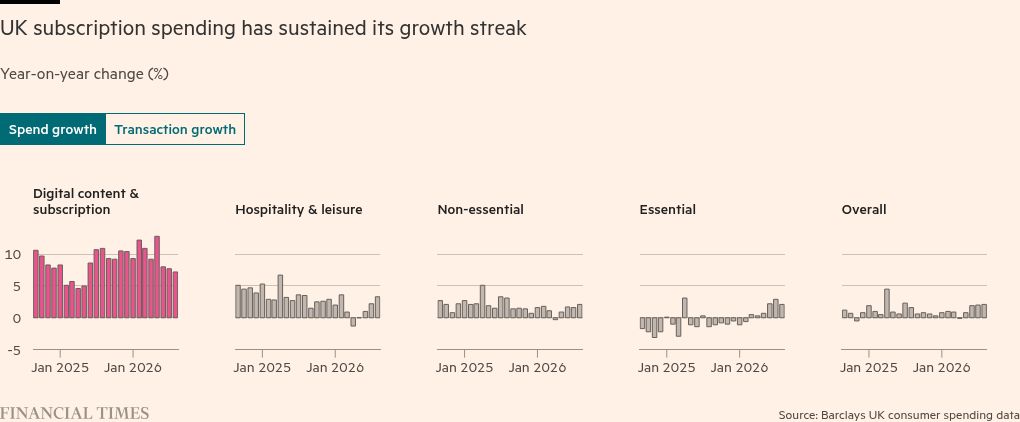
Monthly spending by UK consumers on subscription-based goods and services has grown by an average of 9 per cent a year in the past three years, rapidly outpacing sluggish spending in other areas, data shared with FT Money has shown.
UK payments data from Barclays indicated the compound annual growth rate of subscription spending since August 2023 was five and a half times the 1.6 per cent growth in overall consumer spending.
The growth in subscription spending consistently outpaced the growth in spending on essential goods and services, such as fuel, groceries, childcare and education (up 0.75 per cent per year over the period) and non-essential goods, such as entertainment or beauty products (up 2 per cent per year).
Jessica Gardner, a partner at law firm Fieldfisher, said the data suggests subscriptions are increasingly treated as recurring household commitments rather than discretionary purchases.
Consumers may be retaining existing subscriptions even as they cut back elsewhere, taking out additional subscriptions or migrating to higher-tier or bundled offerings, Gardner said.
Since the growth in subscription transactions (5.1 per cent a year) is slower than the spend, this implies the average value of each subscription transaction is rising, she said.
“This may reflect price inflation or price increases by providers, but it could equally be the result of consumers upgrading to premium services, purchasing higher-value packages or shifting towards more expensive subscription offerings,” Gardner added.
Separate figures from HSBC indicated that spending on health technology subscriptions, spanning smart ring technology such as Oura and wrist wearables, had shown particularly rapid growth from a low base, nearly quadrupling between 2023 and 2025.
Spending on health technology subscriptions grew from £28mn in 2023 to £106mn in 2025, while spending on dating apps and meal-in-a-box subscriptions fell.
David Maddison, HSBC UK’s senior director of retail and leisure, said the health and wellness spending was particularly interesting. “That’s something people have taken extremely seriously post-Covid.”
Spending on pet food subscriptions rose by 36.5 per cent between 2023 and 2025, according to HSBC, from £307mn to £419mn.
However, Maddison noted that some other subscription businesses had either “matured or fallen out of favour” post-Covid.
The meal-in-a-box market — the only sector included in HSBC’s data to have exceeded £1bn — declined from £1.1bn in 2023 to £1bn in 2025.
Spending on dating apps fell to £22mn in 2025 from £30mn in 2023.
Charlie Casey, chief executive of LoyaltyLion, a customer loyalty and engagement platform, said businesses were “increasingly focused on lifetime value and repeat purchasing”, rather than treating every sale as an isolated transaction.
“We’re also seeing the lines between subscriptions, memberships and loyalty programmes blur,” Casey added.
There are an estimated 155mn active subscriptions in the UK, representing around £26bn of consumer spending each year, according to government figures. It estimates that £1.6bn is spent on “unwanted” subscriptions annually in the UK, with new rules for consumer subscription contracts expected to come into force in January next year.
The new regime is intended to address so-called “subscription traps” through enhanced transparency requirements, renewal reminders, cooling-off rights and simpler cancellation processes, Gardner said.
“As the new regime beds in, businesses may start to place greater emphasis on customer retention through product differentiation, service quality and demonstrable value. This may encourage greater use of bundles, loyalty incentives, annual plans and premium tiers.”