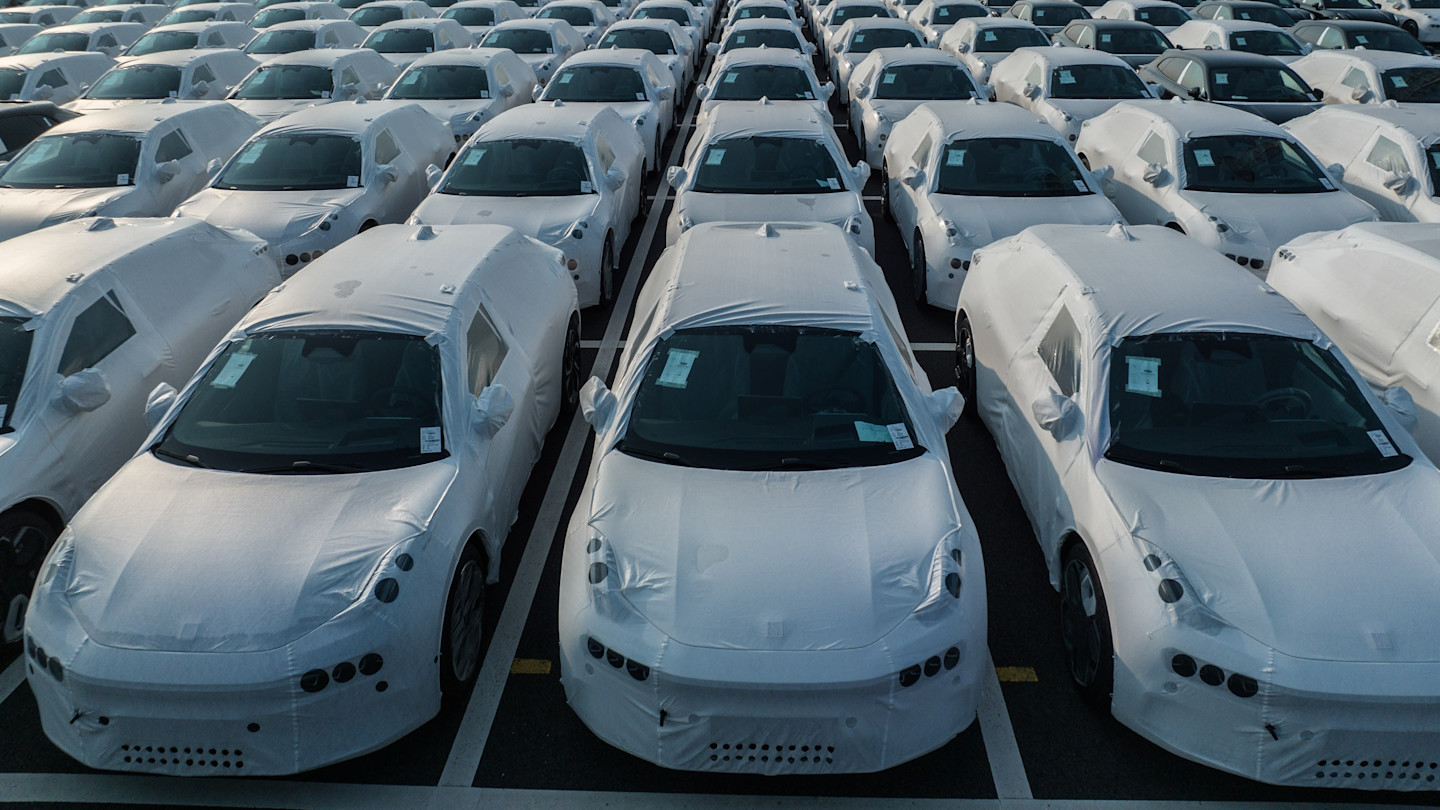
The EU will impose a quota on imports of hybrid cars from China with Beijing’s tacit agreement as part of an “understanding” achieved by the two sides that averted a full-scale trade conflict.
Three people briefed on the deal sealed on Friday said that, if member states approve it, the EU would deploy a trade “safeguard”, a measure that can be applied without evidence of market abuse and would mean China could only export a limited number of vehicles.
China would accept an agreed quota under the measure and would not retaliate against EU imports because of it, the people said.
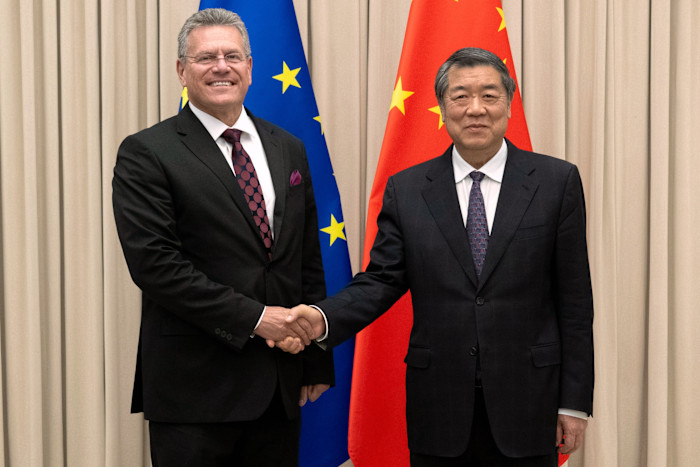
Announcing the deal in Beijing, EU trade commissioner Maroš Šefčovič said China had agreed to restrict its hybrid exports under what the two sides called the “understanding” reached during two days of high-stakes negotiations.
The FT reported before last week’s talks that Šefčovič was seeking a deal based on safeguard measures after China rejected a proposal that it voluntarily limit hybrid vehicle exports to about 15 per cent of the EU market — down from about a third now.
Šefčovič said on Friday the agreement would more than halve projected exports over the next four years, reducing the number of hybrids shipped by China by “several millions”. On the current trajectory, Chinese exports to the EU would hit 800,000 this year.
In 2027 alone, the deal would reduce imports by between 500,000 and 700,000 vehicles, cutting the EU’s expected trade deficit by between €10bn and €14bn, according to an EU official.
The 2027 annual quota was expected to be initially about 350,000 vehicles, increasing by 6 per cent a year for the following three years, the official said.
The EU’s trade deficit in goods with China hit €360bn in 2025 and has increased since. In the second quarter of 2026, it was €103bn, up from €93bn in the same period last year. Vehicles and machinery were the biggest contributors.
Šefčovič said Friday’s deal would be a “blueprint for the next phase” of talks and had proved negotiations with China could bring results.
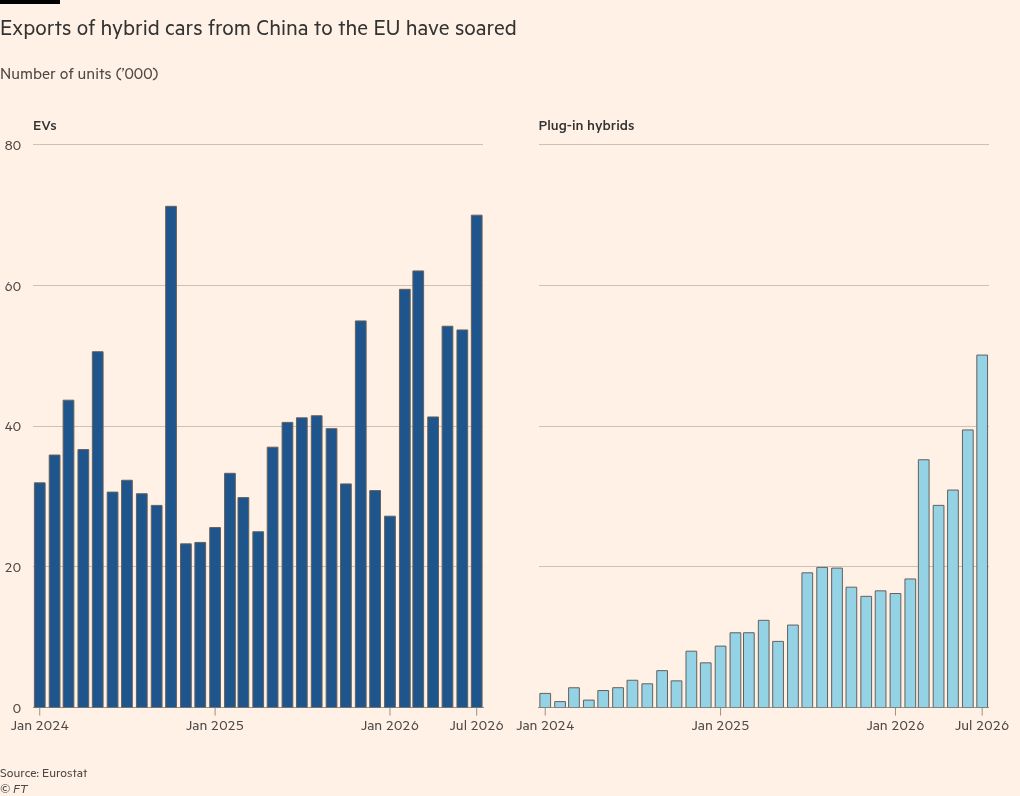
Hybrid car imports have been on course to hit about 800,000 units this year, up from 300,000 in 2025.
China’s commerce ministry said on Monday that the deal ensured “export space and stable growth for Chinese companies” while “addressing the realistic concerns” of its industry and those of the EU.
It said the agreement also did not discriminate against Chinese products or companies. “China’s quota will not be lower than that of any other import source for the EU,” the ministry said.
It added: “China reserves all rights to resort to dispute settlement and demand trade compensation within the WTO framework.”
The European Automobile Manufacturers’ Association (Acea) has welcomed the deal. Sigrid de Vries, Acea director-general, said it could “help facilitate the transition to a new era of Chinese presence in the European market in an orderly way and this is in the long-term interests of all parties”.
“The sudden and rapid rise in imports of plug-in hybrid electric vehicles and hybrid electric vehicles from China is having a destabilising effect on the European car market,” the lobby group said.
The share of the EU market for plug-in hybrid electric vehicles controlled by Chinese imports rose to 25 per cent in the first half of this year and for other hybrid electric vehicles to 14 per cent, both up from 2 per cent in 2024.
Chinese official media praised the deal, with the Communist Party’s Global Times tabloid hailing it in an editorial as “a pragmatic step to properly handle bilateral differences” achieved “against the backdrop of a sluggish global economic recovery and undercurrents of anti-globalisation”.
The talks in Beijing showed the EU and China had the “wisdom” to manage differences and prevent escalation, state news agency Xinhua said.
However, Europe’s chemical industry, which has filed a record number of trade complaints against China this year, said the deal “should be the first step towards broader and lasting relief for the sectors facing the greatest pressure”.
“Europe’s China challenge is far from solved. The chemical sector needs urgent breathing space. In 10 years, our chemical trade balance alone with China has swung from a small surplus to a deficit of more than €15bn in 2025,” industry lobby group Cefic said.
Many analysts say that when EU leaders gather in Brussels for a summit this week, they would be unwise to reduce pressure on China based on just one sectoral deal.
Several member states have been calling for tariffs on more Chinese products. And before Šefčovič’s visit to Beijing, France and Germany produced a joint paper urging a new “last resort” defence tool that would cut market access entirely for some Chinese trade to deter retaliation.
They claim China has subsidised industries and is over-exporting to compensate for sluggish domestic demand — accusations Beijing vigorously contests.
Michael Pettis, a senior fellow at the Carnegie Endowment for International Peace, said the EU’s difficulty with Chinese imports was a “systemic one and not sectoral”. The agreement did not address China’s demand imbalances arising from its weak domestic economy that was leading it to tap export markets for its factories, Pettis wrote on X.
The European Policy Centre think-tank has urged EU leaders not to relax.
“Unless the European Council uses this reprieve to set a timetable for rebalancing and corrective action, this will be a tactical win for Beijing,” wrote the centre’s Georg Riekeles and Ian Hernandez in a blog post.
“Nothing announced so far changes the fundamental imbalance,” they wrote. “Beijing has turned down the heat just enough to keep Europe in the pot. But the frog is still boiling.”
Data visualisation by Anna Marie Alcantara