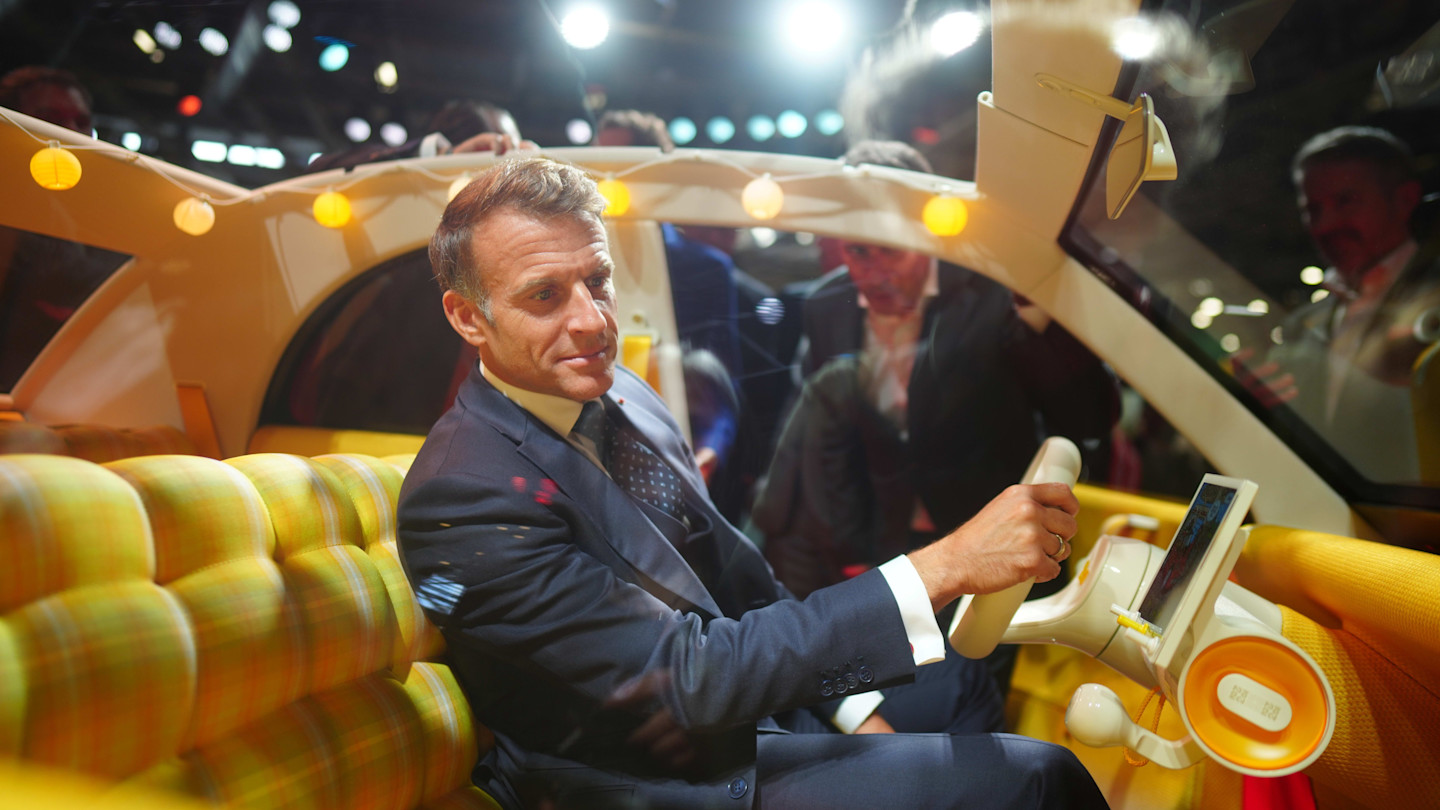
France and Germany are set to announce a grand bargain that would push back Europe’s phaseout of combustion engines and boost car production on the continent, as the EU’s leading economies aim to bolster their embattled car industries from Chinese competition.
French President Emmanuel Macron said a deal on EU car policy was “imminent” at an industry showcase in Paris, adding: “We are finalising an agreement with our German partners so that Europe can advance, in order to better protect our industry and to keep our objectives of decarbonisation, increase our competitiveness and reinforce our sovereignty.”
Paris and Berlin have been in discussions since this summer to agree a compromise on laws relating to the phaseout of combustion engines and new Made in Europe requirements that would reserve public contracts and subsidies for cars, parts and batteries made in the bloc.
Macron said: “I will not give the terms of an agreement before it is finalised but I am simply telling you that it’s a question of, I hope, hours and if not hours, days.”
Several EU laws are being negotiated in Brussels, designed to protect European carmakers from fierce competition in China but also to give domestic manufacturers more leeway to continue to sell combustion engines for longer. One official said an agreement was required on the entire package of rules to advance blocked negotiations on the files.
The expected agreement, which would still need ratification by other EU member states and the European parliament, would dilute Europe’s climate ambitions even further and rile trade partners such as the UK and Japan, which could be excluded from the Made in Europe scheme.
Germany has been seeking to water down 2030 emissions targets for carmakers, although one person familiar with discussions cautioned that this element had not yet been agreed. Macron said that the agreement would give Europe a “pragmatic approach on our decarbonisation targets”.
Germany is also expected to secure a further easing of the EU’s 2035 combustion engine ban, allowing combustion-engine vehicles to account for 10 per cent of new car sales, with no requirement that they use low-carbon fuels or materials, two people said.
France, in turn, is set to gain German support for public subsidies and contracts in technologies such as electric vehicles and batteries to be largely restricted to EU-based manufacturers.
Such a deal could prevent UK-made cars from being eligible for the public subsidies, although one of the people said this element was not entirely finalised.
Renault chief executive François Provost told reporters that a deal would probably come this week, after European carmakers met with Macron at the Élysée Palace on Sunday night ahead of the Paris Motor Show, where Chinese brands as well as European ones are showing off their latest models.
“It’s high time to react,” Provost said, pointing to the million jobs dependent on the car sector in France alone. Carmakers were not simply “crying and complaining” but had invested heavily in overhauling their operations to focus on electric cars as demanded by the EU.
Manufacturers such as Renault, the French-Japanese-owned carmaker, and Ford of the US assemble vehicles with a high share of European components in non-EU countries such as Turkey. They have argued that the fine print of Made in Europe rules should allow exceptions for some third countries.
But European car executives, including Volkswagen chief Oliver Blume, have called on Germany and France to reach a deal quickly, warning that the bloc needs to move fast to counter the threat from Chinese competitors.
The deal comes as the EU prepares to impose a quota on imports of hybrid cars from China before steep tariffs come into force. China has hugely increased its exports of the vehicles after its electric cars were subjected to tariffs.
“[This agreement], along with our measures to protect against unfair competition, is what all of our manufacturers legitimately expect,” said Macron.