“Heavens, what have I become?” is the anguished cry of many a movie protagonist. The Damascene moment strikes when an executive returns to her hometown to shut its last remaining factory. Or it afflicts a scientist who has accidentally turned himself into a bluebottle.
My own moment of revelation occurred as I spread out our labradoodle’s Barbour raincoat on the marble kitchen island of our suburban home. As I placidly began re-waxing the garment in preparation for wetter weather, it hit me: at that moment, I might just be the most middle-class person in the UK.
Here in Blighty, “middle class” pejoratively denotes things that are safe, conventional and boring. Reputedly, this status also brings rising overheads. Lifestyle columnists are apt to pen articles bewailing the extortionate cost of prep-school uniforms and Alphonso mangoes.
These pieces always seem sloppy to me. They are often based on the anecdotes of anonymised acquaintances — “Emma, a PR executive”, for example — and sticker shock concerning a few key consumables.
But have you seen the cost of dog coat reconditioning wax these days? This was reason enough to dive into deeper data. There are two questions I hoped to answer: “How much does it cost to be middle class?” and “Has it gone up?”
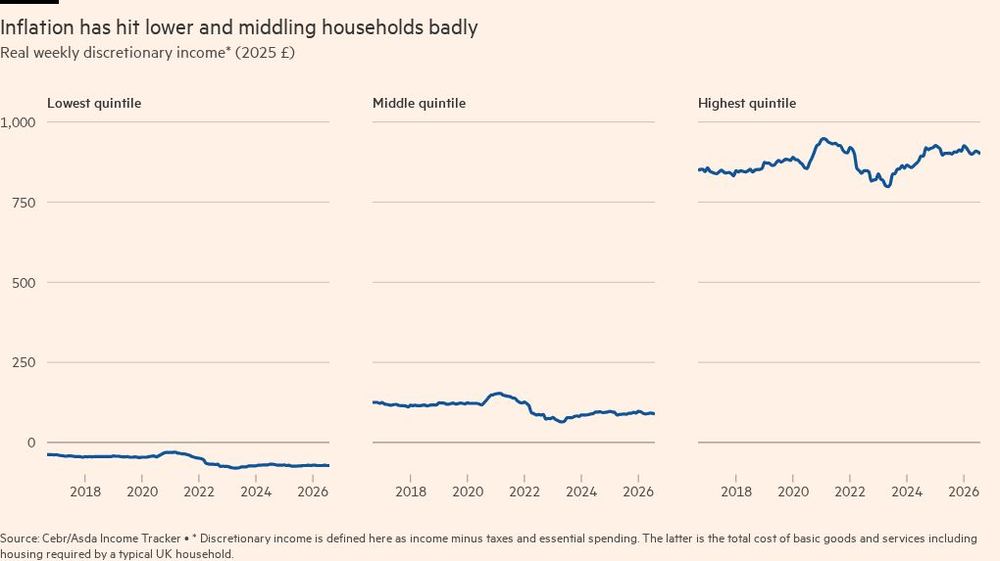
In the UK, “middle class” does not equate neatly with the middle of the spending range. But this is a useful starting point. That middle is nailed down by the Asda Income Tracker, a data series measuring discretionary household spending power calculated for the supermarket chain by the Centre for Economics and Business Research, a consultancy.
“Our modelling suggests there is a drop in the spending power of the middle quintile,” says Sam Miley, CEBR’s head of forecasting. These households have suffered a real-terms cut of around a quarter over the past decade, leaving them with only around £90 of spare cash a week. The top fifth of Britons have 10 times that sum. Their incomes have outstripped inflation.
CEBR calculates its figures by deducting the cost of a standard basket of “essential” goods and services from incomes. I did something similar — though rather more subjective — when I estimated budgets for three invented families.
I varied these to reflect three different levels of capacity and aspiration across 24 spending categories. These line items included things middle-class people are deemed to care about, including larger dwellings, pricier cars, private pensions and independent education.
Base case: £56,000 budget
Mr and Mrs Lowe are in their mid-thirties and live in a three-bed semi in Manchester. One works full time, the other toils half the week, while bearing the brunt of childcare. Their weekly groceries come from Tesco and their clothes from Next.
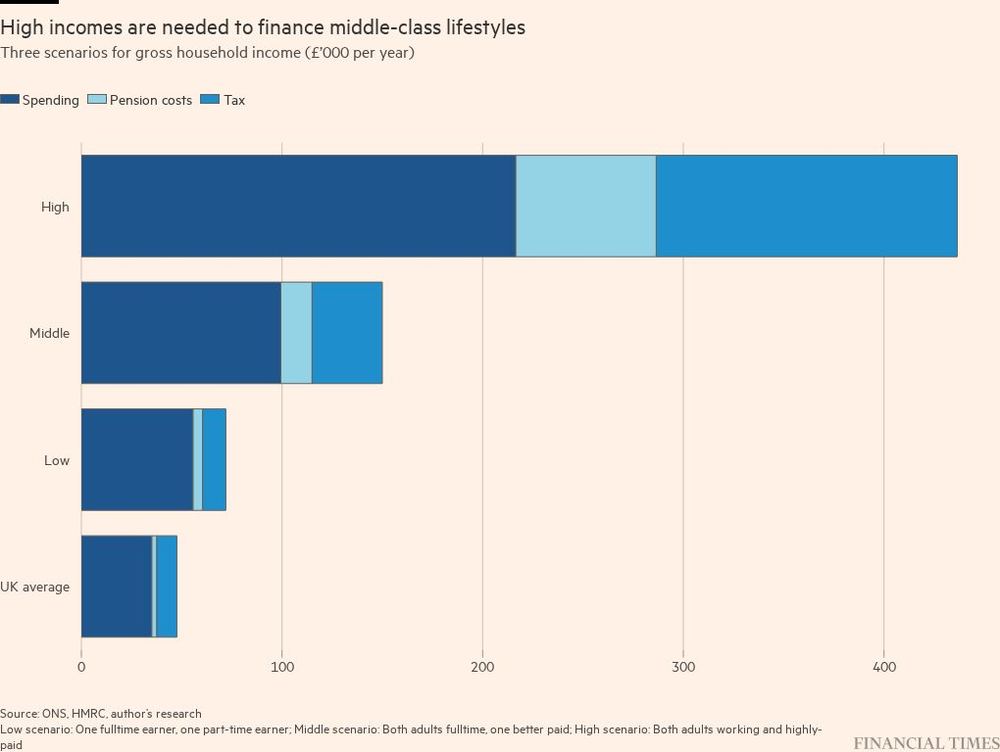
I reckoned the Lowes could rub along solvently, if not entirely comfortably, on a budget of £56,000 a year. This implied an income of £72,000 before tax and a 10 per cent pension contribution by the full-time worker.
Central case: £99,000 budget
The Middletons, who are unrelated to the Princess of Wales, dwell in a four-bed semi in south London. They depend on Sainsbury’s for sustenance and Marks and Spencer for their threads. One child has a discounted-fee scholarship at an independent school. The other attends a state secondary.
Both grown-ups are in their mid-forties and work full time. Together, they would need to earn a gross £150,000 a year to cover tax, pensions and spending.
Higher case: £216,000 budget
The Uppinghams are living the dream. They own a five-bed detached house in north London and a cottage in Cornwall. Their food comes from Waitrose and their clothes from retailers to the mass affluent. They holiday in Tuscany in the summer and the Alps in the winter. They have two dogs to buy waterproof coats for. They also have two kids at full-fee private day schools.
Lest the green eye of envy should alight on the Uppinghams, I must point out in mitigation that they pay a lot of tax. This is the main reason the implied gross income of these fiftysomethings is £436,000, more than double their spending budget.
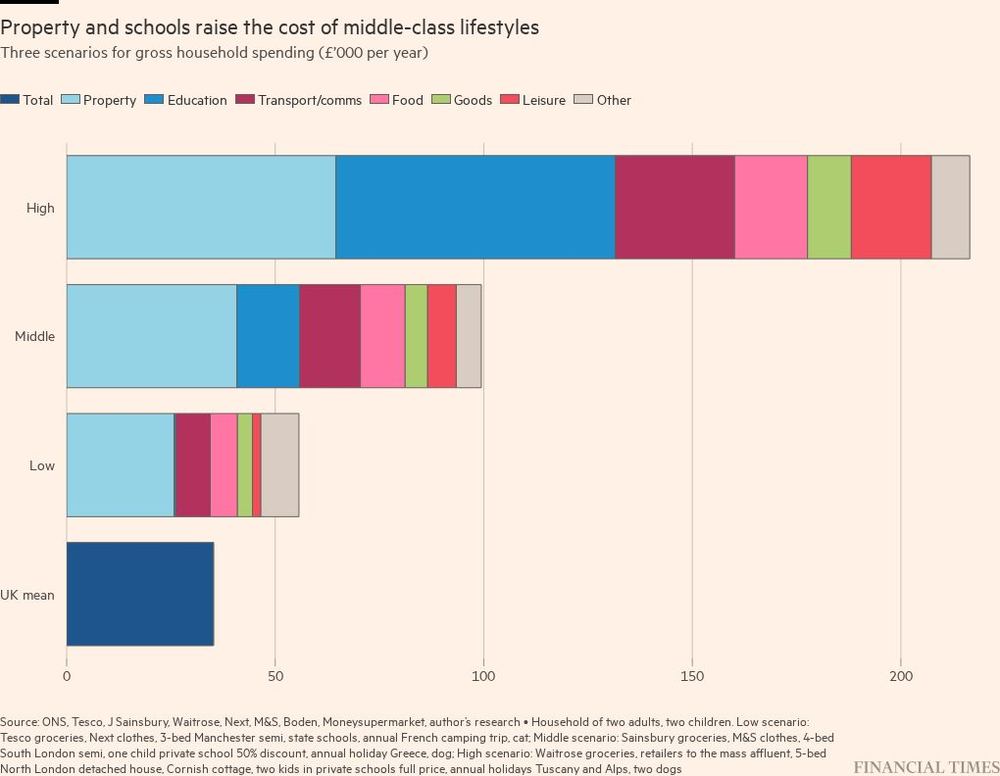
My budgets took a long time to calculate because, as in real life, they kept ballooning out of control. I seriously considered rehoming the Lowes’ imaginary cat to save them money. But the imaginary kids would have been heartbroken.
Implied gross household income in all three cases is way up at the top end of the UK income distribution. One explanation is that the average household has 2.4 people in it and my households, for consistency, all have four. Moreover, my inquiries were skewed towards London, where property is costly.
I am still forced to conclude that those lifestyle columnists are right. Being middle class really has become very expensive, defined materially.
There are several reasons. Higher interest rates have raised the cost of owning larger houses and fancier leased cars. School fees have escalated wildly due to a so-called facilities race. Employers have dumped substantial pension costs on employees. The state has transferred university expenses to students and families in a similar way. Fiscal drag has a heavy impact when it pushes better-paid workers into higher tax brackets.
But I have no patience with any suggestion that middle-class families like my own are entitled to feel particularly sorry for themselves. The CEBR expresses average bottom-quintile disposable income as “-£75” a week. The minus sign means these households cannot afford that “essential” basket of goods and services. They substitute cheaper purchases or do without.
If you think it is tough being middle class at the moment, try being poor.
Jonathan Guthrie is a journalist, adviser and author; [email protected]