Fans of Douglas Adams may remember Hotblack Desiato, the rock star who was spending a year dead for tax reasons. When I moved to London in the 1990s, I was delighted to discover that Adams didn’t invent the name — he swiped it from an estate agency in Islington. I was positively ecstatic to discover an even better real-world parallel: that people will find ways to postpone their own deaths (or perhaps to postpone the reported date of their deaths) if doing so will reduce the inheritance tax liability. For this discovery, the economists Wojciech Kopczuk and Joel Slemrod were rightfully awarded an Ig Nobel Prize in economics back in 2001.
Taxes do not just transfer money from citizens to the government; they also shape our behaviour. A clumsy tax system is likely to prompt all sorts of contortions that will shrink the economy, shrink the tax base, and delight accountants and tax lawyers. Tax-induced distortions are all but inevitable, but some tax systems make more sense than others.
Consider income tax. Without venturing into the far reaches of optimal tax design, it is easy to imagine a straightforward income tax: one with a modest tax allowance and two or three tax bands, each at a higher rate than the previous one. There would be one income tax system, obviously — why have two completely separate ones? — and it would be levied on all income, from whatever source.
Imagine starting with a tax like this and then trying to make the case for changing to two separate income tax systems, one levied on annual income and another on weekly income. The annual tax would be levied in bands of 0, 20 per cent, 40 per cent, 60 per cent and 45 per cent, while the weekly one would have bands of 0, 8 per cent and 2 per cent for some people, 6 per cent and 2 per cent for others, and nothing at all for yet others, depending on how exactly this income was acquired. The extra income tax would be called “national insurance”, but any link to social security would be tenuous. Any takers? It would be hard to stand up in parliament with a straight face and announce the scrapping of the first system in favour of the second.
Which raises an obvious question: as the UK currently has the sub-sapient second system, why is it so hard to make the case for switching to the first one?
VAT is another tax to ponder. It causes minimal distortions and, because it is levied in interlocking slices across the economy, compliance is high. Broadly speaking, it is neither progressive nor regressive, since those who spend more pay more. Nor does it need to be progressive: leave that job to income tax and the benefits system.
New Zealand is the prime example of a government that levies VAT on almost everything: the OECD estimates the country’s “revenue ratio” at 96 per cent of what could, in theory, be collected. VAT rates in New Zealand are 15 per cent, rather than 20 per cent in the UK — and yet, relative to the tax base, New Zealand raises substantially more revenue. If we were starting with the New Zealand system, could any politician credibly argue for switching to the UK’s high-rate, low-revenue alternative?
The UK charges higher rates and raises less revenue because of a tax lawyer’s dream: a pile of exemptions and reduced rates leaving endless room for debate. The question of whether Jaffa Cakes are a biscuit for tax reasons is the most celebrated (answer: no). It sits alongside: the question of whether chocolate Nesquik should attract the same VAT rate as strawberry Nesquik (answer: no, for reasons incomprehensible); the question of whether regular-sized marshmallows are liable to the same VAT rate as either giant marshmallows or mini marshmallows (answer: no); and the question of whether protein-enriched oat bars count as flapjacks for tax reasons (answer: no, largely because the Court tried the oat bars and did not find them “to be of a standard to be served to guests as a treat with afternoon tea”. Yes, this happened.)
Leaving aside the endless arguments over cake-adjacent products, countless goods and services are VAT-exempt or attract low rates of VAT. Broadly speaking, hot food is liable for VAT and cold food is not, although George Osborne’s infamous “pasty tax” episode raised the question of how to distinguish between food which is deliberately hot and food which is only incidentally hot. Children’s clothes are exempt from VAT — even if they are made by Dior or Burberry and cost more than a tailored suit. None of this makes any sense, and the government could easily raise more revenue with a lower tax rate by imposing VAT on everything.
The problem is not just that these rules reduce revenue, distort behaviour, shrink the economy and are also often manifestly unfair — but that they have no purpose. Somehow we have fallen into the trap of believing that VAT might be a useful system for noble ends such as helping poorer households. But the list of potential noble ends is long and VAT is a poor way of achieving them.
To see this, one need only imagine starting with the New Zealand system and trying to think of a way to boost the living standards of low-income households. Would anyone seriously suggest that the best way to do this was not to increase some kind of targeted cash benefit or tax credit, but instead to run down the VAT schedule making a list of items to exempt or discount: food (including food from Fortnum & Mason), children’s clothes (including coats from Balenciaga), fossil-fuel-powered heating, and so on, until literally half the consumption in the country was exempt — but, dash it all, definitely not biscuits or medium-sized marshmallows? Madness.
This is not the end of a list of potential tax reforms. It is barely even a start. Let us try to forget that evaluating the council tax liability for someone living in a newly built home in England begins by asking what that home would have been worth in 1991, if it had existed back then. (Which date in 1991? April 1. Say no more.)
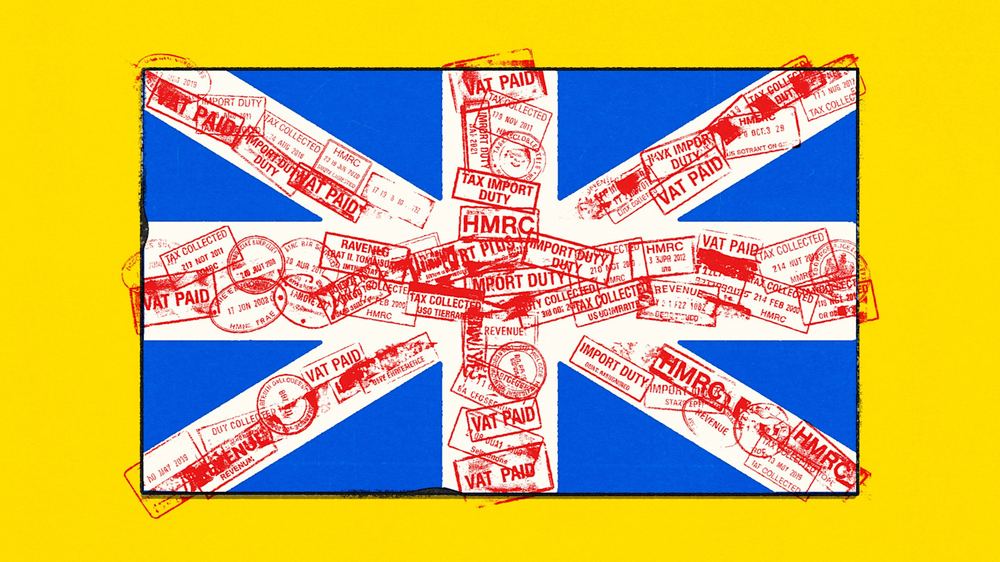
The point is that our tax system is riddled with loopholes and inconsistencies that leak revenue, hurt economic growth and are simply unjust. These problems are glaring enough to be seen from orbit, and ludicrous enough that no finance minister with a more rational system would dream of moving towards the UK’s shambolic approach. The question, then, is why have successive governments been so hesitant to clean up the system?
George Osborne introduced the Office for Budget Responsibility; Gordon Brown granted independence to the Bank of England. Large changes are possible. If the Chancellor will not announce something that will make a difference, the least we can ask is that he prepares the ground.
Find out about our latest stories first — follow FT Weekend Magazine on X and FT Weekend on Instagram