A merger of SpaceX and Tesla, which Elon Musk discussed openly on Tuesday·, would be big and weird in all the predictable ways. But even beyond the futuristic industrial logic of a $3.6tn combination, it would bring about a shift in the balance of power: more for Musk, less for everyone else.
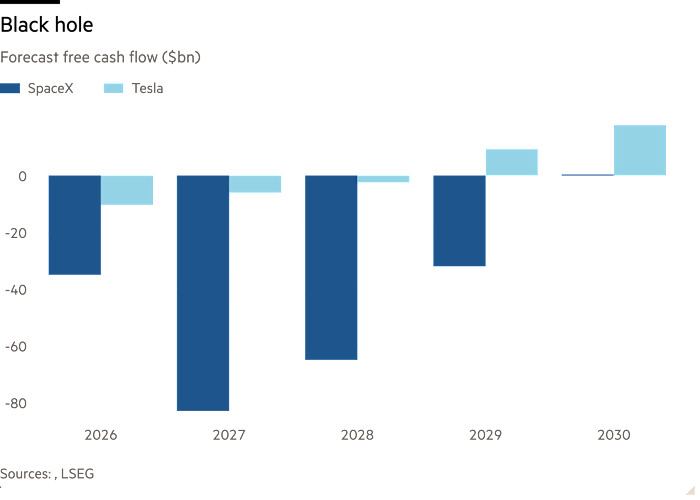
At this stage, it’s an idea rather than a plan. Both companies have set up groups of independent directors to discuss it. But it’s easy to see why Musk would be on board. For starters, he would no longer have to host two separate earnings calls or deal with two separate sets of shareholders. Tesla’s operations could share the burden of SpaceX’s incredibly capital-intensive AI ambitions.
There would also be real benefits, on paper, to putting the two tech ventures together. Both car-and-robot-maker Tesla and its satellites-to-spaceships cousin SpaceX share a voracious appetite for chips, for example. They are already collaborating on making their own; as a single company they could do so more effectively.
This is no small thing, because the dominant high-end chipmaker today, Nvidia, has enormous profit margins. If TeslX — for want of a better name — can make a chip for $3,000 rather than paying $30,000 to a third party, as RBC analysts think plausible, it could save well over $1tn over the long term.
In big-picture terms, a deal would put Musk at the head of a huge experiment in vertical integration. Think of SpaceX’s satellite telecoms business delivering connectivity to Tesla driverless cars in remote places, or — for those given to fantasy — SpaceX rockets delivering Optimus robots and energy cells to Martian colonies.
The problem is that when companies get bigger, shareholders’ sway can end up getting smaller. In this case, Tesla shareholders could lose what flimsy say they have over the company’s fortunes. In round numbers, the 85 per cent of SpaceX’s voting power that Musk holds thanks to super-voting shares would only fall to 80 per cent, all else being equal. Even if he converted all of his shares to the regular kind, he would retain in the region of 40 per cent control.
Moreover, the bigger a company, the harder it is for investors to see what’s happening under the hood. Accounting rules in the US say that companies must break out segments that account for more than 10 per cent of revenue, profit or assets. Tesla’s battery business, measured by sales, could slip down the back of the sofa. At SpaceX, social network X — which cost Musk $44bn in 2022 — already does.
On top of that, Musk and his lieutenants would get greater discretion over how capital is allocated, and investors would have less. A fan of electric cars but not crazy about data centres? Buy a share in Tesla and eschew SpaceX. Merged, that choice disappears. The result, then, would be a much bigger company over which Musk has even more sway, in relative terms, than he does now.
Is that an impediment to a deal happening? Probably not. The companies were together worth roughly $300bn more on Wednesday than they were the day before, suggesting moderate enthusiasm. But that shouldn’t come as a surprise. For many shareholders, these companies are already just two ways of betting on the same asset: Elon Reeve Musk.