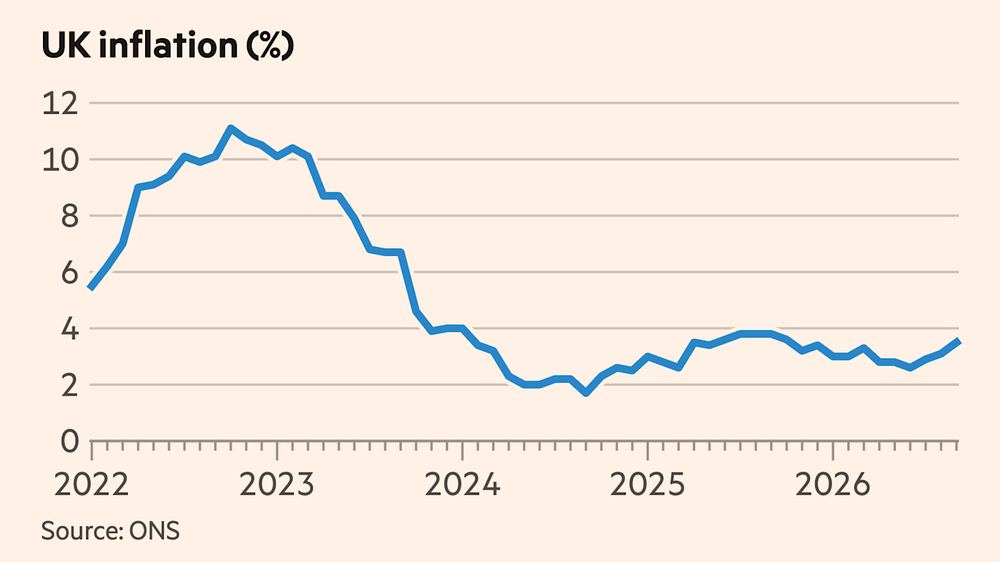
UK inflation climbed to its highest level in almost a year and government borrowing blew past expectations in September, in a double blow to chancellor John Healey ahead of next week’s Budget.
Inflation rose more than expected to 3.5 per cent, up from 3.1 per cent in August, the Office for National Statistics said on Wednesday, cementing traders’ expectations that the Bank of England will raise interest rates next month.
Government borrowing hit £24.5bn in the month, £1.9bn higher than forecast by the Office for Budget Responsibility, the UK’s fiscal watchdog.
The figures underline the damage wrought on the economy from the energy-price shock unleashed by the Iran war, which has pushed up inflation and deepened the strains on the public finances.
The difficult economic backdrop to the Budget has raised the prospect that Healey will have to increase taxes and cut spending to pay for Budget measures to ease the cost of living.
The buffer Healey has against the government’s fiscal rules has probably been slashed to about £12bn, according to FT estimates, from the £23.6bn forecast by the OBR in March.
September’s borrowing was driven by a steep increase in spending on debt interest payments, which reached £10.9bn, the highest reading for that month since records began, when unadjusted for inflation.
Debt at the end of September was provisionally estimated to have exceeded £3tn for the first time, the ONS said, even if it was lower than a year earlier as a share of the economy.
Suren Thiru, chief economist at the Institute of Chartered Accountants in England and Wales, said that higher inflation was “turning the Budget into a perilous high-wire act for the chancellor, increasing pressure for cost-of-living support while pushing up government borrowing costs”.
September’s inflation figures are also the final snapshot of price pressures before the BoE’s Monetary Policy Committee meets early next month to set interest rates.
Traders are betting that a quarter-point increase in rates to 4 per cent is now a near-certainty, according to levels implied by swaps markets, in what would be the MPC’s first move since the Iran war began in February.
The MPC has for months been split over whether the energy-price shock will lead to wider and more prolonged price pressures across the economy.
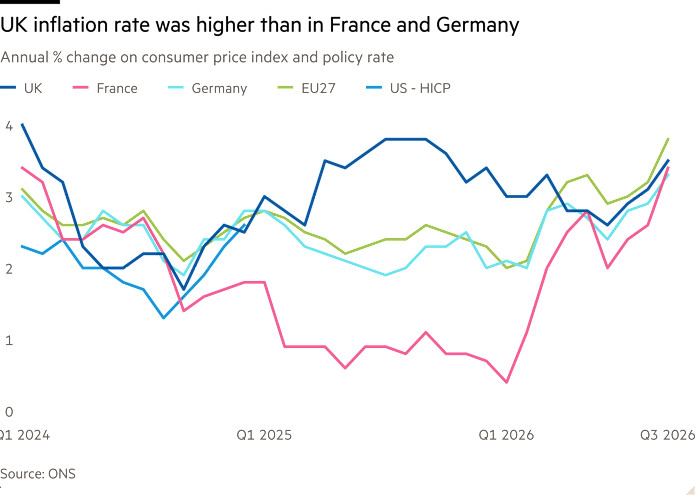
In contrast, the Federal Reserve, the European Central Bank and the Bank of Japan have raised rates in recent months in a bid to tame inflation.
Services inflation, closely watched by rate-setters as a gauge of domestic price pressures, rose more than expected to 3.7 per cent in September from 3.4 per cent in August. Analysts expected an increase of 3.6 per cent.
David Rees, head of global economics at Schroders, said that, given the pick-up in services inflation, “a November rate hike now looks like a done deal”.
September’s increase, which was led by higher motor fuel costs, pushes inflation to its highest point since October last year. Higher airfares and, to a lesser extent, prices for computer games and live events also drove up inflation.
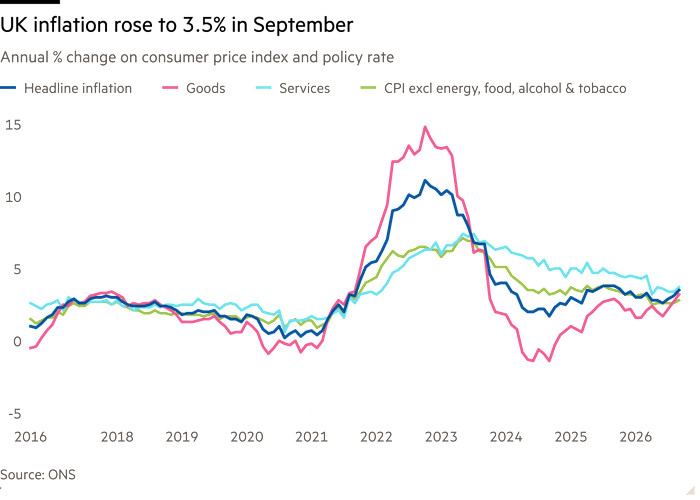
Core inflation, which excludes energy, food, alcohol and tobacco, rose to 2.8 per cent in September from 2.6 per cent in August.
Goods inflation also hit 3.2 per cent in September, its highest in three years, but food inflation remained contained at 1.3 per cent.
Martin Beck, chief economist at WPI Strategy, said that “higher prices threaten another squeeze on real wages just as living standards had begun to recover”.
“Unfortunately, inflation probably has further to climb,” he added, as higher oil and gas prices have yet to feed fully into household bills and business costs.
The pound was little changed against the dollar on Wednesday at $1.339. Gilts gained ground, with the UK’s 10-year borrowing costs falling 0.03 percentage points to 5.38 per cent, continuing a recent run of outperformance against under-pressure Eurozone debt markets such as France.
The MPC last month forecast inflation would hit 4 per cent in the first quarter of next year, double its 2 per cent target, driven by a renewed increase in energy prices.
Ruth Gregory, economist at the consultancy Capital Economics, said that the inflation data supported her view that the BoE would raise rates by a quarter point in November to guard against the energy price shock feeding into wider inflationary pressures.
She added that, assuming the “second-round effects” did not emerge, interest rates would probably peak at 4.25 per cent next year.
While the surge in energy prices has pushed inflation and borrowing costs higher, there are signs that economic growth has proved more resilient than feared.
The economy grew 0.7 per cent in the three months to August, figures showed last week, while data published on Tuesday also showed that the job market stabilised over the summer.
Additional reporting by Ian Smith
What will the UK Budget mean for Britain? Join Sam Fleming and FT colleagues for an exclusive FT subscriber webinar on 29 October, the day after the Budget. To register, and send us your questions, go to ft.com/budget2026