By Howard Chua-Eoan | Updated on Oct 09, 2026 at 05:00 AM
Bruno Verjus, the restaurant-critic-turned-chef, reignited an old debate in July when he announced he was shutting down Table, his two-Michelin-starred Paris restaurant. His provocation: “ Fine dining is dead .” It was too exclusive. Too expensive. Too isolated from the realities of a world of pocketbook-conscious ordinary people. He wasn’t saying anything original.
A decade ago — when Table was just three years into its run — David Chang and the editors of his culinary magazine Lucky Peach took on the insanely intense labor that created the tweezered beauties that emerged from the fanciest sweatshops in the world. They bewailed its toll on the souls of young cooks forced to create painfully exquisite dishes again and again, each one exactingly alike. A lot of that production line brilliance was a benefit of a system of unpaid interns, or stagiares , who could then claim the honor (and an entry in their resumes) of being part of a prestigious kitchen. In January 2023, Chang’s friend Rene Redzepi said very much the same thing: Fine dining was an unsustainable business because the labor required had become unaffordable. He declared he was closing Noma, his groundbreaking restaurant in Copenhagen.
For all his troubles , Redzepi has not closed Noma. I was just there in August and enjoyed it tremendously. Chang has shrunk the restaurant footprint of his big-footing empire but isn’t out of the business either. He is the money behind Kabawa, Paul Carmichael’s fantastic new Caribbean fine-dining restaurant in New York, in the space formerly occupied by Chang’s legendary Momofuku Ko. Even Verjus, whose Table will shutter in December, is already brooding a concept for a new restaurant.
The irony is that, in their respective beginnings, all three men were insurgents against the status quo — and all of them eventually redefined “fine dining,” despaired of it and yet have not really given it up. Chang, beginning with a noodle bar and then expanding into wildly delicious conflations of Asian and Latino cuisine, brought a dizzy, foul-mouthed exuberance to good taste in the New York scene. Redzepi’s Noma was a much-needed expansion of haute cuisine to include Nordic cooking (and by extension the cooking of all nations and cultures) into the paradise gate-kept by France. Verjus was the knowing outsider, a food critic with a clear philosophical approach, who then became a restaurateur/chef at the age of 54, the diner who took over the kitchen. Each of these chefs changed the way we looked at food and dining out.
The problem is that money doesn’t look at restaurants the same way. Investors typically place bets based on four broad categories: fine dining, casual, fast casual and fast food. There are lots of in-between and off-on-their own classes, of course. But the four segments help investors digest what is otherwise a many-splendored smorgasbord across a huge range of concepts, from that bubble tea chain on the corner to exclusive spots like The French Laundry.
Most of the consternation about the future of fine dining takes place in a grouping devoted to the fanciest “haute” — or high — cuisine. The altitude belies the fact that it is much easier to raise huge amounts of money for “low” and fast cooking. Streamlined concepts with the potential for market-cornering scale are much easier to pitch on an elevator, hence the proliferation of burger chains and pizza shops. It’s harder when your vision for a restaurant is rooted in the culinary philosophies of a 14th century mystic. It literally doesn’t pay to be elite.
Investors do recognize a kind of cultural hierarchy in the lineups, even though the most prestigious “brands” are more likely underfunded. To survive, contemporary fine dining appeals to a moneyed class that looks at rankings (hence the persistence of Michelin stars and “50 Best” lists) and degrees of difficulty to snag a status-bolstering reservation. Nowadays, that strategy does little to build confidence for restaurateurs since it depends on catering to the whims of know-nothing influencers. The audience follows the money though, aligning its preferences accordingly. Fine-dining restaurants are thus in demand yet confined to a poorly financed category.
The question then is not whether fine dining is dead or dying, it’s about how we can liberate it from the categories — both financial and psychological — that we’ve boxed it into. The temptation will be to create new subdivisions such as “fine casual” to accommodate marketable differences. A better remedy is to understand that enjoying restaurants isn’t about navigating a hierarchy but discovering a spectrum. Forget fine dining as a peak experience; we need to relearn what good eating is and how fine dining fits into it, without leaning on listicles and rankings, much less business categories.
There’s no better lesson than a visit to San Sebastián in the Spanish Basque country. The food culture begins with village txokos , basically pub-like clubs where good cooking is an integral activity; and goes as far as absorbing other global foodways, including taking cod and cheesecake — things not native to the Basque region — and making them their own.
You can find expressions of gildas — those tiny skewers of olive, anchovies and chili, to cite the dominant combination — from the most humble pintxo bar to the queue-clogged establishments specializing in salty, pickled or spicy variations upon variations on the theme. It’s the only way to appreciate the deconstructed, skewer-less version that chef Martin Berasategui serves in one of his restaurants just outside the city. Over the weekend, I heard there was a txipiron competition attended by the head of Gastronomika, the culinary convention I’m attending here. A contest over squid preparations? These micro-rivalries help push creativity and quality. I tasted an otherworldly serving of txipiron stewed in ink with finely grated orange rind. Incredible balance and texture. Black teeth totally worth it.
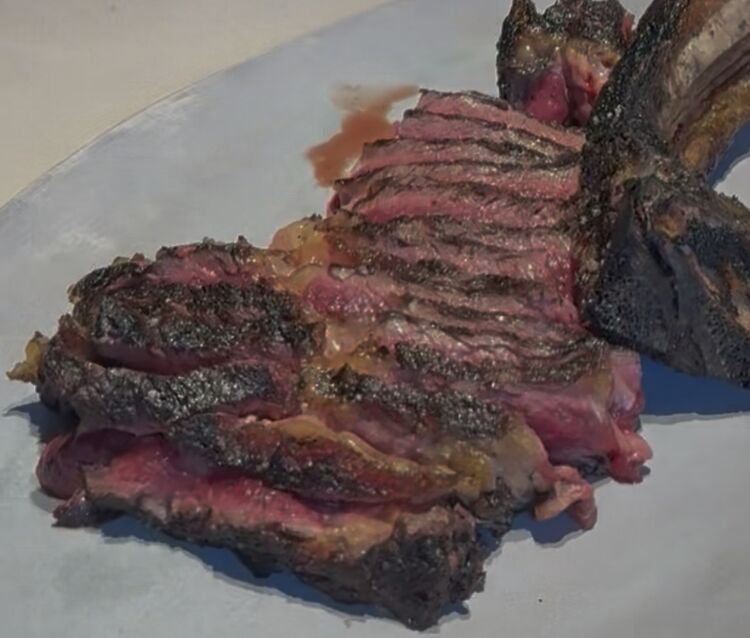
You may end up preferring the gilda from the corner shop to its post-modern mutation, but each complements the other as customers expand their experiences of the archetypical snack. At one end is the beef chop or txuleton served up at a multi-generational shop, on the other a $500 apotheosis of Basque grilling techniques at Asador Etxebarri, where perfectly charred steak is just one of nearly 20 courses in one of the most astonishing feasts imaginable. You understand the cost once you know the range — and you appreciate the evolution as you return to the humbler restaurant. Both ends are artisanal.
Verjus is contemplating a restaurant where he can serve inexpensive dishes to the elite and non-elite alike, as well as pricey ones to keep a hold of the caviar-class. But that’s a move toward monopoly, not coexistence. I don’t believe you can be both. Every restaurant along the spectrum plays a different role in defining the whole, from tasty popular tweaks to tradition in small shops to avant-garde weirdness in cerebral kitchens. The wonder of the San Sebastián area is that one of its most beloved figures is Andoni Luis Aduriz, the chef of Mugaritz and its madly intellectual, almost inedible cuisine. Fine dining will always be precarious because it’s supposed to push boundaries. That’s why it’s at the more endangered end of the spectrum. That’s also why it is so valuable.
More From Bloomberg Opinion:
Want more Bloomberg Opinion? OPIN <GO>. Or subscribe to our daily newsletter .