
As hundreds of thousands of people poured on to the streets of France to protest against planned budget cuts last week, the bond market made clear its own deep discontent with the country’s public finances.
Teachers, nurses and civil servants marched against what they denounce as unbearable austerity in a demonstration of the public anger that could sink the government’s plans to rein in its deficit. In parallel, the brutal sell-off in the country’s bonds took borrowing costs close to 5 per cent, their highest in almost a quarter of a century.
“Schools with no money, a country with no future,” read one sign held aloft by a protester in Paris. Angry students have adopted more radical tactics by shutting down high schools across France, clashing with police and setting destructive fires, leading to 5,000 arrests.
France is caught between the protesters on the street calling for more funds from the government and “bond vigilantes” in the markets who punish perceived fiscal irresponsibility by betting against the country’s debt.
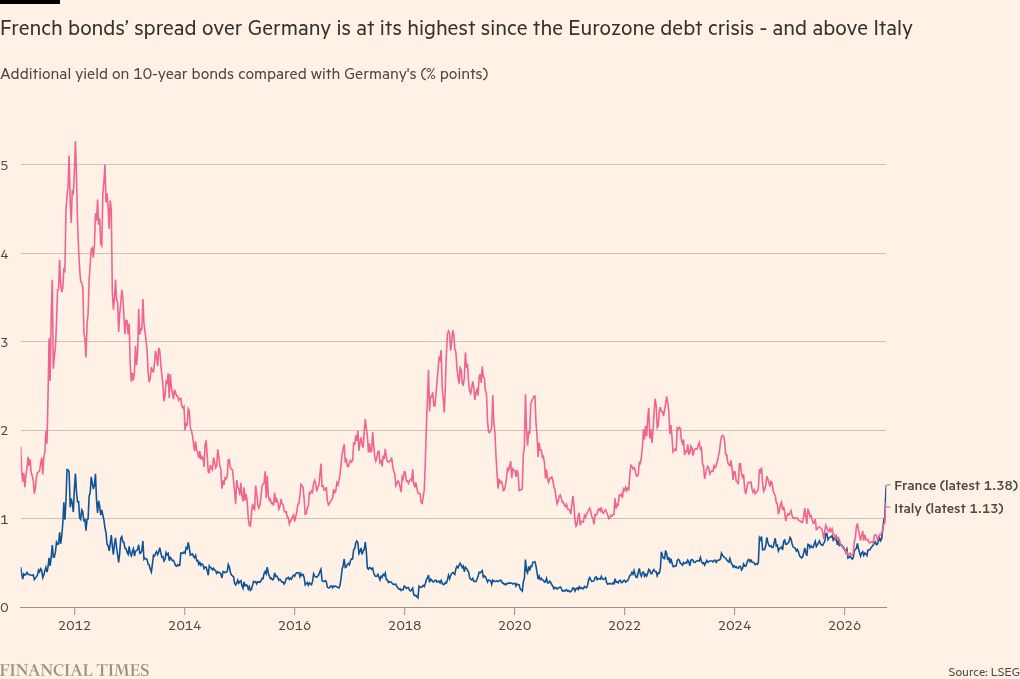
Not only does it now cost France more to borrow than it does Italy and Greece; a rising number of big French companies enjoy lower market interest rates than does the French state. Of all the G7 nations, it has suffered most from the debt sell-off triggered by the Iran war.
“We are already in a slow-burning, deep and structural crisis,” says Pierre Moscovici, finance minister during the tail-end of the Eurozone crisis in 2012. “France is probably too big to fail, but it is not too big for the markets to punish.”
Tensions are rising as the confrontation over the budget deepens and the country prepares for an April presidential election that could end in a face-off between the far right and hard left.
The fear among investors is that the country could be tipped into a full-blown debt crisis that could not only rock France’s economy but also shake the Eurozone.
On Monday, the euro fell to a 17-month low· against the dollar as worries intensified about the impact of the French debt sell-off on the single-currency area.
Emmanuel Moulin, the governor of the Bank of France, says the market ructions are “serious and worrying” although he maintains that the country can get back on track.
“Whoever is elected president will face a situation in which interest rates are high, the cost of servicing the debt is high, the deficit has to be brought back below 3 per cent, and the debt has to be cut,” Moulin tells the FT.
“If we don’t act, there is indeed a risk of being gradually strangled by rising interest rates. We have to remain in control of our own destiny.”
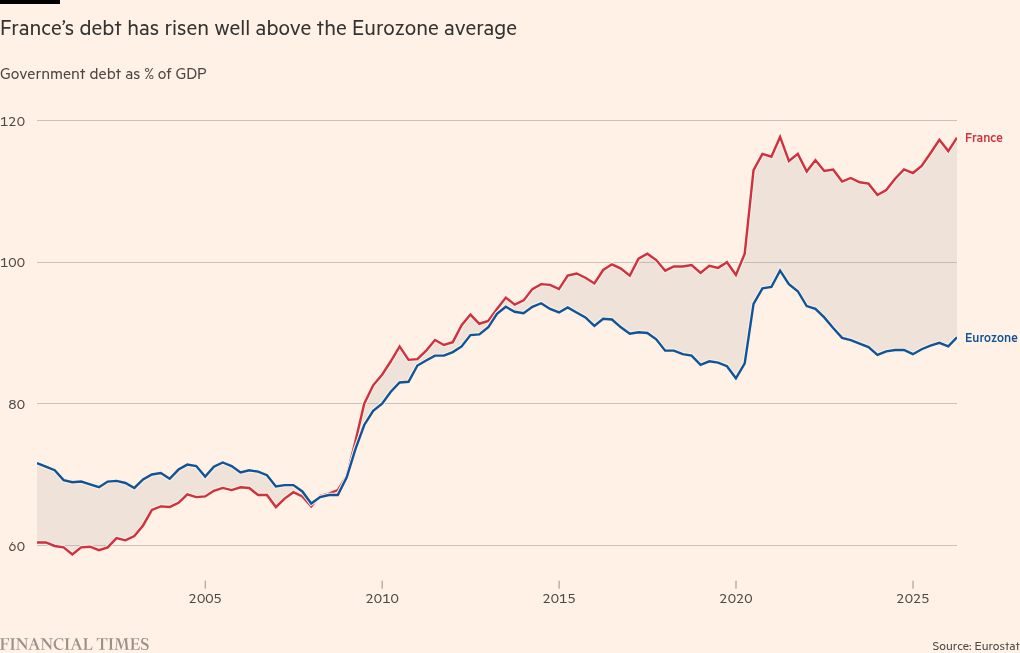
At present, France’s debt has reached €3.5tn, at nearly 120 per cent of GDP, far above the Eurozone average. Servicing costs have climbed fast to become the state’s single biggest expenditure ahead of education or defence.
In just a month the additional interest rate that France pays to borrow over ultra-safe German debt — a key barometer of investor concern — has surged by almost two-thirds to around 1.4 percentage points on 10-year debt, heading towards the heights charted during the Eurozone debt crisis.

The sell-off in French debt continued even after the government set out a belt-tightening 2027 budget plan last week.
In the worst-case scenario, some think the European Central Bank could be forced to come to the rescue. That could come at the cost of demanding structural reforms, such as slashing pension spending, which the French public has long rejected.
“France has been sleepwalking down the path that leads towards a financial crisis,” says Mike Riddell, a fund manager at Fidelity International. “It feels like broader markets are starting to notice.”
The budget showdown
In Paris, ministers and former officials play down the idea that France could fall prey to a full-blown debt crisis. They cite the country’s solid economic and institutional foundations — high domestic savings, reliable tax collection and a stable banking sector.
As the global bond market sells off, France is not alone in facing rising long-term yields, which move inversely to prices, nor have the country’s fundamentals worsened overnight, they say. Bond auctions continue to be oversubscribed.
“France is not Greece during the Eurozone crisis,” says Moulin, the Bank of France chief. “If it can pass a budget this year to reduce spending and narrow the deficit as the government has proposed, then markets will be reassured by this concrete step of fiscal consolidation.”
Speculating about the ECB swooping in to help France is beside the point, he adds: “The safety net lies closer to home. It lies in the capacity of the French and their elected representatives to recognise the need to repair public finances.”
But debt has risen by more than a trillion euros during the nine-year presidency of Emmanuel Macron, whose business-friendly reforms quickly gave way to big spending to blunt the impact of successive crises.
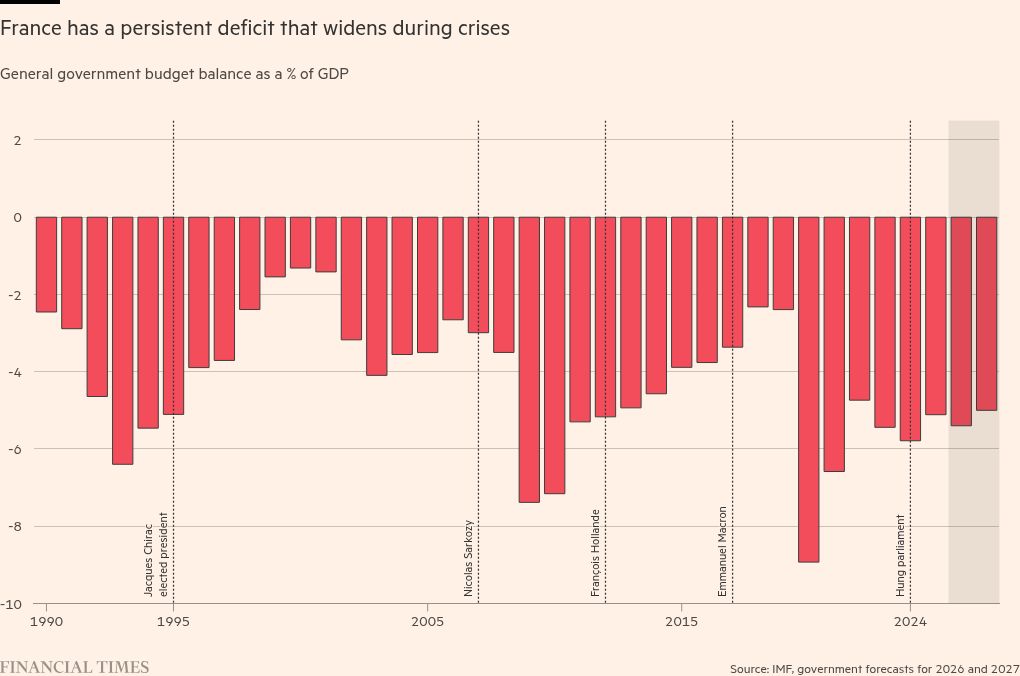
Since Macron called snap parliamentary elections in 2024, the gridlock of a hung parliament has turned budget debates into trench warfare, claiming the heads of two prime ministers and leaving the deficit stuck above 5 per cent of GDP for three years.
The rapidly widening spread over German Bunds has added a new urgency.
“This is where you can really see the protection that the euro represents for France,” says Moscovici. “If we still had a system of national money, then the spreads of interest rates would be even higher.”
Some investors suggest the pain inflicted by increasing borrowing costs — and the risk of still worse travails — could force French fiscal policy back on track, much as former British prime minister Liz Truss ditched unfunded tax cuts when confronted with a gilts crisis in 2022.

Indeed, last week Prime Minister Sébastien Lecornu proposed a €43bn package of spending cuts and tax rises for next year’s budget, including unpopular curbs on pension increases and partial freezes on civil servant salaries.
Lecornu had been urged on by Macron to make ambitious cuts to project determination and calm the markets. The risk is that the bigger and more unpopular the proposed cuts, the more vulnerable Lecornu’s minority administration is to being toppled by parliament — particularly with the opposition preparing for next year’s presidential contest.
While the French government has constitutional tools to ram through a budget, passing it by decree would be unprecedented and would inflame the opposition.
Another convulsion on debt markets will be all but certain if the government collapses during the budget debates that could last to year-end.
In any case, investors are sceptical that the budget can deliver spending cuts to reach Lecornu’s goal of bringing the fiscal deficit down to 5 per cent in 2027. This year, instead of holding steady as hoped, the deficit is projected to rise to 5.4 per cent because of the economic slowdown and higher borrowing costs. France once promised to rein in the deficit back within the EU limits of 3 per cent of GDP by 2029; at present such targets are firmly out of reach.
Next year’s presidential race provides still more uncertainty.
Marine Le Pen, the far-right politician leading the polls, sought on Tuesday to reassure the markets and voters by promising €140bn in budget cuts over five years.
Amid the bond rout, she has called for a national debt limit of 60 per cent of GDP — half of current levels — to drag the country back “from the brink of a financial, economic and moral crisis”.
But she is also campaigning on lowering the retirement age for some and slashing VAT on energy and food essentials — which could add tens of billions to the debt.
One big question is whether, if elected, she would follow in the path of Italy’s prime minister Giorgia Meloni, who managed to quell the market anxiety that accompanied her rise to power in 2022.
“Unless you think they are so extreme they are willing to blow the whole thing up, I think some kind of natural caution prevails,” one big bond investor says of Le Pen and other populists.
Meanwhile, more mainstream centrist and rightwing candidates who urge fiscal rectitude are flailing in the polls.
Surveys show far-left leader Jean-Luc Mélenchon within striking distance of a hypothetical run-off with Le Pen, although they also indicate he would be roundly defeated in a second-round vote. The former Trotskyist recently proclaimed that French bonds held by the central bank could be thrown “into the fire”, or cancelled with no consequence. Debt investors were spooked that such a radical idea was even in the public debate.
And yet the fiscal plight of the Eurozone’s second-largest economy is worsening. France has not balanced its budget since 1974; even when interest payments are excluded, it has run a deficit every year since 2002.
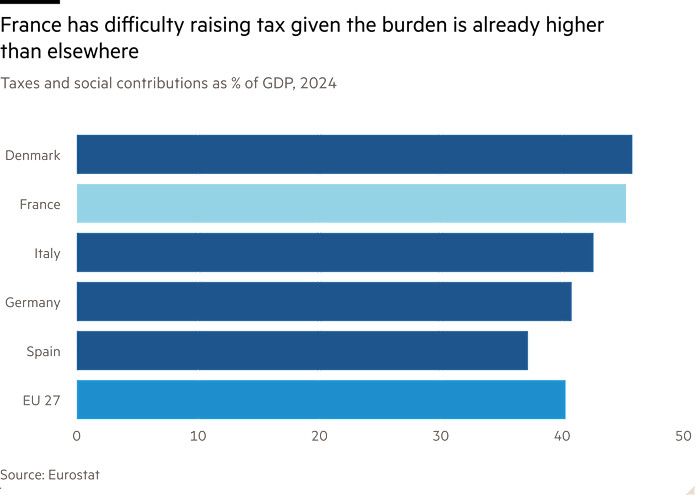
Increasing taxes to deal with the rising cost of debt servicing could also be perilous. At 44 per cent of GDP, the tax burden is already among the world’s highest; the average in the OECD club of rich countries is 34 per cent.
Almost a quarter of public spending is gobbled up by pensions. French retirees leave the workforce earlier and receive relatively generous benefits by OECD standards. Attempts to push back the retirement age trigger angry protests.
Eric Lombard, who served as finance minister last year, says there is no way to fix public finances without increasing the retirement age and reducing unemployment. “The fundamental problem in France is we don’t work enough,” he says. But if more people are in employment and benefits curtailed, he adds, with “a bit of luck in five years we can turn things around”.
Some consider this wishful thinking.
“France has a great history of trying to be less profligate and failing to achieve that,” says Andrew Jackson, head of investments at Vontobel Asset Management.
But he also cautions that there is a risk that spending cuts could hit the country’s already “anaemic” growth, worsening the debt squeeze still further.
A vicious spiral
Nowhere has France’s declining economic status been more apparent than in the bond market.
Paris was long deemed a “semi-core” Eurozone borrower for its safe status, trading at a modest spread to German Bunds. Debt trouble spots such as Italy and Greece, by contrast, were badged as the Eurozone “periphery” for their greater debt risks and higher spreads.
France’s political gridlock and worsening debt have made things very different. A series of ratings downgrades has helped push up the country’s borrowing costs, which passed Greece’s in late 2024 and Italy’s last year. Investors now label France the “new periphery”.
Despite the government’s tax-raising powers, its borrowing costs now exceed those of big French multinationals such as LVMH, the luxury group, and Sanofi, the pharmaceutical company. According to Goldman Sachs, more than a quarter of investment-grade French companies had a lower yield on their bonds than comparable government debt as of the end of September.
All big western economies have endured rises in borrowing costs since the end of the pandemic. Benchmark interest rates have returned to more normal levels after Covid-era lows. Central banks scrapped their vast asset-buying programmes just as bond issuance from sovereign and corporate borrowers hit record levels, while Japanese investors have also pulled back from French bonds and other Eurozone debt.

The phenomenon has gained pace since the outbreak of the Iran war, as central banks have raised interest rates to combat oil price-fuelled inflation.
But France has been hit hardest among big bond markets, as investors demand a much bigger premium to compensate for the growing risk to its public finances.
Downgrading French government debt last month, the rating agency Scope said rising yields would hurt the country through “further constraining fiscal flexibility and increasing the scale of the adjustment required to stabilise public debt”. A further test will come in a review by Moody’s late this month.
Market interest rates take time to feed through into countries’ debt servicing costs, but France’s are already painfully high. The government expects interest payments to total €79bn this year and €91bn, or 2.9 per cent of GDP, in 2027.
Even those figures are based on a yield below the current market rate; they assume an average of 4.3 per cent on the yield for 10-year government debt from 2027 onwards. Since they were calculated, it has climbed to more than 4.8 per cent. Analysts at Morgan Stanley said that yields running above the assumption were a “significant upside risk on interest payments for the coming years”.
Some observers worry that France is entering into a self-fulfilling spiral: the cost of debt servicing rises, increasing the country’s deficit, and then investors respond by pushing bond yields and debt costs even higher.
The European dimension
The widening spreads between French bonds and those of the country’s European neighbours have set off market speculation about the ECB stepping in.
French government officials and some opposition figures privately signal that such outside intervention may be the only way to force deep spending cuts.
Alain Minc, an influential adviser to French corporations who has informal ties to the government, argues that the crisis could snowball even before the presidential election.
“The question that investors will be asking themselves is if the ECB is prepared to support France with no strings attached until the presidential election,” he says. “The mere fact that people are asking will make the crisis worse.”
Bond investors are also debating whether a certain level of French spreads above German Bunds would force the ECB to step in to calm the markets that determine Eurozone economic conditions.
Most think the central bank would be especially likely to act if there is serious contagion from France to other European debt markets.
“The move is no longer just about France,” wrote TD Securities strategist Pooja Kumra in a note last week, as European bonds sold off, together with other areas of the debt market. “Broader financial tightening may require a more forceful response from the ECB to help stabilise markets.”
A much bigger sell-off may be needed for the ECB to act, but investors are aware that political conditions in France could amplify the risk.
Asset management giant Vanguard warned last week that “grandstanding” from political parties ahead of April’s presidential election could threaten the fiscal adjustment outlined in Lecornu’s budget proposals. Spreads could then widen across the Eurozone.
In such a scenario, the ECB’s capacity to buy huge quantities of bonds could provide the ultimate backstop on the basis that the central bank would not allow a big European economy to tip into a full-blown debt crisis.
ECB president Christine Lagarde, a former French finance minister, has in the past been reluctant to react when differences emerge between countries’ borrowing costs.

Months after taking office as ECB president, she told journalists in March 2020 that it was not the central bank’s job to “close spreads”, triggering short-term market unrest that only eased after she almost immediately backtracked.
Two years later, the central bank announced it had designed an emergency bond-buying tool to fight “unwarranted” and “disorderly” swings in bond prices that are a “serious threat to the transmission of monetary policy”.
Details of this so-called Transmission Protection Instrument are opaque, and it has never been used so far. Analysts think that the hurdles are high; in the summer of 2022, the ECB declined to intervene when the Italian spread with Germany shot up to 2.5 points, more than a percentage point above the French spread’s current level.
The ECB said it would only use the instrument to buy the bonds of countries that pursue “sound and sustainable fiscal and macroeconomic policies”, an argument that might be difficult to make for France. “Widening spreads without clear fiscal consolidation efforts will not trigger TPI,” says Carsten Brzeski at ING.
Morgan Stanley’s chief Europe economist Jens Eisenschmidt, a former ECB official, says he suspects the bank’s governing council “would prefer not to touch TPI”, highlighting the political sensitivity of emergency bond buying. He also cites “scant evidence so far” that the rise in borrowing costs is pushing the central bank’s monetary policy off course. “But surely, the ECB will be closely monitoring that situation.”
Some insiders think it is just a matter of time before the ECB switches into crisis mode. There could soon be change at the top. Lagarde’s mandate officially ends in October 2027 but she recently said that she might be “leaving a few months before the end of my term”.
One former European central banker adds that the institution’s next leadership will have to walk a fine line between preventing a crisis and escalating it: “There is a high probability that the next president of the ECB at some point during their tenure will have to buy French government bonds.”