
Ryan Avent is a journalist, author of In Good Faith, and writes a newsletter called The Bellows.
Have you thought about borrowing money lately? If the answer is ‘no, obviously not, have you seen what’s happening with interest rates?’, then congratulations: you’re a victim of “crowding out”.
The hot economic craze is popping up everywhere, from the commercial real estate, to residential mortgages, and, as MainFT notes, it’s spreading to cuspier corporate borrowers too.
What’s going on and how likely is it to lead to trouble?
Basically, crowding out is a competition for scarce real resources which plays out in credit markets. It is a gross simplification but a useful one to say that savers and borrowers are swapping around claims on the productive potential of the economy today for claims on the productive potential of the economy some time in the future.
And there’s real economic activity at stake, which is why a sudden spike in desired saving relative to desired borrowing often sees unemployment soar and the economy fall into a recession.
Suppose, though, that we were to see a pronounced and sustained rise in desired borrowing, as actors in one part of the economy tried ever harder to obtain claims on the productive potential of the economy today. Prying these claims away from others means outbidding them with ever-greater offers of jam tomorrow.
In some cases, these offers might induce people who were thinking about using their claims to obtain goods and services today to save instead, because the market reward for patience has increased.
In other cases, people and businesses may find that the price they need to pay to obtain their desired claims on the economy’s present purchasing power has become exorbitant.
Or in jam terms, some regulars at the café are excited about their daily jam portion, but could be persuaded to go without jam today for a triple portion tomorrow. One or two others enter with plans to offer a patron or two precisely this bargain, because an eccentric inventor down the street has agreed to swap an improved jam-making device for a few portions of jam today. But there’s also another customer in the café today, who promises to come back tomorrow with the OpenJam whizzmatronic bottomless jam-spouting fountain if everyone hands over all of their daily jam portions today. When everyone obliges, the schemers with the more modest jam-making plans are out of luck.
Hopefully that’s clear.
This latter effect is crowding out. Low interest rates imply that people will swap their claims on today’s productive potential for a song. In such cases, a debt-financed investment plan need not yield very much to pencil out. As rates rise, however, the expected return on an investment plan needed to justify the borrowing costs also goes up. Decent investments get squeezed out, then good investments, and then maybe really excellent investments that stand to deliver big economic benefits. So it goes.
We are experiencing this today, and you’ll never guess which part of the economy is responsible for the pronounced and sustained rise in desired borrowing.
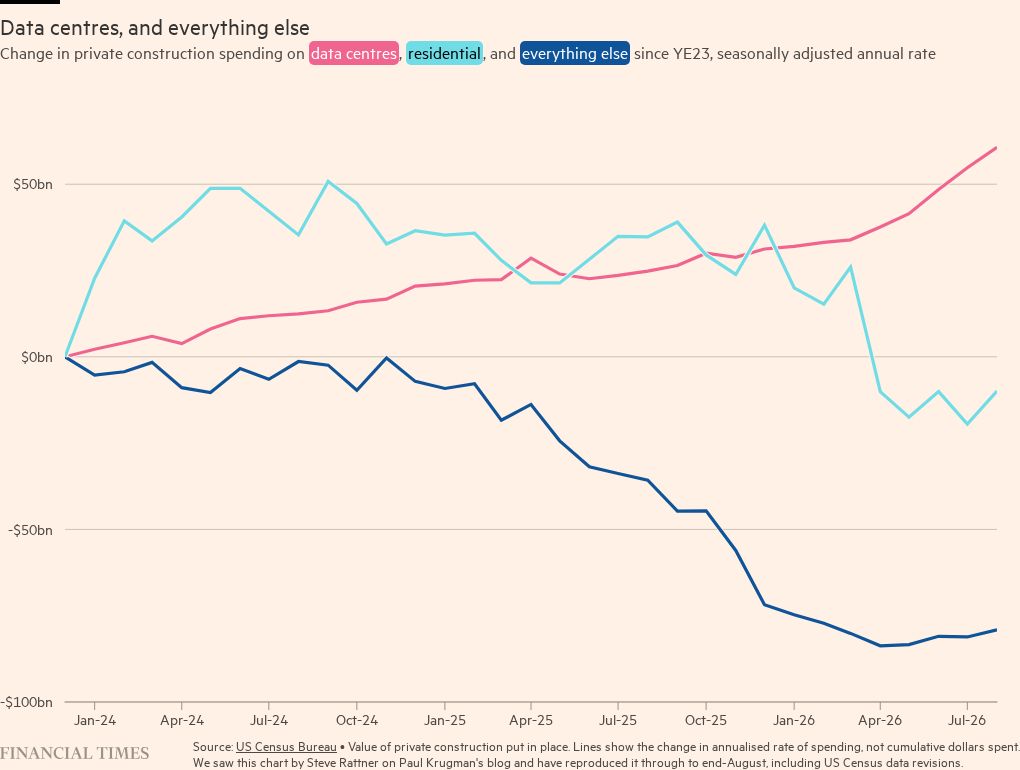
The AI complex can go to markets and pay what it takes to get the capital they need, because they expect — and investors believe — that money poured into AI capex will deliver enormous returns in the future. Firms in other parts of the economy can’t promise those same returns, and so they are relinquishing their investment capacity to all things AI. In a new Substack post, Paul Krugman charts the phenomenon (with a typo in the header, which should say 2023 rather than 2003:
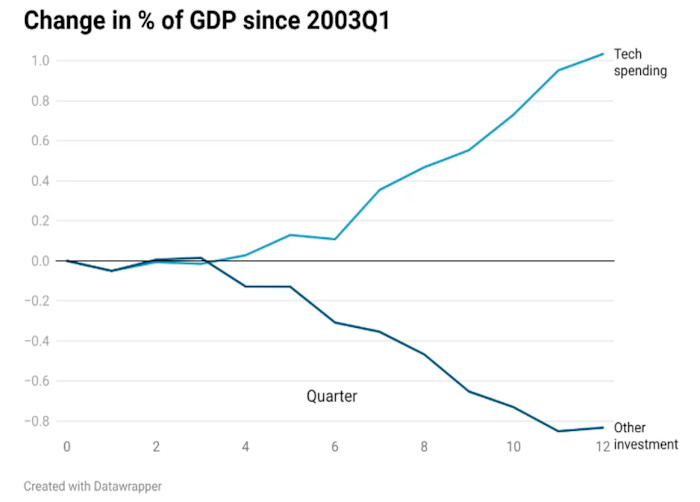
Krugman argues that this could be a problem for the economy. Sure, AI execs believe that future returns will be massive, but they could be wrong. And if AI doesn’t deliver on its promise then we face a double blow to growth: because AI didn’t expand our productive capacity as hoped, and because other investments which might have didn’t take place.
It is interesting to note, however, that crowding out like this didn’t take place during the tech investment boom of the 1990s. Another chart tells the tale:
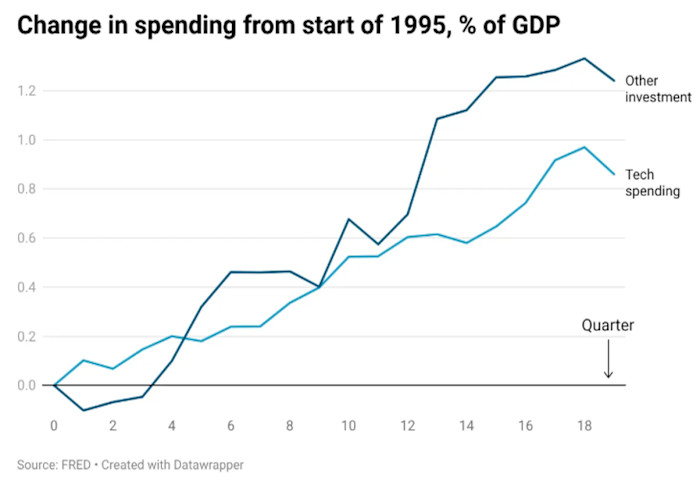
What’s the deal here? Krugman writes:
Most of the answer is that during the 90s boom America attracted very large inflows of investment from abroad, which essentially financed the tech boom even as other investment rose.
That’s certainly true, but a quick look at US current account data suggests that there’s still quite a lot of foreign money flowing America-ward. There is another big difference, though, if you can guess it. Yes! Governments are borrowing a truckload more than they were three decades ago.
To the extent that “crowding out” entered the popular imagination, it did so in the late 1980s and early 1990s, when economists warned that government borrowing was pushing up interest rates and choking off private investment. Bond-market ructions in the early 1990s prompted fiscal consolidation efforts in the US and elsewhere, however, and from 1998 to 2001 the US government actually ran a surplus.
(Krugman knows all this, by the way, I’m not trying to pwn him. He made his big splash as a political commentator pointing out that the tax cuts promised by George W Bush in his campaign for president would in effect hand the surplus to well-off households. He made his big splash as an economist long before that, doing groundbreaking work that ultimately won him a Nobel Prize. But none of you children remember.)
Anyway, gross government debt across advanced economies rose from 67 per cent of GDP in 2001 to 108 per cent today. So one could say that AI borrowing is crowding out other private investment, but one could also, and perhaps more reasonably, say that government borrowing is stymieing what might otherwise be a very broad-based, AI-driven, private sector investment boom.
If this turns out to be the better way to think about it, we’ll know soon enough. Firms in non-AI sectors may abandon efforts to claim more of the economy’s productive potential in the face of rising interest rates, but governments almost certainly won’t. For governments to give way, budget deficits need to fall. Accomplishing this means disappointing people who are expecting to receive claims from the government. It also means people have to give up more of their own claims to the government through higher taxes. In this fractious age, governments that do such things tend to be tossed out in favour of crazier governments which are even less able to do the needful.
Unfortunately, this likely means that we are on one of two paths. Either the AI complex ultimately smashes itself against the irresistible borrowing needs of the public sector and is forced to retrench, with potentially unpleasant consequences for growth, or rising interest rates cause one or another sovereign to slip into a market-destabilising crisis first.
Vote for which outcome you favour in the comments.