The writer is head of consilient research at Counterpoint Global, Morgan Stanley Investment Management
In 1932, Bernard Baruch, a financier who made his fortune on Wall Street, wrote the foreword to a reprint of the 1852 edition of Charles Mackay’s classic book, Extraordinary Popular Delusions and the Madness of Crowds. He cited a quote by the German playwright Friedrich Schiller: “Anyone taken as an individual, is tolerably sensible and reasonable — as a member of a crowd, he at once becomes a blockhead.”
Any theory of the stock market must explain why prices are usually sensible but periodically go bonkers.
About 70 years after Baruch’s take, James Surowiecki, a journalist, wrote a book called The Wisdom of Crowds. He showed that crowds can be remarkably accurate in reflecting objective values when certain conditions are satisfied, but highly inaccurate when one or more of the conditions are violated. Surowiecki offered a single framework to explain the “tolerably sensible” and the “blockhead”.
Surowiecki’s conditions, presented with slight modification, include cognitive diversity, aggregation, and incentives. Cognitive diversity means that people with different points of view are participating in the process. Aggregation provides a mechanism to combine information into a price. And incentives reflect rewards for being right and penalties for being wrong. The costs to participate and correct mispricings also affect results.
I applied this framework to prediction and stock markets. In prediction markets, participants buy or sell contracts that generally pay based on a binary result. For instance, an election pays $1 if a candidate wins and $0 for a loss. A price of 70 cents implies about a 70 per cent probability of winning.
Prediction markets are very well calibrated as measured by the relationship between the implied probability and the outcome. A closer look reveals that the win rate is slightly above average for high contract prices and slightly below for low prices. This is the “favourite-longshot bias,” which is underestimating the winning rate for high-probability bets and overestimating the winning rate for low-probability bets.
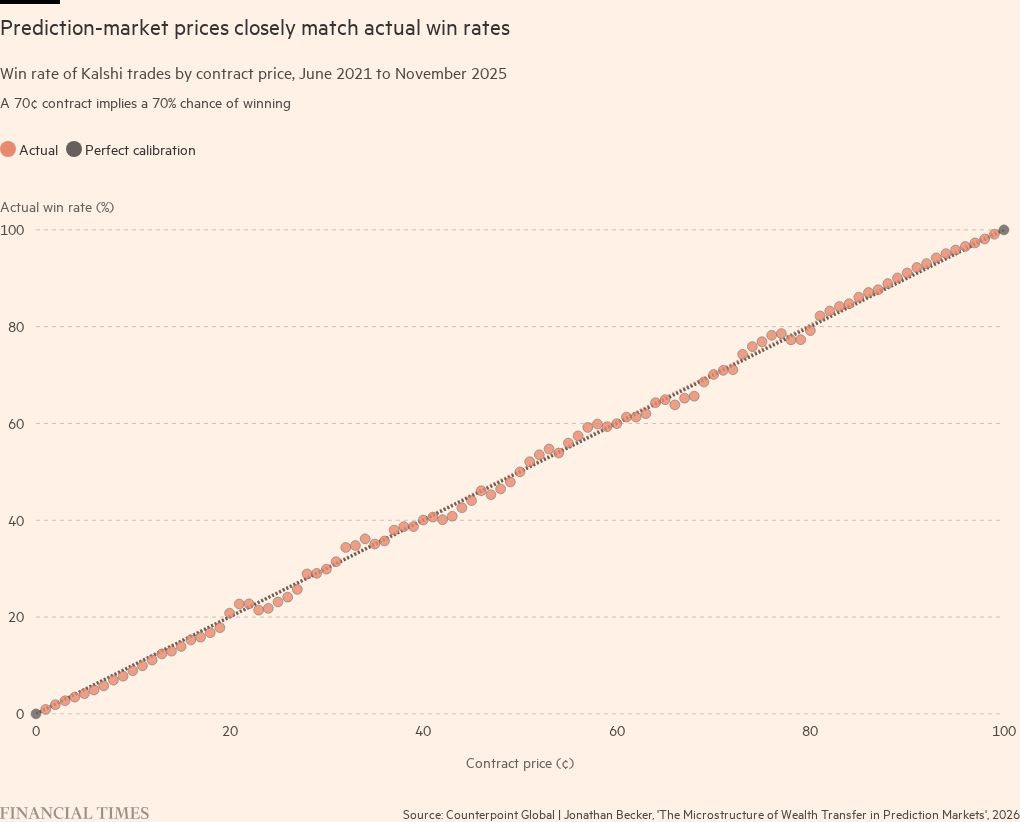
The high degree of calibration means that contract prices are a reliable source of information about the likelihood of future events in the aggregate. Prices in the stock market, on the other hand, do not offer such a clear signal. This makes sense. Prediction markets forecast a definitive outcome that is often revealed in relatively short order. Stocks generally lack a similar settlement, allowing narratives and herd thinking to emerge and persist.
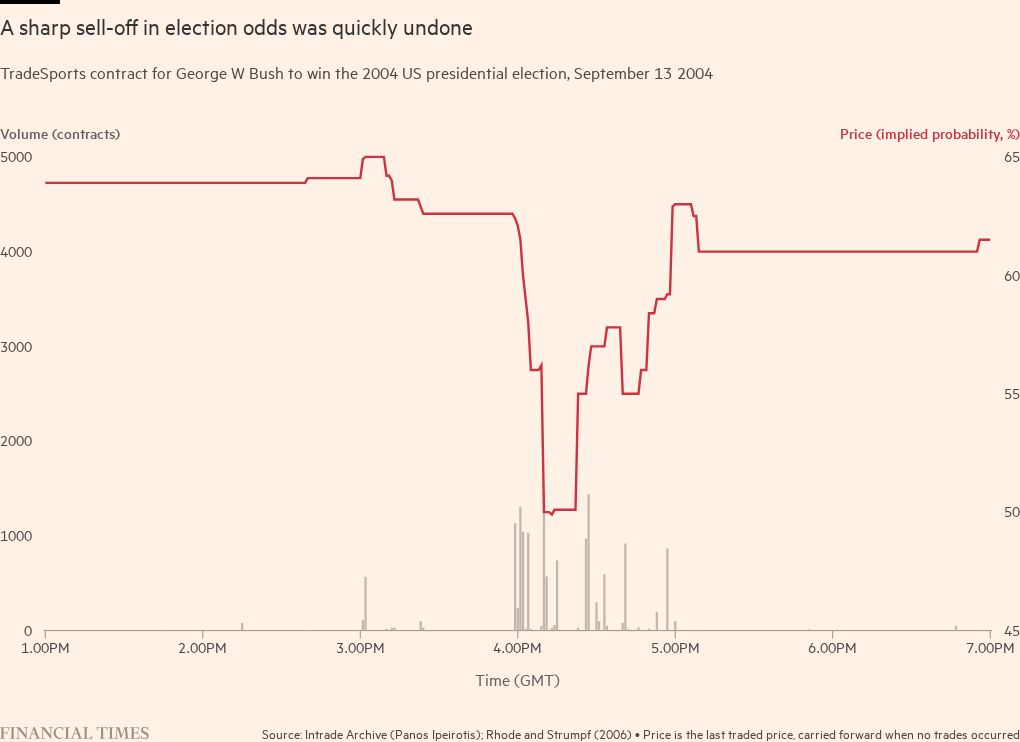
For the same reason, price manipulation in a prediction market is difficult to sustain. Such attempts have a long history, including on political contracts in the 1800s. But economists who studied the phenomenon concluded “that the speculative attacks initially move prices, but these changes are quickly undone”.
Prediction markets are zero-sum, which means that aggregate gains and losses are equal, before considering the costs to participate. Further, a small percentage of participants earn the lion’s share of profits.
The stock market is “positive-sum”. Stocks represent partial ownership in businesses that generally create wealth by growing profits. Investing is zero-sum only in a relative sense. For example, if the market rises 10 per cent, some investors outperform and others underperform. But underperforming the market need not mean losing money.
Despite their rapid growth and popularity, prediction markets remain illegal in many parts of the world and there is still legal wrangling in the US over regulatory oversight of contracts related to sports. There have also been episodes of insider trading. And detractors point out a high percentage of participants lose money.
However, these markets also offer important benefits. One is substantial informational value, which may continue to rise as AI agents, which now forecast as accurately as the best human forecasters, become involved. Prediction markets may offer valuable cues for businesspeople and investors.
Another is that these markets also allow participants to hedge risks. For instance, the owner of a bar in New York City offered free tabs up to $100 if the Knicks won Game 1 of the 2026 NBA Finals. He bet $5,000 on the Knicks and the payout covered the bar tabs. In this way, a zero-sum contract can be useful for risk management.
For stock market investors, the lesson is to look for opportunities arising from breakdowns in cognitive diversity. When independent opinions give way to imitation, prices can go to bullish or bearish extremes. The wisdom of crowds yields to madness when investors act as Baruch’s blockheads.