
Welcome to FT Asset Management, our weekly newsletter on the movers and shakers behind a multitrillion-dollar global industry. This article is an on-site version of the newsletter. Subscribers can sign up here to get it delivered every Monday. Explore all of our newsletters here.
Does the format, content and tone work for you? Let me know: [email protected]
One scoop to start: Clients of Goldman Sachs’ wealth management division and UK-listed hedge fund Man Group are among the victims of a major data breach at Big Four accounting firm EY, according to notifications sent out in recent weeks.
In today’s newsletter:
How a trillion-dollar hedge fund borrowing spree became Wall Street’s cash cow
JPMorgan Asset Management’s growth ambitions in Europe
Surge in borrowing costs hits corporate America
How hedge funds became Wall Street’s cash cow
Investment banks have a rising class of superstars: prime brokers.
Two decades ago, investment banks used to be dominated by big trading personalities immortalised in books such as Michael Lewis’s Liar’s Poker, write Costas Mourselas, Ortenca Aliaj and Joshua Franklin in this must-read deep dive. Prime broking, the business of lending to hedge funds and trading firms, was seen as a boring back-office function.
But the market crash of 2008 led to a crackdown on banks, with punishing regulations hobbling their trading desks. Gradually, they bled traders and quants to rivals including Ken Griffin’s Citadel and prop-trading giant Jane Street. But those firms, which have enjoyed a meteoric rise over the past decade, needed someone to borrow money from to juice their market bets.
Banks have been more than happy to step into the breach, lending trillions of dollars to their erstwhile rivals.
Prime brokerage has gone from being a piddly revenue stream within bank equities businesses to a projected 38 per cent growth this year, according to Coalition Greenwich. Revenues from equity and fixed income prime broking — two of the main ways that banks lend to hedge funds — are forecast to hit $47.9bn this year.
While most big global banks are taking a swing at growing this business, prime brokerage is still largely dominated by US banks JPMorgan, Morgan Stanley and Goldman Sachs.
But the giant hedge funds and trading firms that have come to dominate their industries know full well how important their partnership is to bank revenues. Gradually, they have pushed for better and better terms, tying their fates ever closer to the banks lending money to them.
So-called prime brokerage lock-ups, the notice period a bank must give clients before pulling financing, have increased from days to weeks, to now six months for the industry’s most coveted clients.
Banks are gambling that the risk management of the industry’s biggest hedge funds and trading firms is sophisticated and that giving up some control is a risk worth taking for growing revenues. But as this business has exploded and bank exposure to the industry keeps rising, regulators are increasingly antsy.
“It has just grown and grown and grown,” said one regulator. Has it become too big? “When you see a chart that keeps going upwards, you do have to naturally ask yourself.”
JPMorgan bets on European asset management growth
JPMorgan Asset Management has outlined ambitious targets to double its assets under management in Europe to $2tn in the next five years, in a bet that the continent’s wealthy can drive growth at the investment division of the Wall Street bank.
“Europe is a very good place for us to continue to grow,” said Patrick Thomson, chief executive of JPMorgan Asset Management for Emea, in an interview. “Our three strategic priorities — active ETFs, alternatives and developing partnerships with the biggest wealth managers — are going to drive our growth.”
JPMorgan Asset Management has already doubled its assets in Europe over the past nine years from $500bn to $1tn, boosted by rising markets and inflows from new and existing clients.
Alongside BlackRock, JPMorgan established an early lead in Europe in the market for active exchange traded funds, which combine an ETF wrapper with active management rather than passively tracking an index.
Its European active ETF business has grown to $60bn since its launch five years ago. Thomson said the products had further potential, with ETFs becoming the first point of entry into investing for mass-affluent and younger investors.
Thomson said there were opportunities for investors in European equities and European fixed income, where volatility in government bonds makes for a fertile environment, and in infrastructure, where there is huge demand for capital to invest in energy grids and transition.
More than 85 per cent of JPMorgan Asset Management’s funds ranked above median over the 10 years to July 31, according to data from Morningstar Direct.
JPMorgan’s ambitions come as Europe’s asset management industry is forecast to grow 5.6 per cent a year to reach almost $50tn by 2030, according to a PwC report.
The industry is increasingly split between scale providers such as JPMorgan that offer a broad range of strategies and specialist players. Firms have sought scale and diversification, sometimes through mergers and acquisitions, in pursuit of cost efficiencies and new growth channels.
Scale was particularly important “on the technology agenda”, said Thomson. The JPMorgan parent bank invests $20bn a year in technology, while its asset management business invests $600mn a year in its technology platform globally, and employs 1,400 engineers. “That’s an expensive commitment but we think it’s necessary,” he added.
JPMorgan has resisted dealmaking, however. “We’ve not done any major acquisitions because we think they’re hard,” says Thomson. “We favour organic growth.”
Chart of the week
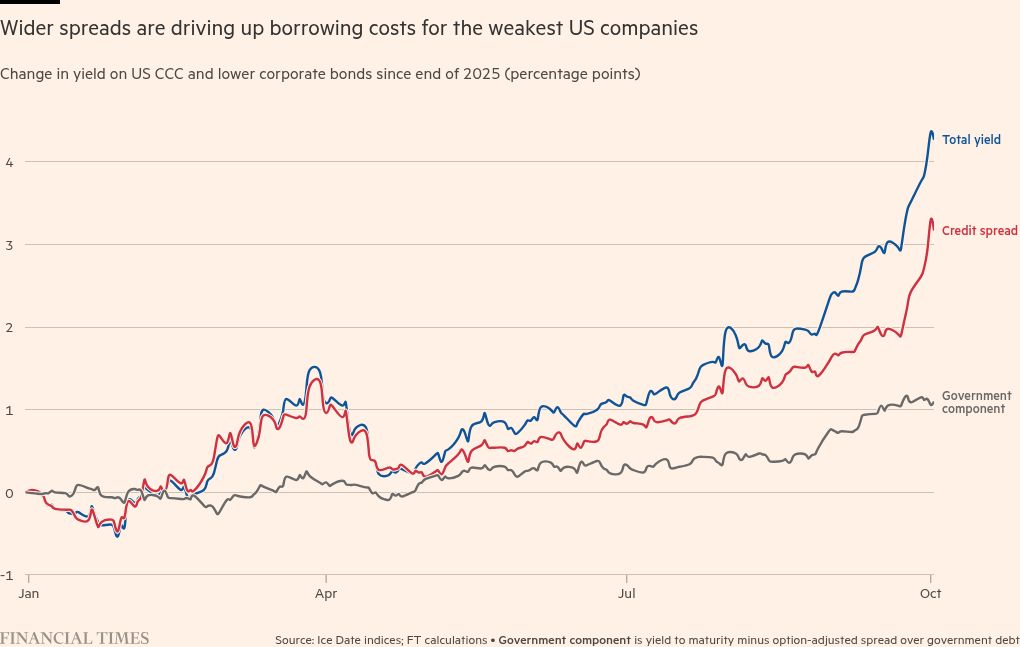
A sharp sell-off in US government bonds is starting to reverberate across corporate America, forcing companies to overhaul their borrowing plans and even raising the spectre of defaults among the most lowly rated businesses.
Borrowing costs for companies with the lowest credit ratings hit their highest level since May 2020 this month at 17 per cent, driven by the rise in Treasury yields to multiyear highs and by investors demanding more compensation for lending to such businesses.
The risk premium for companies rated triple C or lower has risen to 12 percentage points, the biggest since 2022.
Analysts said companies with floating-rate loans, and those needing to refinance debt in the coming months, were most at risk from the government bond sell-off, which last week pushed the yield on the 10-year Treasury note to its highest since 2002.
“Investors are increasingly demanding more compensation for taking on the corporate credit risk,” said James Reilly, a senior markets economist at Capital Economics.
In a sign of the chilling effect of the ructions in the Treasury market, Bank of America has cut its forecast for the amount of dollar-denominated investment-grade debt that companies will sell this month to $110bn from about $160bn.
Among corporates, investor nervousness is already being felt on some deals. US media conglomerate Paramount Skydance last week sold $52bn of debt to fund its $111bn acquisition of Warner Bros Discovery.
Unusually, demand for Paramount’s two-year bonds was almost double that of 30-year bonds, according to people familiar with the matter, in a sign of investors’ worries over interest rate rises hitting the value of longer-maturity debt.
As a result, investors were allocated more long-term debt than they had expected, leading to a significant sell-off after the bonds debuted on the market.
Five unmissable stories this week
US benchmark borrowing costs risk hitting 6 per cent for the first time in 26 years as fears over high oil prices, inflation and America’s towering public debt roil the world’s most important bond market, Dan Ivascyn, chief investment officer at bond giant Pimco, has warned.
A sell-off in French government bonds that spread into broader Eurozone markets this month has lured big investors to “bottom fish” among beaten-down assets including Italian bonds and corporate debt, on a bet that contagion fears are overdone.
London credit investor Arini Capital Management’s flagship fund has suffered losses of almost 16 per cent this year, after enduring a string of soured bets on the debt of financially troubled companies.
Blue Owl, the group at the centre of recent turmoil in private credit, is planning a “big push” into insurance to tap a growing source of long-term capital as it seeks to expand into new areas, according to its co-chief executive Doug Ostrover.
The Securities and Exchange Commission moved to prevent asset managers from working together to influence corporate policy, after investigating BlackRock, Vanguard and State Street’s role in the ousting of ExxonMobil directors in 2021.
And finally

A new exhibition at the Royal Academy traces how Cézanne, Picasso, Matisse and more drew inspiration from the French Riviera — and how “from around 1880 to 1960 the Mediterranean became a defining and sexy site of modern art”, writes the FT’s chief visual arts critic Jackie Wullschläger.
Thanks for reading. If you have friends or colleagues who might enjoy this newsletter, please forward it to them. Sign up here
We would love to hear your feedback and comments about this newsletter. Email me at [email protected]