Good morning. A scoop to start: The Trump administration has threatened to stop supplying US-made weapons to Ukraine if Kyiv does not halt its deep strikes on Russian energy infrastructure, European officials told the FT·.
Today, our economics correspondent brings us the latest on the battle over the EU’s next budget, while our tech correspondent looks at Poland’s concerns over Brussels’ push for digital sovereignty.
Europe Express is edited by Mari Novik. Read the previous editions here. Please send tips, thoughts and feedback to [email protected].
'Misguided approach’
EU countries are clashing over where to cut spending ahead of a leaders’ summit this week aimed at bridging deep divisions over the bloc’s next long-term budget, with the goal of reaching a deal by the end of the year, writes Paola Tamma.
Context: The Irish presidency of the EU council has proposed slashing €141bn from the next budget, an 8 per cent cut compared with the European Commission’s original proposal.
Most of the cuts would come from the EU’s development and co-operation funds and the European Competitiveness Fund, which is meant to support strategic priorities such as innovation and defence. Funding for agriculture and poorer regions has been largely left uncut.
But the six countries led by Germany that are among the EU’s largest net payers are unimpressed, calling the proposal a “wildly unaffordable increase” on the bloc’s current budget, and lamenting that they mostly affect “EU strategic priorities”.
“It is unacceptable that the current [Irish compromise] further exacerbates the misguided approach of asymmetric cuts,” wrote Germany, Denmark, Austria, Sweden, Finland and the Netherlands in a letter addressed to European Council president António Costa’s chief negotiators, seen by the FT.
Meanwhile, countries that are net recipients of funds, as well as Italy and Spain, have pushed back on the cuts at a meeting of EU ambassadors on Sunday. But they were pleased that traditional spending areas had been largely spared, according to people briefed on the discussions.
Costa will take over negotiations from Ireland this week and try to broker a compromise among the EU’s 27 leaders. Two more summits are scheduled for late November and December, with the aim of reaching a deal by the end of the year.
“We really need the leaders now. There is too much distance between debates in the European Council and the budget debate,” said one EU diplomat.
Chart du jour: Hybrid conflict
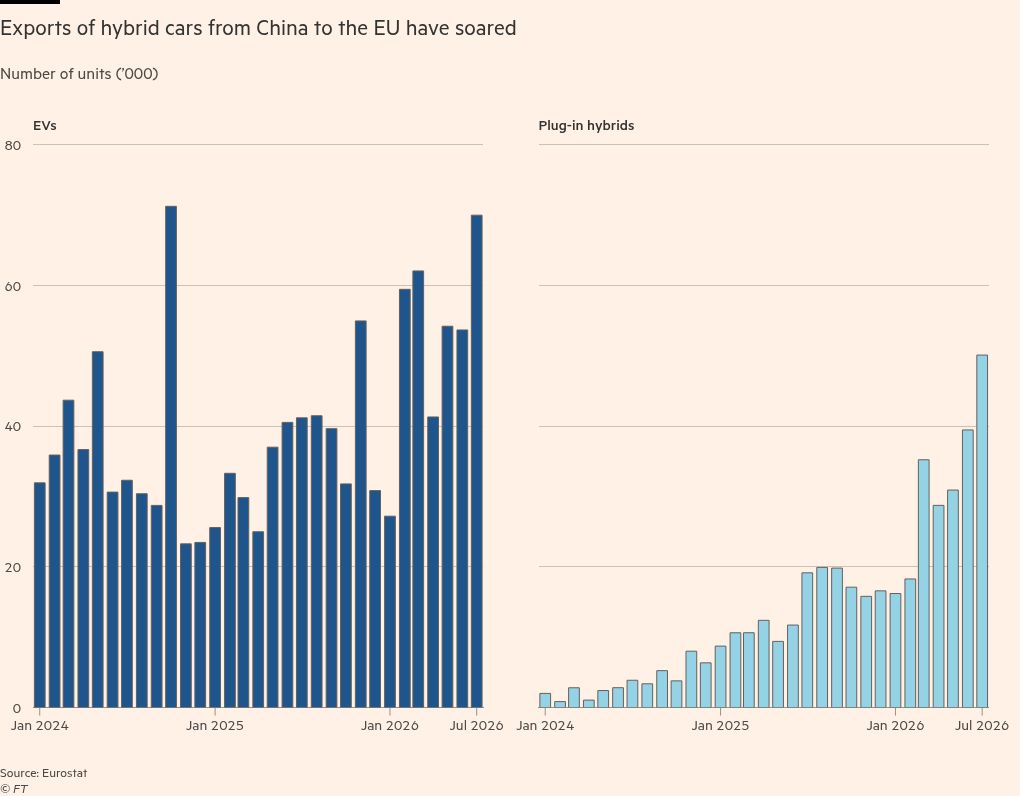
The EU will impose a quota on imports of hybrid cars from China with Beijing’s tacit agreement as part of an “understanding”· achieved by the two sides to avert a full-scale trade conflict.
Cloud conundrum
If the European Commission wants the EU to rely less on US tech players, Brussels has to think about who picks up the bill for the costs, Poland’s deputy digital minister tells Barbara Moens.
Context: Brussels presented its Cloud and AI Development Act in June as part of efforts to reduce the bloc’s reliance on American tech companies, which is increasingly seen as a geopolitical vulnerability.
European capitals are now combing through the details ahead of upcoming negotiations on the proposal. The act introduces a framework of four assurance levels, with sovereignty requirements for governments when they acquire cloud services. The idea is also to encourage European players to scale up and provide alternatives to US tech companies.
But Warsaw is warning Brussels that imposing stringent sovereignty requirements without additional support risks undermining the bloc’s ambitions to become more competitive.
Dariusz Standerski said there is not enough discussion about “the balance between the incentives and the regulations” in the upcoming legislation, and that the bloc should do more to push European companies to achieve higher sovereignty levels and make the act more business friendly.
“You need to be able to achieve those conditions and those requirements,” Standerski said. “If we want to make our companies compliant with those obligations, we also need to give them some incentives to do so,” suggesting preferential procurement rules, simpler regulatory requirements and allowing greater state aid support for companies meeting the higher sovereignty levels.
What to watch today
EU foreign ministers meet in Luxembourg.
EU environment ministers meet in Luxembourg.
Polish Prime Minister Donald Tusk and Ukrainian President Volodymyr Zelenskyy speak at the Warsaw Security Forum.
Now read these
Sanctioned departures: A Paris-backed airport operator has received fees from sanctioned Russian and Iranian airlines·.
Casualties could rise: Nato members should prepare a robust response for a possible deadly Russian “hybrid” attack, Poland’s foreign minister has said.
Take care: The 2016 Brexit vote was targeted by Russian “state-sponsored interference”, UK Prime Minister Andy Burnham has said.
Are you enjoying Europe Express? Sign up here to have it delivered straight to your inbox every workday at 7am CET and on Saturdays at noon CET. Do tell us what you think, we love to hear from you: [email protected]. Keep up with the latest European stories @FT Europe