
Good morning. We’ve entered the stage of the market cycle where people are wondering if an IPO flop of a company no one had heard of is a signal of what’s to come. Elice, a South Korean data centre builder, debuted on the Kosdaq index yesterday and immediately fell 32 per cent.
But before we could extrapolate too much from what this means for data centre demand, SpaceX’s third-quarter earnings· showed us there is still juice in that trade. Continuing its slow transition from rocket company to data centre landlord, the Elon Musk venture reported a net profit of $4.4bn and a ninefold increase in its AI-linked revenue from a year ago. The share price rose 5 per cent in after-hours trading. Musk also announced that the company is exploring a long-expected merger with Tesla. If nothing else, a SpaceX-Tesla tie-up would lay to rest any doubts we have about Musk as chief executive of two public companies. Or would it? Send us your thoughts: [email protected].
Small caps
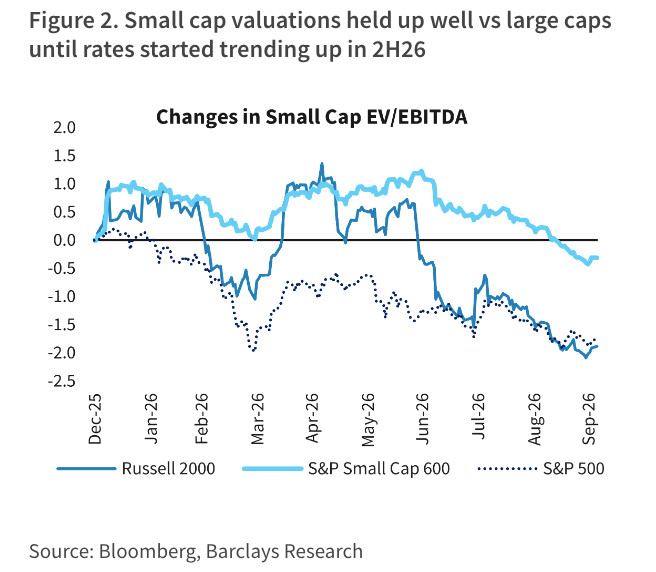
Earlier this year, it seemed like small caps were finally having their moment. After nearly six years of underperformance, the Russell 2000 rallied 22 per cent in the first half of 2026 while the S&P 500 added 10 per cent. The gains were spread across sectors too, which gave believers hope the rally was a broad-based reflection of strength. Valuations relative to large caps were also holding up well, as shown in the following chart from Venu Krishna at Barclays:
Alas, the fall has been swift. Small-cap indices entered correction territory last week after falling 10 per cent since August 14:
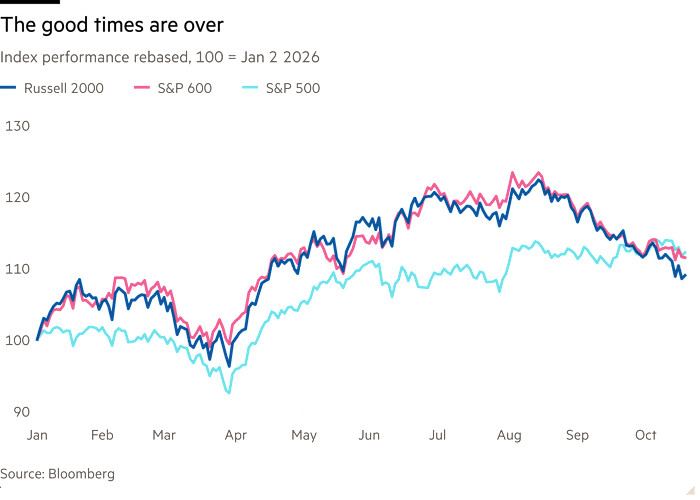
In theory, the tiddlers should maybe stand out as a hedge against the AI trade, which is dominated by the big dogs. But that’s clearly not working out.
Small-cap index investing is tricky. About 40 per cent of Russell 2000 companies are unprofitable, and there’s been a pattern of the index’s outperformers “graduating” into the bigger market-cap Russell 1000. But the small-cap sell-off can’t be chalked up to issues with just the Russell 2000. The S&P 600, which screens for profitability, has held up a bit better but unable to avoid slipping into a correction.
The most obvious explanation for small caps’ sharp fall is the reversal in interest rate expectations from the start of the year; they’re notoriously sensitive to higher rates. Even before Federal Reserve chair Kevin Warsh’s hawkish Jackson Hole speech in August, the markets had been pricing in higher oil prices and higher rate expectations.
More recently, widening credit spreads have added to the pressure. Matt Rowe at Man Group says widening credit spreads in September have been critical to the small-cap sell-off:
In September, even when the broader equity market was pretty strong, credit spreads widened, particularly [in] high yield, while equities rallied with narrow breadth . . . [With] base rates up and credit spreads wider, cost of capital for small caps went up disproportionately. The credit impact can’t be underestimated. The rising cost of capital oftentimes can be a form of friction for larger companies. They can weather things like this, but it can be existential for small caps. The market is pricing in not just the inefficiency, but also the potential increase of failure of small caps.
Small-cap defenders are a devoted bunch, and they highlight the Russell 2000’s relative resilience during the dotcom bubble as proof that this is a good way to AI risk-proof your portfolio. But the irony here is that hyperscaler debt issuance has played a part in pushing up borrowing costs across the board, hurting the very companies that should be relatively insulated from the AI hype cycle.
There is, however, an AI-induced sell-off scenario in which small-cap investors could be vindicated. This would essentially mark a return to conditions at the start of 2026: strong growth, lower rate expectations and a valuation-driven rotation out of AI. But this is a tall order that the market isn’t pricing in, which makes it hard for us to see small caps catching a break any time soon. They can work as a hedge against AI valuation and concentration risk, but not necessarily a broader AI sell-off.
(Kim)
FOMC meeting fatigue
The Federal Reserve meets eight times a year to set interest rates. In July, chair Kevin Warsh raised the prospect of meeting less often. He asked the Federal Open Market Committee to consider whether a thinner meeting schedule “would allow more information to accumulate between meetings than under current practice”.
There may be something to this.
According to Matthew Luzzetti and colleagues at Deutsche Bank, “there are good reasons to revisit the FOMC’s calendar”, which is sub-optimal when it comes to incorporating crucial data releases.
Take the September personal consumption expenditure index — the Fed’s target inflation measure. Next week, it comes out after the committee’s decision, for the third time this year. By itself, this may not be a big deal; we can infer PCE from other data. But it also happens with the consumer price index figures, which can be released after or too close to an FOMC meeting to be incorporated in the decision and forecasts.
The current eight-meeting schedule dates back to 1981, but it was not intended to be permanent. As Deutsche Bank writes, it “was built around a monetary framework that no longer exists”.
We put our cutting-edge data visualisation skills to use to show you how the number of meetings varies or doesn’t across developed-market central banks:
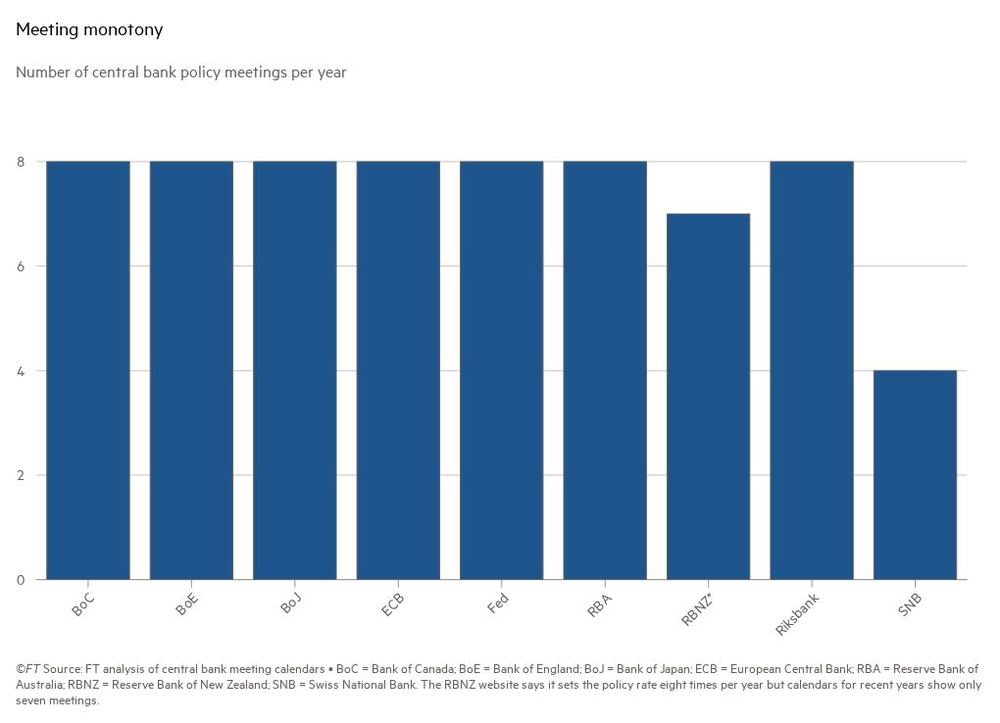
Luzzetti and co propose six meetings per year for the Fed, in line with Warsh’s suggestion in the July minutes. This would create longer gaps between meetings, but allow the committee to incorporate two each of the jobs report, CPI and PCE data in its deliberations. “[T]he relevant question is whether the Fed would be willing to trade two additional weeks between meetings to have data available that is 30 per cent timelier.”
Reducing the number of meetings is not unprecedented. In 2016, the Bank of England moved from 12 to eight meetings per year and the system didn’t fall apart. Unhedged, for one, would welcome more time to analyse the CPI data before we decide what to say about it.
(MacFadden)
One good read
FT Unhedged podcast
Can’t get enough of Unhedged? Keep following Rob Armstrong and Katie Martin’s incisive and unfiltered analysis on the Unhedged podcast, a twice-weekly, 15-minute lively dive into the latest markets news and financial headlines. New episodes every Tuesday and Thursday.