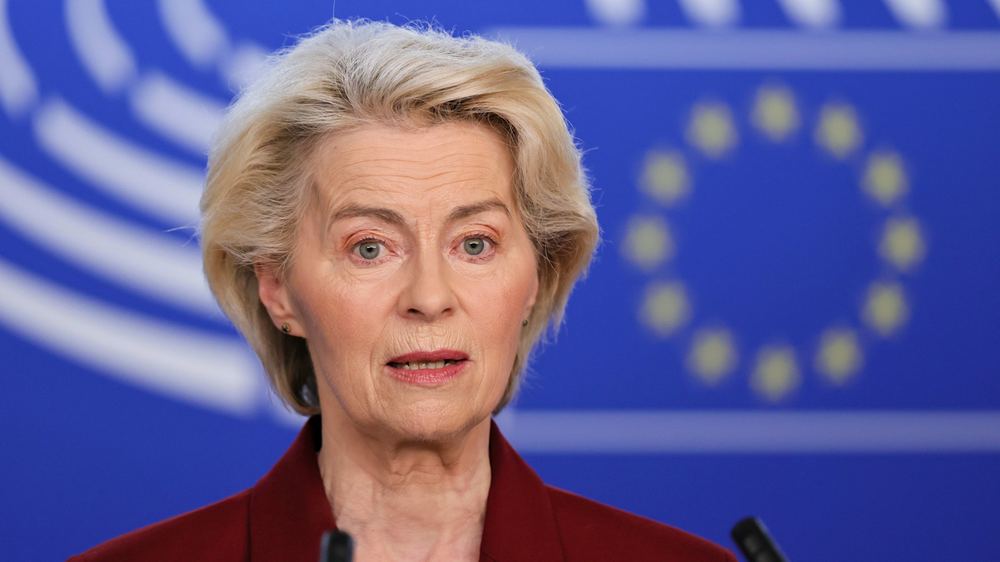
Good morning. Today, my Brussels colleague explains how the close relationship between European Commission president Ursula von der Leyen and European Council president António Costa also has downsides, while Canada’s AI minister makes the case for more co-operation between Brussels and Ottawa on tech.
Europe Express is edited by Mari Novik. Read the previous edition here. Please send tips, thoughts and feedback to [email protected].
Presidential bottleneck
The smooth working relationship between the presidents of two once-feuding EU institutions has been welcomed by most in Brussels, but has had unexpected consequences for foreign diplomats, writes Andy Bounds.
Context: After the notoriously difficult relationship between European Commission president Ursula von der Leyen and former European Council president Charles Michel, his successor António Costa has made an effort to maintain a smoother working relationship.
To help patch up relations after five years of rivalry, Costa agreed to jointly perform the ceremony of welcoming new ambassadors, after five years in which seeing them separately was sufficient. But now, ambassadors are facing long waits, with the last ceremony held in May.
“Finding a diary slot where both are free at the same time is not easy,” said one non-EU diplomat. This left new envoys as “ambassadors-designate”, unable to attend certain events, they said.
After a proposed September event was not possible, the two had now agreed on October 22, spokespeople for both presidents said. In total 19 envoys will present their credentials including India, South Africa and Ukraine.
That will spare the embarrassment of holding summits with Canada on October 29-30 and the UK on November 20 before their ambassadors are sworn in.
“These ceremonies are held on a regular basis, as soon as there is a critical mass of ambassadors meeting the established conditions,” the spokespeople said.
An EU official said there was no question of returning to the regime before von der Leyen, when Jean-Claude Juncker decided he would leave the presentation entirely to Donald Tusk.
Chart du jour: Battery walls
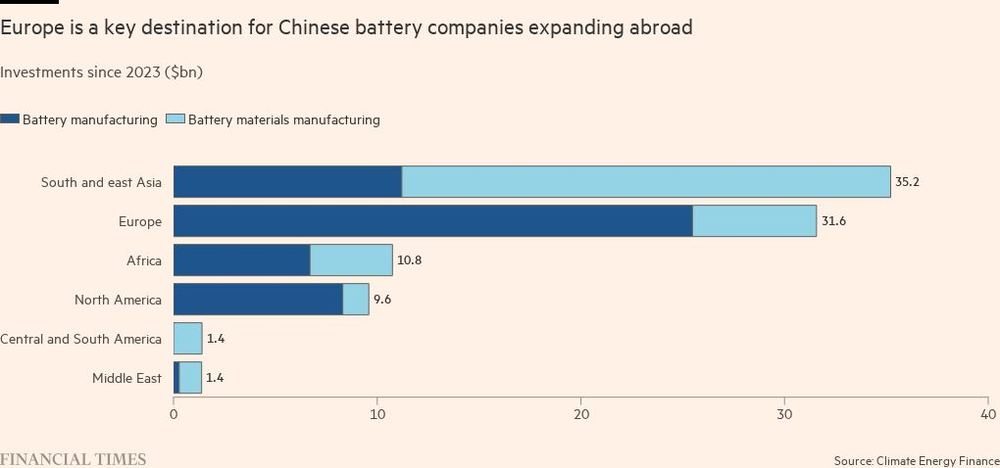
Chinese companies are building a global supply chain for batteries outside their home market as the west moves to protect itself from a torrent of materials, components and finished cells made in China.
AI allies
Canada’s AI minister said the tech sector was “a critical element” of the conversations between Brussels and Ottawa, the country’s AI minister told Jude Webber.
Context: The EU and Canada will hold a summit in Montreal next week as Canadian Prime Minister Mark Carney seeks to bolster global “middle powers” in the face of a more hostile US and China. Both also want to reduce their reliance on US tech.
For Evan Solomon, Canada’s AI and digital innovation minister, “digital and AI are a critical element of the Canada-EU relationship.” He said: “you will find with the Carney government there’s always substance. The salad has protein.”
Last month, on the same day that European Commission president Ursula von der Leyen announced that Canada could become the first EU associate member, Canada’s homegrown large language model Cohere announced a merger with Germany’s Schwarz Group. That followed a deal between the two countries to boost co-operation to strengthen sovereign AI capability.
“I think we share this view that we need strategic optionality,” said Solomon during a visit to Dublin ahead of the summit.
Put simply, that meant less reliance on a handful of global US AI companies such as OpenAI and Anthropic, and a more “resilient model”, based on more players and having “sensitive and secure data secured under your domestic laws, not subject to the coercion of another country”, he said. “Governments want to be kill-switch-proof.”
But there are challenges — and as yet unresolved rivalries. France also has its own domestic AI company, Mistral, which, like Cohere, is attracting clients from around the world interested in “AI sovereignty”.
“Our definition of sovereignty is not solitude,” Solomon said. “We’re not trying to build everything ourselves but to diversify and have reliable partnerships.”
What to watch today
European Commission executive vice-president Henna Virkkunen meets Bill Gates, chair of the Gates Foundation.
German Chancellor Friedrich Merz receives Czech President Petr Pavel in Berlin.
Now read these
Hogan’s pitch: Former European commissioner Phil Hogan, vying to lead the UN’s food agency, is set· to seek Donald Trump’s help to secure Black Sea shipping.
No breakthrough: Leaders of Ukraine, Finland and Norway hailed progress· in talks in Oslo yesterday about how to end Russia’s war in Ukraine.
Disinformation probe: EU regulators are examining possible foreign online interference and disinformation campaigns· around the French riots.
Are you enjoying Europe Express? Sign up here to have it delivered straight to your inbox every workday at 7am CET and on Saturdays at noon CET. Do tell us what you think, we love to hear from you: [email protected]. Keep up with the latest European stories @FT Europe