
This article is an on-site version of our FirstFT newsletter. Subscribers can sign up to our Asia, Europe/Africa or Americas edition to get the newsletter delivered every weekday morning. Explore all of our newsletters here
Good morning and welcome to FirstFT. In today’s newsletter:
France’s far-right leader Marine Le Pen promises to cut public spending
Brazil’s currency, stocks and bonds jump after Bolsonaro’s first-round win
US AI start-up launches first open model
Is there such a thing as masculine style?
French far-right leader Marine Le Pen has promised to drastically cut public spending and cap future borrowing· if elected president next spring, in a bid to bolster her economic credentials and calm jittery markets.
Le Pen, who is topping opinion polls ahead of her fourth bid for president,
proposed a “golden rule” to cap national debt at 60 per cent of GDP and to reduce the public deficit each year by 0.5 per cent to reach “close to a balanced budget”.
Bond markets have turned on France in recent weeks, taking borrowing costs for the government close to 5 per cent, their highest in almost a quarter of a century. Not only does it now cost France more to borrow than it does Italy and Greece; a rising number of big French companies enjoy lower market interest rates than does the French state.
Le Pen outlined her economic plan as protesters took to the streets across the country in support of students demanding that President Emmanuel Macron’s cash-strapped government tackle understaffed and dilapidated schools.
France is caught between· the protesters on the street calling for more funds from the government and “bond vigilantes” in the markets who punish perceived fiscal irresponsibility by betting against the country’s debt.
France risked being “strangled by interest rates” if it did not clean up its public finances, the head of the French central bank told the FT· ahead of Le Pen’s announcement.
Emmanuel Moulin, governor of the Banque de France, said that the Eurozone’s second-largest economy could win back investor confidence despite the “serious and worrying” moves on sovereign debt markets in recent days.
More European news: Germany’s former foreign intelligence chief August Hanning has been arrested on suspicion of treason·.
Here’s what else we’re keeping tabs on today:
Companies: Paramount Skydance’s $111bn merger with Warner Bros Discovery is expected to close. Marvell Technology, Constellation Brands and Lamb Weston publish results.
Economic data: US international trade data for August is scheduled to be released and in Brazil the September trade balance will be published. Mexico’s consumer confidence data for last month is also due.
Nobel Prize: The winners of the award for physics are announced.
What is driving the global bond sell-off? Alphaville editor Robin Wigglesworth and senior markets correspondent Ian Smith will answer reader questions in a live Q&A on Thursday October 8 at 8am ET. Submit a question here.
Five more top stories
1. Brazil’s currency, stocks and bonds jumped yesterday as investors bet that Flávio Bolsonaro will become president and push through market-friendly reforms· to lower interest rates in Latin America’s largest economy.
More election news: Sweeping rightwing gains in Brazil’s Congress have boosted Flávio Bolsonaro’s chances of pushing for amnesty for his father.
FT View: The return of the Bolsonaro family lies less in the achievements of Flávio, who has been a mediocre candidate, and more in the failure of Lula·.
2. Donald Trump has temporarily eased limits on the use of tax-exempt red diesel as midterm elections approach· and his administration tries to contain a fuel price crisis triggered by the US president’s Iran war. The president signed an executive order on Monday night allowing dyed fuel to be used on public roads and highways.
3. Warnings about a possible Iranian drone attack on the UK-US air base at RAF Fairford led the US to withdraw 12 B-1 bombers from the facility over the weekend, officials said on Tuesday·. Washington believed the suspected plot could have involved short-range weaponised drones, the officials added.
4. China, which is set to host the Asia-Pacific Economic Cooperation forum in Shenzhen next month, has proposed moving a key meeting of foreign and trade ministers online, according to six people familiar with the plan, prompting a backlash from partners·. The summit was already at risk of being dominated by a meeting between US President Donald Trump and Chinese leader Xi Jinping, their third this year.
5. A US AI start-up backed by Nvidia and the Trump administration has unveiled its first open-weight model, boosting American ambitions to compete with Chinese groups· that dominate the market for public, customisable AI products. Reflection AI claimed on Monday that its first model, Beam, was on a par with Z.ai’s GLM-5.2, a leading Chinese competitor.
More AI news: Insurers are preparing for multimillion-dollar claims stemming from AI agents going “rogue”, with growing concern that top executives such as OpenAI’s Sam Altman and Anthropic’s Dario Amodei could be held liable· for the actions of their models.
China’s AI ambitions: Hong Kong’s de facto central bank questioned HSBC on why its new AI hub would be established in Singapore and not in the Chinese territory.
AI and jobs

Few signs exist of AI killing jobs across the global economy. Even in the US, where adoption is most advanced and recent data shows payrolls are down in sectors such as finance, there is no clear evidence· that the technology is changing the mix of occupations in the workforce or putting graduates out of work.
We’re also reading . . .
Erebor: Palmer Luckey’s bank for the technology industry has surged to more than $7bn in deposits since launching in February.
India’s rail ambitions: A flagship high-speed rail project between Mumbai and Ahmedabad has been beset by delays, cost overruns and tensions.
Sleep politics: There is still a class divide when it comes to work that tramples over your body clock·, writes Sarah O’Connor.
Empty threats: The weakening of Russian nuclear deterrence has global implications — and they are not all positive, writes Gideon Rachman.
Chart of the day
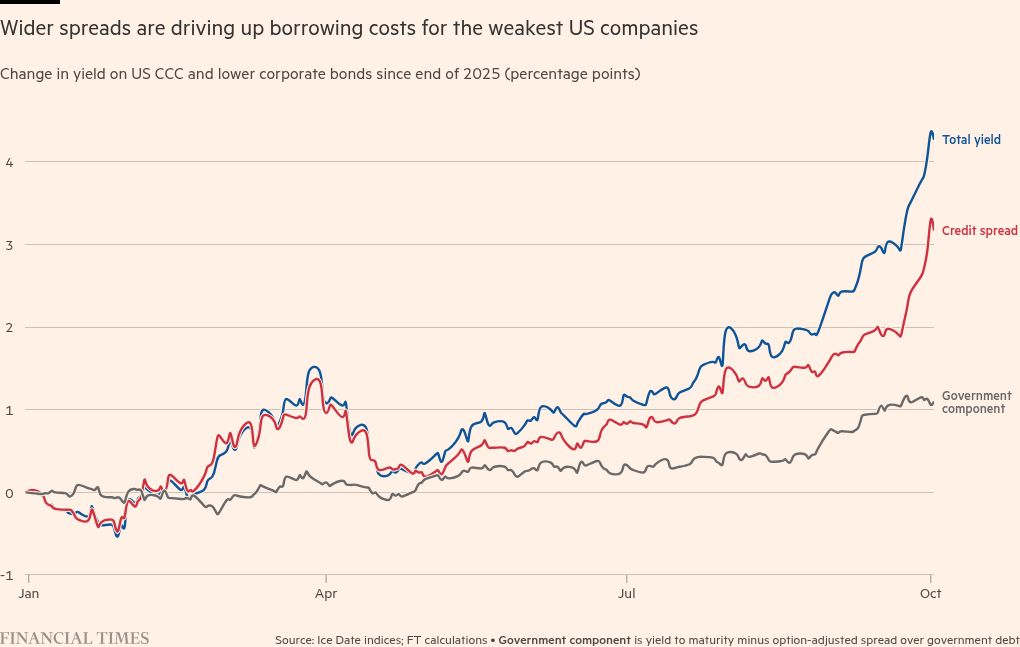
A sharp sell-off in US government bonds is starting to reverberate across corporate America, forcing companies to overhaul their borrowing plans and even raising the spectre of defaults among the most lowly rated businesses·.
Take a break from the news . . .
Is there such a thing as masculine style? Robert Armstrong identifies four characteristics· of men’s clothing that remain even as the overlap between the sexes’ clothing has increased dramatically over the past century.

You can also listen to today’s top news stories in the FT News Briefing podcast·.
Thank you for reading and remember you can add FirstFT to myFT. You can also elect to receive a FirstFT push notification every morning on the app. Send your recommendations and feedback to [email protected]
Recommended newsletters for you
The State of AI — A series of conversations between the FT and MIT Technology Review on the geopolitics of tech. Sign up here